Very glad that our paper "Optimization over Sparse Support-Preserving Sets: Two-Step Projection with Global Optimality Guarantees" was accepted at @icmlconf! https://t.co/uIOFXhVDTv.
Extremely grateful to Pr. Xiao-Tong Yuan and Pr. Bin Gu for being amazing co-authors & mentors 🙏
Few concepts are invoked across as many disciplines as intelligence, and few are theorized in as many incompatible ways. To statistics and machine learning it is extreme compression of data; to the study of complex systems it is the emergence of universal computation; in the interaction of an agent with its environment it is open-ended adaptive behavior. Each appearance has its own literature and its own objective function, and the literatures rarely meet. Here we show that these appearances follow from a single principle: the pursuit of learnable novelty. 🧵
This was our first incident of this kind, and we want to thank OpenAI for its transparency about what happened and for the collaboration.
Fortunately, Hugging Face is used to being a target of (human) hackers: we sit at the centre of the AI ecosystem, with all the models, datasets, evaluations, and libraries. Over the years, our security team has built formidable expertise and uses top open-source models to process information and respond quickly.
But this incident also reinforced my belief in the importance of access to capable open-weight models for cyber defence. When a frontier model is attacking you and moving laterally inside your infrastructure, defenders need wide access to near-frontier tools within hours or even minutes, rather than being pointed towards a closed-door, vetted application programme for model access.
Transparency and access to capable AI systems are as important for responding to threats as they are for democratization and innovation. We believe open-science and open-source AI are among the strongest tools for building a safer, more collaborative and more secure AI ecosystem.
Slides from my ICML tutorial "Is numerical optimization theory irrelevant to machine learning practice in 2026?":
https://t.co/nRmKdzTrdA
(Updated to fix some typos, incorporate feedback, and add some things I did not have time for. Will link to the video here when posted.)
hello there the jacobian conjecture is false thanx to my close friend akhil for asking about it and my other close friend fable for working during the world cup final
((1+xy)^3 z + y^2 (1+xy) (4+3xy), y + 3 x (1+xy)^2 z + 3 x y^2 (4+3xy), 2 x - 3 x^2 y - x^3 z): \C^3\to \C^3, has jacobian determinant -2, and sends (0, 0, -1/4), (1, -3/2, 13/2), and (-1, 3/2, 13/2) to (-1/4, 0, 0)
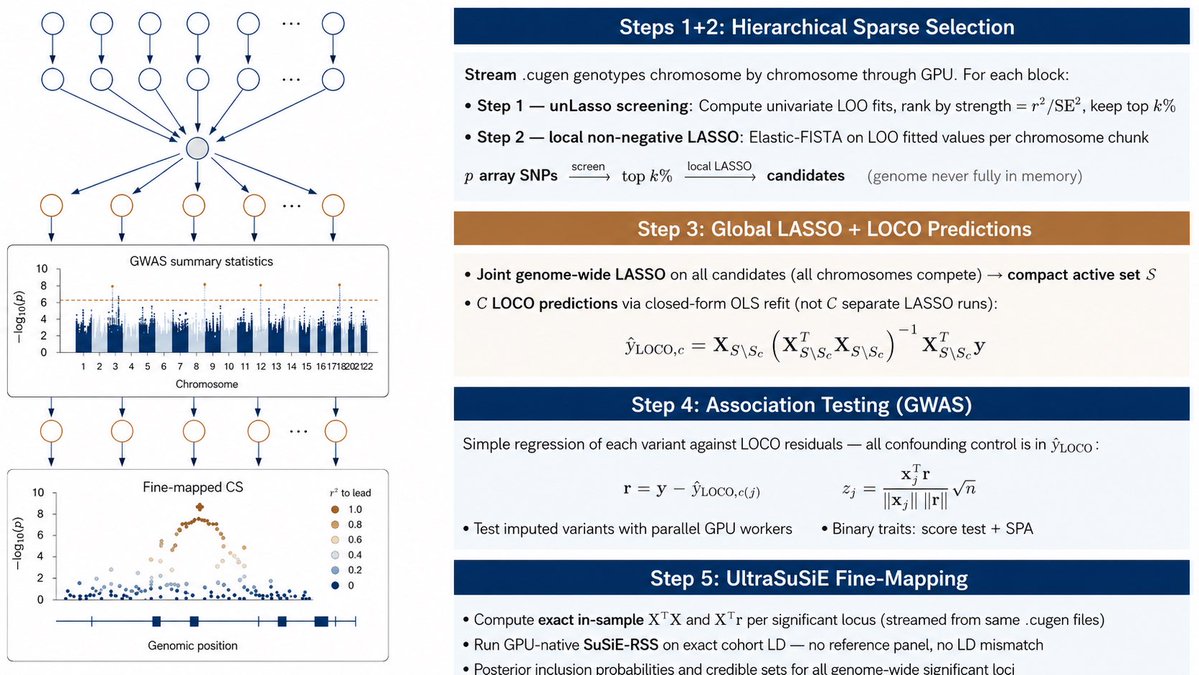
Massive genomic analyses are growingly important in bio. We present ”CuGen” - a GPU-accelerated framework for large-scale genomics. (links to preprint and repo below!) 🧬🐍
CuGen runs a GWAS and fine-mapping in the UKBB in 10 mins on a single H100. And a stack of 8xH100s can output even >2,000 analyses a day. 🔥
This is a new computational SOTA as biobank-scale GWAS have traditionally been multi-hour jobs on CPUs.
Running massive GWAS on GPUs is enabled by a few novel contributions:
1. UltraLasso - a new sparse hierarchical statistical learning architecture that we use to account for confounding, enabling the final association phase to be maximally parallelized against the residual.
2. .cugen - a new GPU optimized genotype file format enabling both fast streaming and random access and largely eliminating most of I/O time
3. UltraSuSiE - a new in-sample implementation of SuSiE fine-mapping method that runs directly after the GWAS is completed.
Both quantitative and binary traits are supported. Confounding control is on par with previous SOTA methods.
Paradoxically running massive analyses becomes also cheaper as the runtimes are so short 😳.
I envision the speedup also accelerating AI assisted science through both agents iteratively coordinating massive analyses and also improving with faster RL paradigms and real biobank scale benchmarks.
Beyond GWAS, also a (growing ) general toolkit is supported.
Preprint: https://t.co/l4I3J6OazF
Repo (open source ofc):
https://t.co/2JgJcaaSed
Want to predict non-coding variants, but complex code/env is holding you back?
seq2fun models for regulatory genomics are now easily deployable through chat interface using Chorus! By @dmitrypenzar@lucapinello and co.
Read about it on Genomics x AI Blog
https://t.co/p7Sot1lWU9
It's telling about the teaching of math that even thought I studied a lot of maths, and I am obsessive about nice representations, I never saw that before.
What kind of global culture and educationfailure is that.
AI + RNA-seq meets drug repurposing.
Can public transcriptomic datasets automatically identify drugs that regulate disease genes?
A new bioRxiv study introduces SNACKKSS (Signature-based Networks from Automatically Curated Knockout, Knockdown, and Small-molecule Studies)—an end-to-end framework that automatically mines GEO metadata using fine-tuned BERT models, constructs perturbation signatures from RNA-seq experiments, and predicts gene regulators without manual curation.
Key findings:
• Built an automated NLP pipeline using BioBERT/BioMedBERT to curate GEO knockout, knockdown, and drug-treatment RNA-seq studies at scale.
• Generated consensus transcriptomic signatures from >300,000 human and mouse perturbation samples using ARCHS4, Recount3, and DEE2 datasets.
• Introduced DF1 (Differential F1), a computationally efficient signature-matching algorithm for comparing perturbation transcriptomes.
• Developed SA4, which combines transcriptomic signature matching with ARCHS4 co-expression networks, substantially improving identification of inhibitory drug–gene relationships.
• Ensemble models integrating literature mining (PubTator3, PARMESAN), co-expression, Connectivity Map, and SNACKKSS consistently outperformed individual predictors.
• At high-confidence thresholds (~95% precision), adding SA4 expanded inhibitor coverage by ~40 additional target genes, highlighting complementary value rather than replacing literature-based approaches.
• The authors also report an important reproducibility observation: identical BERT pipelines produced different outputs across CPU architectures, emphasizing that AI pipelines should be validated on multiple hardware platforms.
Rather than relying solely on curated knowledge graphs or manually annotated datasets, SNACKKSS demonstrates that automatically curated public RNA-seq perturbation data can become a scalable source of pharmacologic hypothesis generation, especially when integrated with complementary literature- and network-based predictors. The work provides both an openly available resource and a practical roadmap toward transcriptome-driven drug repurposing for Mendelian diseases and beyond.
#DrugRepurposing #RNAseq #Transcriptomics #Bioinformatics #AI #MachineLearning #DrugDiscovery #MendelianDisease #SystemsBiology #PrecisionMedicine #SNACKKSS
An encyclopedia of enhancer-gene regulatory interactions — online today! https://t.co/LN4hCxDQ3M
Now with an improved model, expanded maps across 1400+ biosamples, larger validation CRISPR datasets, and guidance on applying the model
1/
@ShikaiQiu Super interesting! Did you ever apply it to DNA language models by any chance ? (for which the randomness content may be much higher than from text, and potentially harder to "separate" from true information)
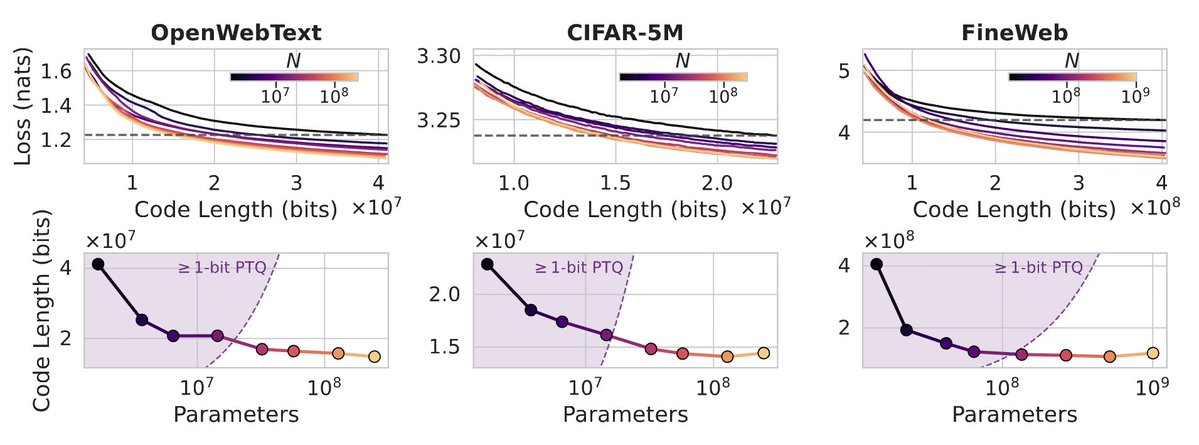
How far can we compress billion-parameter LLMs? We introduce requential coding, which achieves < 1-bit per param compression, and explains why scaling doesn't hit a generalization wall!
https://t.co/gUZekHiFRU
w/@m_finzi, @YujiaZheng9 ,@kunkzhang, @andrewgwils
1/🧵
I'm so excited about this new work. We introduce requential coding, pushing compression to the absolute limits! We show larger neural networks and ensembles are much stronger compressors, even in an absolute sense, with better generalization bounds.
Sometimes I wish I knew nothing about computer science, just so I could learn it from Tim. He is probably my favourite lecturer in computer science: he speaks with such lucidity and conviction. Check this (or his wealth of other educational content) out if you don't know it yet!
@bryan_johnson if you do RNAseq profiling of your cells you might be interested in sending that to @ScientaLab , IIUC they help predict which kind of autoimmune drug will work best, based on such profile
My plan to cure autoimmune gastritis
To our knowledge, no one has ever done this to try and cure an autoimmune disease.
Context: In May, I got diagnosed with autoimmune gastritis (AIG). We found it by taking a tissue biopsy of my stomach. My immune cells are confused, causing my stomach to eat itself.
AIG stops your body from absorbing nutrients like iron and B12, and can eventually lead to cancer. It likely started decades ago when I was diagnosed with hypothyroidism when 21 years old. The thyroid and stomach are closely linked in your immune system.
I feel fortunate that I've been taking such good care of my body for the past five years as my condition would otherwise be much more severe. Millions of people are affected by this disease and are undiagnosed.
Standard of care tells you that you can’t do anything about it. That’s old fashioned.
Here is how we are going to try and cure it:
Step 0: find and diagnose the disease ✅
AIG is rarely caught early because symptoms are subtle. Early warnings are low iron and B12, but when hemoglobin and hematocrit look normal, doctors routinely miss it because there are no obvious signs of anemia.
A standard colonoscopy won't find it either, because it only checks the lower digestive tract, not the stomach. It was only through a highly targeted stomach biopsy that we found it. Even biopsies can miss it if they don't sample the exact right spots. Most people with AIG go undiagnosed.
Step 1: Map my immune system ✅
Last Thursday, I had a blood draw to isolate and decode 1 million of my immune cells. Think of your immune cells as trillions of soldiers. Each carries a unique key designed to unlock and destroy a specific threat, like a virus or bacteria.
A standard blood test allows you to see how many soldiers you have, but not their keys. Sequencing one million individual immune cells allows us to read the exact pattern of the teeth on every single key.
This is important for my autoimmune gastritis (AIG) because a specific platoon of rogue soldiers has developed keys that unlock an attack on my stomach lining.
Right now, we don’t know who they are. This test will inform us of which soldiers have gone rogue and are attacking me from within.
Once we know the soldier and key, we know what therapy path to pursue to shut them down.
Step 2: Catch the rogue soldiers
I will be getting a second biopsy from my stomach because we need to collect live tissue. We are currently planning out the logistics of getting the sample from my stomach to the lab.
We need these live cells because the initial blood tests showed the antibodies, which prove that an attack is happening, but doesn’t show us the actual rogue soldier doing the damage which is a T-cell.
The live sample will allow us to match the immune system mapping we did to the live T-cells.
Step 3: Build an early warning system
To keep an eye on the disease as we work towards a therapy, we’re building an early warning system. I'll have my blood drawn every two weeks and we’ll pair that information with wearable data to look for flare ups. This is important because the attack happens without producing symptoms that I can easily feel.
Step 4: Create a “Bryan in a dish” testing model, a miniature of my immune system
At the same time, we are taking a massive sample of my immune cells and deep freezing them (cryopreservation) for two reasons:
a) we’ll create a living lab: using these cells to replicate my immune environment in a lab dish. This allows us to test experimental drugs and therapies on my actual live cells before putting them into my body.
b) it creates a back up plan for me by preserving the raw cellular material needed for targeted rejuvenation therapies in the future.
Step 5: Build precision guided therapies to end the attack
Once we know who the rogue soldiers are, we will engineer a therapy designed uniquely for them. The trick is only turning off the rogue soldiers while leaving all the other healthy ones functioning as they are.
For safety checks, we’ll do two test runs:
1) we’ll run the therapy through a computer model that has my biology to evaluate how my molecules interact.
2) We will take my actual cells that we froze in Step 4 and watch them interact for real.
If both are successful, we’ll pursue one of four therapies:
a) fix the mistake my cells are making, restoring my immune system's natural off switches
b) teach the rogue cells to tolerate my stomach instead of attacking it
c) design smart molecules that physically plug into the rogue cells and turn them off
d) build soldiers who will track down and eliminate the rogue soldiers causing the damage
new post on harness engineering for AI self-improvement: https://t.co/ZYvGfVs61k
It is hard to forecast how much the future of RSI will rely on harnesses. Likely harness engineering will evolve in the direction of self-improvement and enable auto-research, and, in turn, smarter models keeps harnesses simple.
Even when many harness improvement get eventually internalized into core model, the need to specify goals and context will not disappear.