“A great business at a fair price is superior to a fair business at a great price… The investment game always involves considering both quality and price, and the trick is to get more quality than you pay for in price. It’s just that simple." - Charlie Munger
@ByteTree Quality is an investment research service which does exactly that.
#Quality #Investing
https://t.co/yx5VRE0Ow3
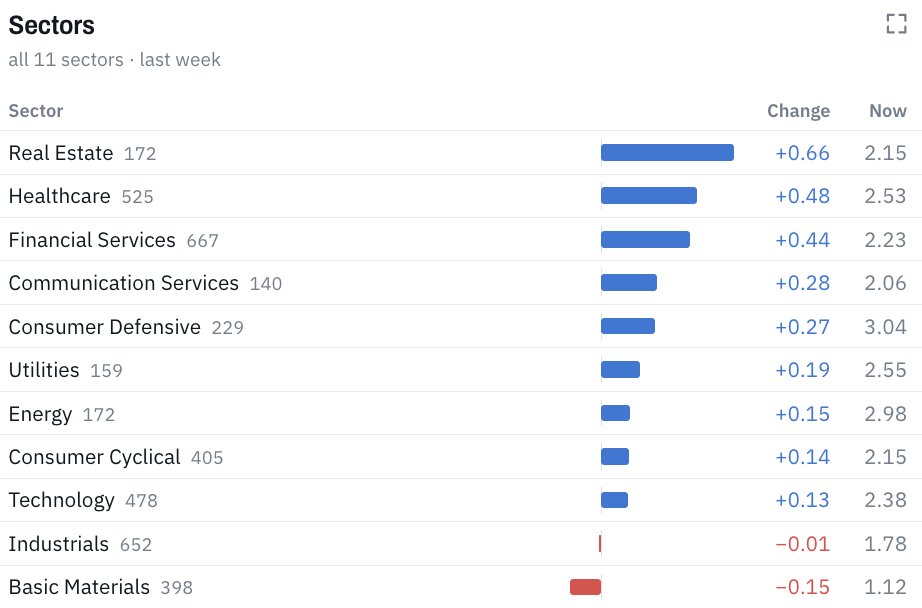
The last week saw Real Estate's average trend score improve significantly.
Having been the weakest sector by far, its average trend score jumped the most, as its deep value met falling rates. Tech and Industrials were weak.
A powerful rotation.
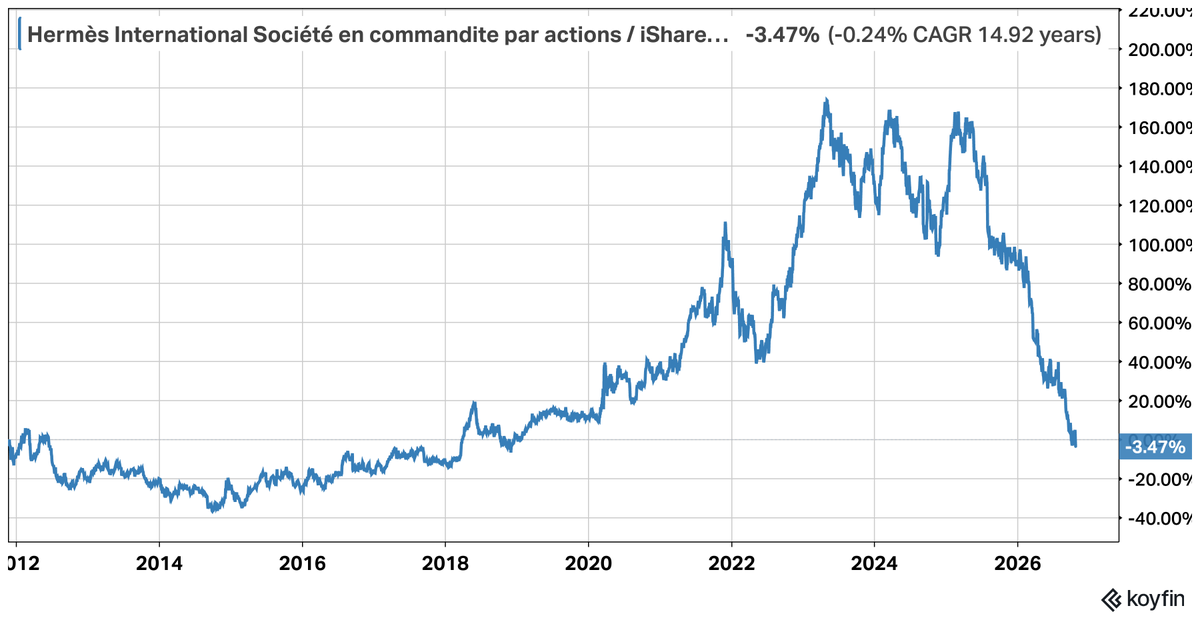
Hermes $RMS relative to the world since 2012.
-65% drawdown.
In 2023, Hermes traded at an EV/Sales that was 7.5x higher than the index. Today, it's "just" 2.2x. Previous average 4.5x.
What premium is still deserved?
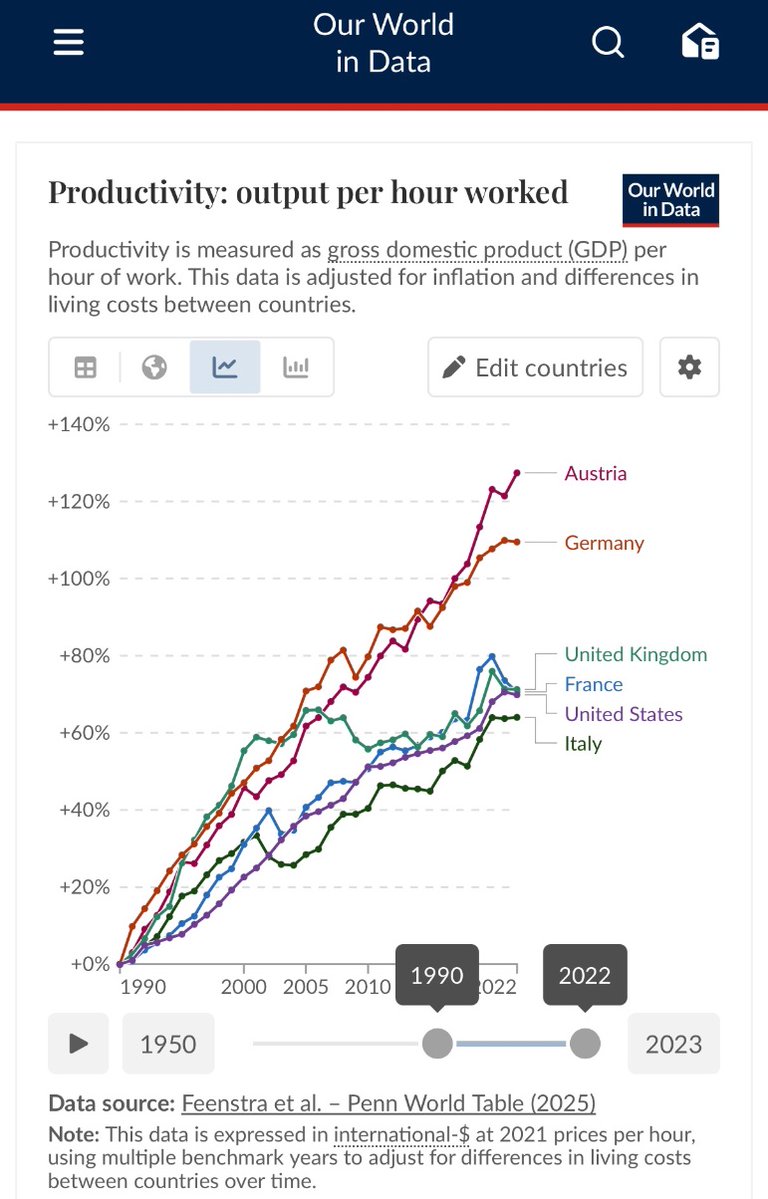
One of the strangest and under-discussed phenomena in macro is how different GDP per capita and GDP per hour worked have evolved since 1990 in the US and Europe.
I get where you’re coming from, but would challenge the extremity of the view. Take them together and you get the wisdom of an intelligent crowd, with a 6-18month time horizon. They might not do great with turning points and cyclicals, or long term calls, but there rarely way off for long…
@darquandier@FTAlphaville Thanks will look more into their metrics. P.S. Nice cover photo. I was an instructor there for 6 months after graduating, what a place.
Great note by @FTAlphaville on the different ways to slice and dice French debt metrics. Firstly, converting it into constant currency to make intl rates more comparable, and then looking at spreads over the overnight funding rates, showing how small the current crisis is compared to Greece in the early 2010s.
This is a seismic flicker at the moment - a warning - but not an earthquake (yet).
In the end, perhaps what matters most is how much of a country’s GDP goes towards interest payments. France has quite a long average maturity (8.5yrs) sparing it a degree of urgency. And despite the last few weeks, France’s EU-leading govt spending and debt/GDP levels, the US and Italy are still set to spend a higher proportion of their economic product on paying off interest.
https://t.co/kVK4DicVra How nervous are bond markets about France?
Great post, and stats, thanks.
There appears to be a lot of “we need to make savings - desperately” but also “when I said we I meant you”.
The politicians and people’s willingness to pay is a huge factor in the pathway for France, and for European peers who aren’t far behind. In France at least, there appears little political will to explain and take difficult decisions. As a result, it doesn’t seem that many people are really talking about the painful but necessary measures - rather, as you say, looking for silver bullets in immigrants or wealth taxes that are more of a distraction than a solution.
@RnaudBertrand@sarthakgh A very good piece - as was Toby Nangle’s taking a closer look at the brewing (but not yet burning) debt crisis:
https://t.co/JzGl3zwDI3
Great note by @FTAlphaville on the different ways to slice and dice French debt metrics. Firstly, converting it into constant currency to make intl rates more comparable, and then looking at spreads over the overnight funding rates, showing how small the current crisis is compared to Greece in the early 2010s.
This is a seismic flicker at the moment - a warning - but not an earthquake (yet).
In the end, perhaps what matters most is how much of a country’s GDP goes towards interest payments. France has quite a long average maturity (8.5yrs) sparing it a degree of urgency. And despite the last few weeks, France’s EU-leading govt spending and debt/GDP levels, the US and Italy are still set to spend a higher proportion of their economic product on paying off interest.
https://t.co/kVK4DicVra How nervous are bond markets about France?
I caught up on Friday with my friend and business partner Anatole @kaletsky for our weekly Gavekal zoominar. We were supposed to discuss how sustainable the AI capex spending boom would prove to be in the face of rapidly rising corporate bond yields? But given the headlines on France, on the Middle-East and on the growing likelihood of a peace deal between Russia and Ukraine, we struggled to stay on track…
I asked the @gavekal editors to remove the locks on the podcast…
https://t.co/sPUAJh357Q
Bill Ackman’s Ground Rules
(As per his Knowledge Project interview with @shaneparrish)
- Large cap, liquid companies
- Simple predictable businesses
- Free cash flow generative
- Great management teams
- No short selling
They’re looking for the best companies in the world with the most durable moats run by the best management teams.
IMO the first rule is underestimated by many.
@ReneSellmann Yeah restaurants in general - similar to ice cream - esp fine dining. Many are in the game for love rather than money, so hard to be sustainable profitable. Also scaling Michelin star level is near-impossible as it requires uniqueness…