I worked at different parts of the financial industry.
Analyst at a leading brokerage firm.
Analyst/fund manager, portfolio manager at semi-sovereign funds.
Portfolio manager at family offices.
I can tell you with confidence, the most advantaged individuals in financial sector are "part-time retail traders".
Note: if you are disciplined with great self control and operate not with instincts but with predefined rules, do not need to follow markets intraday, do not need more than 1 screen to run research and place orders, have the flexibility to step out of your office and engage in non-finance activities you are way ahead and with more clear mind than the trader who sits in front of 4 screens that are connected to a Bloomberg terminal.
I coded open source (free) ATR trailing stop where you can set the initial ATR multiple, trailing atr multiple, starting date, long/short.
See which parameters work best for you.
https://t.co/j2Q5YpWIuW
Summary: 1) The hack job on Jensen Huang by the NYT failed. 2) Journalists don't like it when they lose their power over us citizens.
Social media works better than journalism.
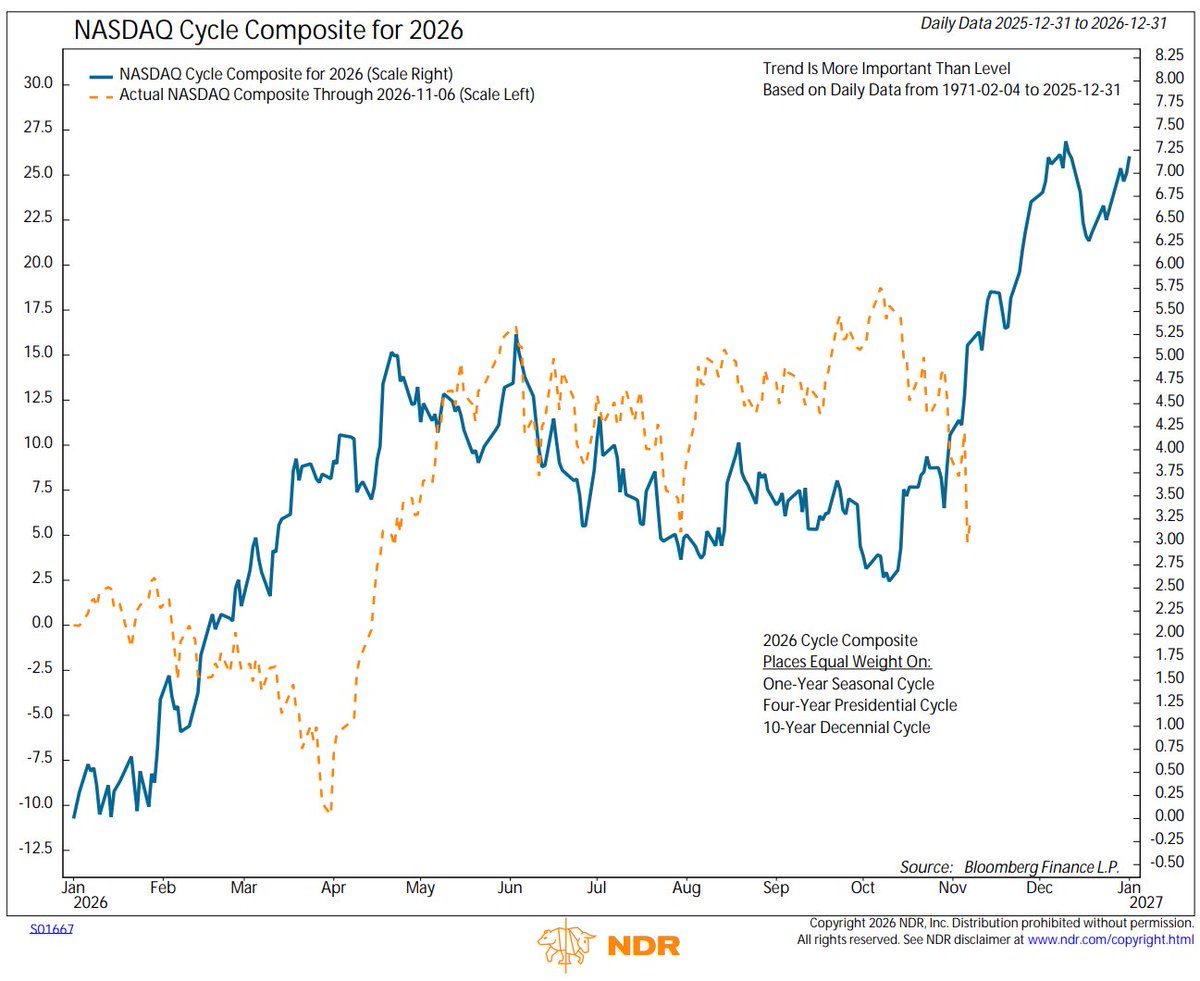
Will seasonality and cyclical tendencies bail the market out as we head into two of the stronger months of the year?
UPDATE: On October 15, I added the $SPY short to our portfolio in anticipation of a general market decline. At the time, the position was initiated as a hedge against our long exposure.
Since then, the market declined, with the $QQQ falling 11% and the $SPY declining 5% from our entry price (short). That weakness stopped us out of all but one of our long positions ($TEVA) - either at small losses or with profits on stocks where we had backstopped gains.
By default, as our long exposure came down, the $SPY short transitioned from being a hedge to leaving us net short the market.
We view the recent action as a stealth bear market in certain areas, where the major indexes have masked significant deterioration beneath the surface, particularly among AI infrastructure and technology stocks. Many of those names have suffered substantial declines from their highs, driving them to oversold levels.
My original stop on the $SPY was 778.00, which represented a new all-time high only about 1% above our short price. I have now improved that stop to our breakeven price of 769.64, eliminating stop-loss risk on the position.
The trade has already been a success from a risk/reward standpoint. We initially risked approximately 1%, while the $SPY declined roughly 5% from our entry—about a 5R move.
Our decision to hold for a potentially larger move was based first on the position serving as a hedge and, subsequently, on our ability to de-risk the trade to the point where we now have zero principal risk.
This is a classic way I approach many of my market/ETF trades when shorting the general market.
https://t.co/JXzFFTmMtn
https://t.co/FfBnR93ojq
I did this podcast over the weekend which has already gotten a great response. Check out my interview with @richardmoglen and @traderlion - I think it’s very timely!
https://t.co/cG6MGutmMd
With millions of people on Twitter, every day someone makes a prediction or a “market call.” And out of all those people, every day SOMEONE is going to be right.
It’s like the lottery. Every week there’s a winner—but every week the name is different.
I’ve been succeeding in the stock market for 43 years. Not because I was a natural-born trader, and certainly not because I can predict the future. It’s the result of practice, study, discipline, patience, strategy, rules, experience—and being smart enough to never allow a prediction to get in the way of my respect for risk.
My entire fortune has been built on three key rules:
1. I never buy at the bottom.
2. I always sell too soon.
3. I never hold or add to losses.
That’s how you survive long enough to build a generational fortune. And for those smart enough to heed its wisdom, this tweet is worth a fortune.
I don't think we're going to see an '87-style crash in percentage terms, but today could set the stage for some form of market meltdown that could potentially last a week or two. If the decline picks up steam, throw your oversold indicators out the window. My guess would be $SPY 10%-15% from peak with 20% as a worst case. Nasdaq could drop 20-25%. Possible 1998 cyclical bear market.
Oversold markets: Markets that have gone down a lot in a short time.
Sold-out markets: Markets that have gone down so far and so long that there's just no stock left to sell. They are often seen during a successful test of a low.
Sold-out markets are more bullish than oversold markets.
Both of them use stops, both of them look at charts.
They just can't say it out loud because the institutions that invest money with them wants to hear fundamental analysis and a narrative.
Unless you are out there with your fund's prospectus clearly stating you act purely on technical strategy, most hide their use of charting and its impact on their decision making.
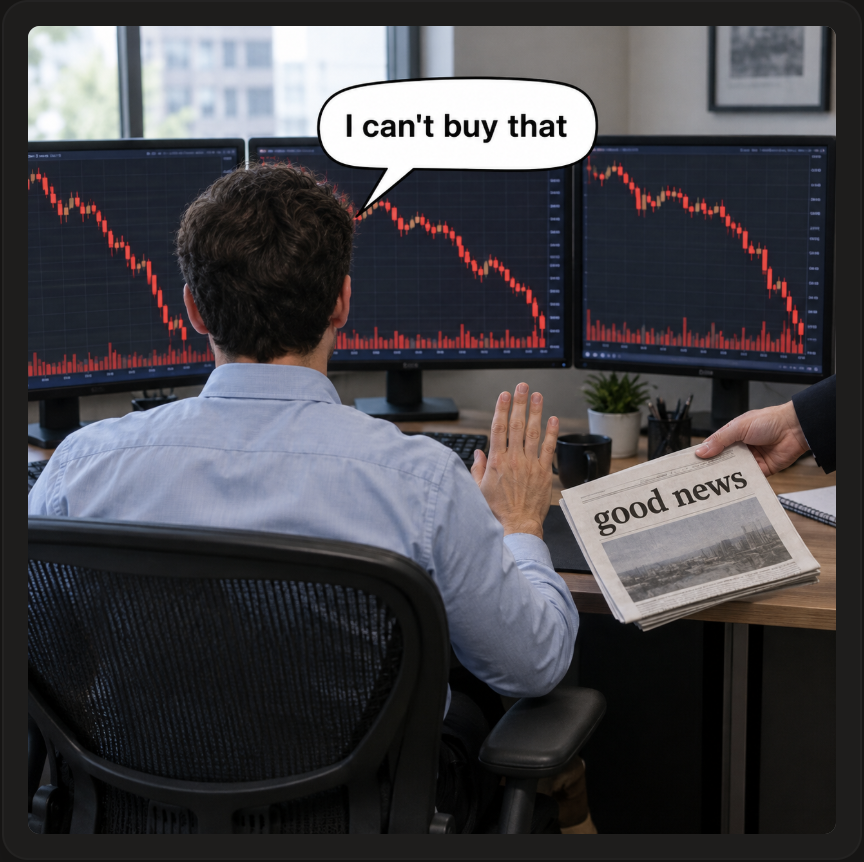
I don't see much 'good news' out there, seems like a pretty nice wall o worry:
-high oil
-rising rates
-wars
-election uncertainty
-AI is a bubble, if not it'll take our jobs and after that kill us all
-Bears lost to the Packers & Vikings
Anyone ready to get long if any good news happens? Asking for a friend...
This is the Nasdaq futures daily chart—flipped upside down. Look at it this way, and you probably would’ve spotted the potential move a few days ago.
I sometimes like to flip my charts to get a fresh perspective. I shared more about this technique in my interview with @chartfanatics and @Wordsofrizdom , which I’m told will be out on YouTube in the coming days.
Stay tuned. 👀
Let’s use a recent example that perfectly illustrates how market narratives and sentiment tend to follow price.
The AI Memory Trade.
When memory stocks were ripping and going vertical, we were talking about absolutely insane moves, even surpassing $CSCO ’s legendary run during the dot-com bubble.
$SNDK: +1,000% ++ in 1 year
$MU: +672% ++ in 1 year
At the highs, nobody seemed to care about the cyclical nature of memory stocks. In fact, the low P/E multiples only reinforced the bullish thesis. These were no-brainer longs. You couldn't own enough $MU or $SNDK because we were in the early innings of an AI memory supercycle. $DRAM was an ETF people said was free money to buy in a retirement account and HODL (45% off highs now)
Fast-forward to today:
$SNDK rallied 8,340% from its 2025 lows to its highs and has now corrected 44%.
$MU rallied 1,830% from its 2025 lows to its highs and has now corrected 30%.
Suddenly, the narrative has completely flipped.
"Cyclical stocks always look cheapest at the top."
"Analysts are extrapolating peak-cycle pricing and earnings into the future."
"These stocks have already gone up thousands of percent. How much higher could they possibly go?"
Here's what I find fascinating:
>> Every single one of these arguments could have been made at the highs, but nobody cared because PRICE was going up.
Now that prices have corrected significantly, those same arguments are suddenly front and center, reinforcing the bearish narrative.
Could the bears be right? Absolutely. That's not the point.
The point is how quickly market psychology, sentiment, and the prevailing narrative shift depending on what price is doing.
When stocks are going vertical, everyone finds reasons to justify why they should keep going higher. When they start breaking down, everyone suddenly finds reasons why they should go lower.
The price action changes, and the narrative follows.
Again, at the end of the day, the only thing that PAYS is price. You can have the greatest thesis in the world, but if the chart doesn't agree, it doesn't matter.
However, I think understanding market psychology, positioning, and sentiment provides an additional edge in recognizing when narratives become extreme and how those extremes can influence future price action.
Follow price, but understand the psychology driving the participants behind it.
Does anybody remember when I posted about "Price Walls" (a decades-old TA tool) at the BTC bottom in 2021?
Well, we are here again. $BTC
Old-school TA can outcompete new school TA any day of the week
If anything, the past two months should have taught you to 'trade what you see' and trust your judgement of price action (assuming you've put in the requisite screen time to discern normal and abnormal price action).
There is a lot of noise on this platform, and admittedly I succumb to it from time to time. It is no wonder when the moment I check out/go travelling and just focus my own trading/judgement, results improve in relatively short order.
Another lesson that should come to you quite quickly is the need to view the market from the lens of individual stock first rather than the index. The quantity and quality of your watchlist is almost always a leading indicator for what is to come in the short term.
$QQQ near all time highs? Yeah that's great! But individual stock action for the most part the past two weeks have deteriorated significantly and it must have been difficult to catch traction unless you got positioned in the right names. Study the RS lines of individual stocks in relation to its own 20/21-DMA, many have begun to lag the index by a pretty wide margin the past week. Additionally, their respective RS lines have been choppy and failed to register any sort of consistency in terms of sustained relative strength momentum (yes, I'm looking at you AI names).
It has generally been a tough year and the goal is really to preserve any gains you have and survive - not just from a financial standpoint but importantly your mental capital too. Have low expectations and wait for that fat pitch to swing the bat hard. It certainly will be difficult to do that if you've drained yourself trying to press hard in a tough environment.
"While the building blocks of a new bull market are always put in place during a correction, most people are looking the other way. While you are waiting, others are paving the way for the next strong market environment." - William O' Neil