STOP READING THE MARKET WRONG
The Weekly 8EMA is the cheat code.
This is how I called the moves in $SPY $MU $SNDK $ARM before the crowd saw it.
Both pullbacks and breakouts.
When stocks get too extended from it, they almost always:
• pull back
• or consolidate until the 8EMA catches up
That’s how you stop buying tops and start understanding when to buy/sell.
The market warns you before almost every pullback.
Now you won’t be lost because you have followed me. Watch video below for more.
📈Guru Screener - Qullamaggie Minervini Stockbee
Below is the "Guru" scanner* of the excellent work of @Qullamaggie@markminervini and @PradeepBonde
- Qullamaggie Breakouts
- Minervini Trend Template
- Stockbee 9 Million Movers
- Stockbee 20% Weekly Movers
- Stockbee 4% Daily Movers
* based on my interpretation
Results have been limited to stocks less than 5x ATR-to-SMA50. The ATR-to-SMA50 extension is shown in the "badge".
Read the Market Wizards chapter on Kristjan Kullamägi this weekend. The one section that really stood out was when he discussed his drawdown off of his 2021 peak.
"I started 2020 with $3.5 million and ended the year at $36 million. It was a thousand percent year. Then I ran that $36 million to a high of $105 million, and the last portion of that move from $65 to $105 million occurred in just a month and a half. For a brief period, just a few days, I was over $100 million. You have to understand what that did to my psyche. It made me feel completely detached from reality. I thought, “I’m going to get to $200 million in six months.” I was completely sure of that. I started seeing trading as a video game, which I kept winning.
Measured from my $105 million peak in November 2021 to my mid-2022 low, I lost approximately $60 million. About half of that loss represented the late 2021 retracement of the large open profits at the November peak to the stops on those positions. The initial retracement loss was so large because I was leveraged long at my peak. My long exposure was $150 million—a number I recall because I remember bragging about it to a friend"
These boom and bust type tales are as old as time. Look at Jessie Livermore as the classic example. Net worth of $0 in 1906 to a peak of $1.6 billion (inflation adjusted to 2021 dollars) in 1929. Just 5 years later he blew up and owed $104 million dollars to his brokers...
Or look at Paul Tudor Jones. Hit one of the most legendary trades in history, making roughly $200 million dollars during the 1987 crash. It cemented him as a legend. His mental coach Tony Robbins said that Jones consistently lost money for the next 4 years after that peak.
Dan Zanger parlayed $10,000 into $42 million during the late 90's. Then in late 2000 he took a 70% drawdown when he was 200% long 3-4 fiber optic stocks as the dot-com bubble was popping.
Charles Harris reached 8-figures status after he ran up his account over 4,000% from 2020-21, then experienced a -80% drawdown, mostly due to his big TSLA bet in 2021-2022.
I have seen a few people speculating on Kristjans story from the outside. Saying "I would have stopped trading at $100 million" or "I would have just taken that money and started investing". To those people I ask if you have ever experienced a real euphoric run in your trading account, let alone turning 5k into 100mil? Extreme winning streaks like the ones above breed overwhelming euphoria and overconfidence. The mind shifts its focus from process to outcomes, with ego-driven decisions overriding risk parameters and rules. From my experience I have found it near impossible to be aware of this at the peak of the run. It is almost like you are blacked out and the greed/ego completely takes over your trading.
Then the drawdown begins. The emotions shift from euphoria and greed to revenge, fear, and doubt. This is where things can really start to spiral out of control. It is only after the drawdown has run its course that you finally come back to your senses and your emotions drift back towards baseline levels. Then all you're left with is regret...
Few people ever talk about what a big winning streak can do to you. It can literally change the way you think and operate. Often the ability to achieve super returns is also its biggest drawback—a true double-edged sword. To be able to conquer both sides is the holy grail...
From the Hour Between Dog and Wolf by John Coates:
"When traders enjoy an extended winning streak they experience a high that is powerfully narcotic. This feeling, as overwhelming as passionate desire or wall-banging anger, is very difficult to control. Any trader knows the feeling, and we all fear its consequences. Under its influence we tend to feel invincible, and put on such stupid trades, in such large size, that we end up losing more money on them than we made on the winning streak in the first place. It has to be understood that traders on a roll are traders under the influence of a drug that has the power to transform them into different people."
When breakouts fail to gain traction, it’s often a signal that the market is crowded and retail activity is elevated. This helps explain why the vast majority of significant stock advances begin out of corrections and bear markets—periods that effectively wash out the noise.
As a trader, your role is not to fight the market, but to interpret its message and adapt accordingly—minimizing losses during choppy, indecisive conditions. By doing so, you preserve both capital and flexibility, positioning yourself to capitalize when truly favorable opportunities emerge.
Bottom line: Breakouts are timeless, but the results are cyclical. Just like with individual stocks, patience and discipline are required. No one has a crystal ball. Managing the downside puts you in position for the upside. That truly is the "secret."
https://t.co/JXzFFTmMtn
My guest today is Paul Tudor Jones (@ptj_official), one of the greatest macro traders of all time.
He correctly predicted the 1987 stock market crash and shorted the Japanese bubble in 1990. For over 40 years, his flagship fund has had a negative correlation to the S&P 500. 100% of his returns are alpha.
He says today's market has so many similarities to 2000, "the easiest bear market I've ever seen in my whole life."
He makes the case for going long dollar-yen, why Bitcoin beats gold as an inflation hedge, and why he was wrong about Warren Buffett.
But what I'll remember most from this conversation is Paul's zest for life. He's 71 and still wakes at 2:30 every morning to trade the London open. He works out for two hours a day. He walks with his wife every evening. He travels the country chasing peak spring and peak fall. He's so excited about the songs picked for his funeral that he wishes he could be there to hear them.
Paul has lived five lifetimes in one. He's one of the most entertaining and interesting people I've met, and the conversation will leave you searching to be as passionate about what you do as he is about what he does.
Enjoy!
Timestamps:
0:00 Intro
1:00 The Kindest Thing
13:19 Trading vs. Investing
17:33 Lessons from Warren Buffet
22:24 The Existential Risks of AI
29:54 The Nature of Trading
31:46 Bitcoin
35:55 Bubbles
42:08 A Day in the Life of PTJ
46:00 Information Overload
47:07 Passion for Markets
50:49 The Robin Hood Foundation
54:18 The Workless World
56:03 Journalism
1:00:00 Principal Components of a Great Life
1:05:06 Kill Them With Kindness
Instead of watching an hour of Netflix, watch this 1-hour MIT lecture by Jim Simons.
It’s basically Kasparov-level strategy applied to markets.
The Quant King reveals more than most Wall Street players learn in an entire career.
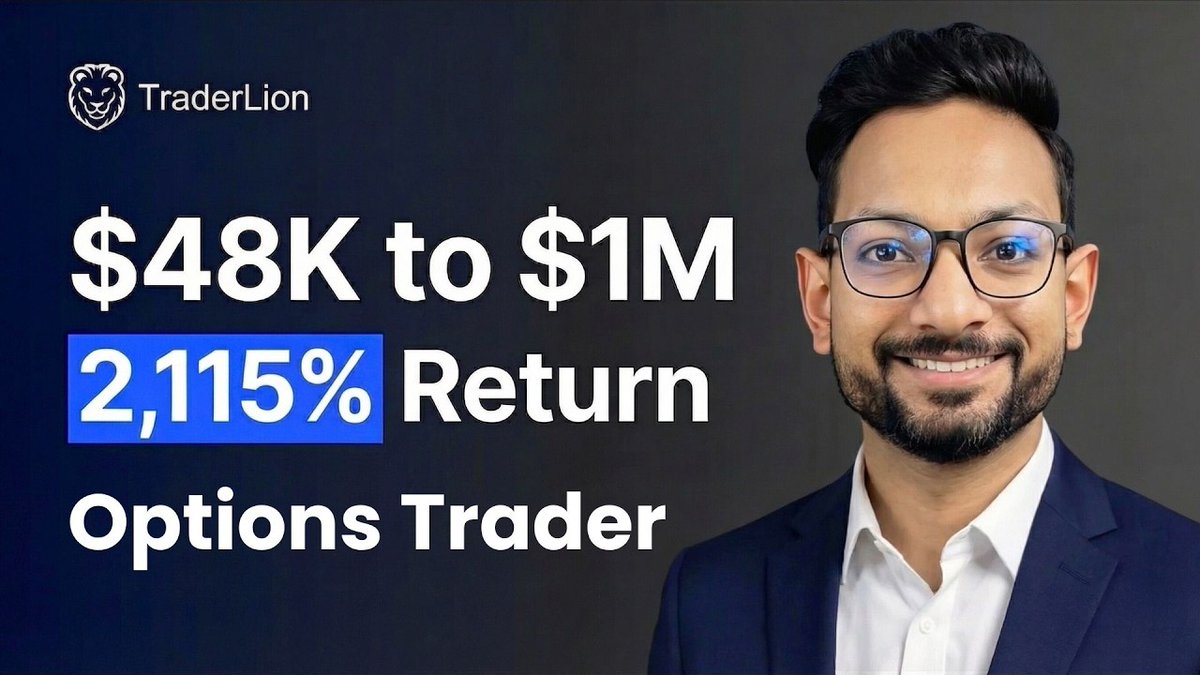
Tito Adhikary is a Harvard cancer scientist who just returned 2,115% in the 2025 US Investing Championship.
No finance degree. No Wall Street background. PhD in cancer research.
Lost $33K in one day on a $40K salary. Traded a $5K account in 2023. Then turned $48K into over $1M with options.
10 clips. Full story below 🧵
Game theory
Most people are playing the wrong game.
If you want to get rich, there are only 3 games that actually matter.
Everything else is a distraction
Ray Dalio gives a free lesson exploring what he believes to be the most important economic and investment principles. If you know these principles it's like the old saying, “Give a man a fish and you feed him for a day; teach a man to fish and you feed him for a lifetime.”
Learn to fish for yourself and give this video a listen.
Dr. Eric Wish’s “blue dot” setup is simple:
Find a stock that recently hit all-time highs, gets oversold, and bounces near the lower Bollinger Band.
Strength + pullback + bounce = high-probability entry.
Howard Marks once said:
“I tell my father’s story of the gambler who one day hears about a race with only one horse in it, so he bet the rent money. Halfway around the track the horse jumped over the fence and ran away”
Here are 10 lessons that will make you an better investor:
Just recorded an Investor's Business Daily podcast with Justin Nielsen that you can access from this link. https://t.co/beRRGFo5yU I cover the general market and the weakness developing in the "FANG" stocks. I also suggest groups that are just emerging.