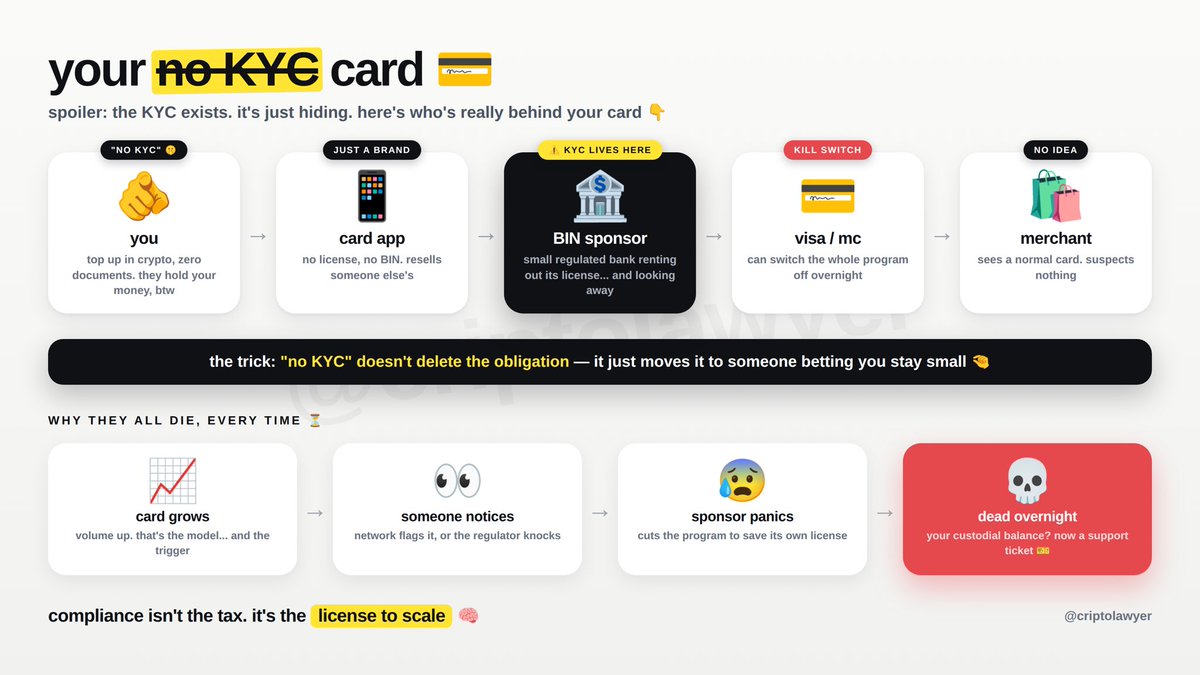
NON KYC CRYPTO CARDS will disappear, but why?
Every @Visa or @Mastercard card program on earth runs on a BIN owned by a regulated issuer (@raincards@wirexapp @pomelo_latam @reapglobal) who is legally required to know who's spending.
so when a card promises "no kyc", what it really means is that someone, somewhere, is renting out their license and betting your volume stays too small to notice.
that's why they all look the same: low limits, custodial balances, BINs from small issuers in flexible jurisdictions. it's not innovation, it's arbitrage
and the bet always ends the same way. the card grows, the sponsor gets nervous, and one morning the BIN is cut. or the regulator cuts the sponsor first. we've seen this movie many times, different logo every time
they don't die because users get caught. they die because their own infrastructure runs on entities obligated to do the kyc they promised you didn't need.
So eventually all of them will KYC users or simply shutdown when they got caugth, cause the big issuers won’t take the risk for a few extra bucks.
Wirex today is increasingly an infrastructure company.
The retail business gave us years of experience operating cards, accounts, payments, scheme connectivity and compliance ourselves. The shift was to take that operating stack and make it available to other companies building financial products.
We launched the infrastructure business in November 2025. In 131 days, it became the fastest stablecoin payment infrastructure to reach $1B in annualised onchain volume. That run rate has since passed $2B.
Partners can now build with cards, accounts, payouts, settlement and other financial products through one integration, with an average signed-to-live timeline of 44 days.
That is the direction of the business now. We are building the infrastructure other companies use to bring stablecoin-powered financial products to market.
In this conversation with @samconnerone, Community Lead Developer at @circle and @arc, our Group CEO and Co-Founder @matveevp explains how Wirex moved from retail into infrastructure and what that focus looks like today.
corporate accounts + cards via API are live on @wirexdevelopers
we have our first design partners live and follow up wave of customers integrating
get in touch if you want access
🚣⛵🛥️⛴️
@wirexapp
Barça Mobile, the official mobile partner of @FCBarcelona recently announced the development of a digital wallet, in collaboration with @wirexapp and @crossmint, and built on the Stellar network.
⚽️ on Stellar.
https://t.co/cwAFJ3HmwP
WE’VE REACHED ≈$2B IN ANNUALISED CARD SPEND VOLUME! 🚀
July’s $160M+ in onchain card spend pushed our annualised run-rate to ≈$2B in just 8 months since launch.
We reached $1B in 131 days, the fastest in the industry. Roughly 110 days later, that run-rate had nearly doubled.
Agentic commerce could account for $1.5 trillion in global transaction value by 2030.
Reaching that scale will require payment infrastructure that lets agents search, complete the required details and transact after receiving explicit user approval.
In this video, our Co-Founder @Dmitrywirex explains why agentic payments are a natural next step for Wirex BaaS, extending the stablecoin infrastructure, self-custody wallets, cards and bank accounts we already provide to partners.
How much of the payment process would you hand over to an agent?
GIVEAWAY TIME! 🎉
To celebrate Bitcoin Pizza Day, we're doing a #giveaway! Here's how to participate:
→ Follow us @wirexapp
→ RT & Comment "HAPPY BITCOIN PIZZA DAY"
3 winners will each win $100 in $BTC.
Giveaway runs for 5 days. Good luck! 🍕
The Idea: WPAY Burn-on-Redemption Mechanism
Every time a user redeems rewards, a micro-percentage of WPAY is burned from circulating supply. More users = more redemptions = more burns = deflationary pressure = price support. This transforms WPAY from a passive holding into a demand-driven asset with a built-in buy pressure loop. Solves the 94% supply overhang problem structurally.
The Litepaper was just the start.
Wirex One is the next chapter of Wirex, built fully onchain around true ownership, speed, and a smoother experience. There is much more to come, and we want your input.
Share your feedback 👇
https://t.co/suO3BJBQlM
Over the last year, Rain’s share of crypto card transaction volume has dropped from 88% to 65%!
They've mainly bled this marketshare to Wirex who have grown from 0% to an impressive 30% this last week.
Check out our new issuers page on PaymentScan to learn more!
GIVEAWAY TIME! 🎉
To reward our community, we're doing a #giveaway!
Here’s how to participate:
→ Follow us @wirexapp
→ Like + RT + bookmark this post
→ Tag 3 friends in comments
1 winner will win $100 in $BTC. Go!
. @Visa Crypto Card Volume hits $1.8B in Q1 2026 - and we're only in mid-March.
For context: the entire Q1 2025 was $580M. That's a 3x growth YoY in the same period.
The market is no longer dominated by one player. @RedotPay remains the leader at $792M in Q1 2026, but @raincards has gone from $47M to $733M - a 15x surge that signals serious institutional and retail adoption.
@ether_fi Cash grew from under $1M to $137M. Even the "Others" bucket - which includes @wirexapp, @MetaMask, @gnosispay, @holyheld and a dozen more - jumped from $71M to $131M.
At this run-rate, full-year 2026 volume could reach $10B - more than double the $4.9B recorded across all of 2025.
What's driving this?
Stablecoin infrastructure is maturing. More wallets are getting @Visa rails. Users are spending crypto like cash - on groceries, travel, everyday purchases.
The crypto card space is no longer a niche experiment. It's becoming a mainstream payment channel.