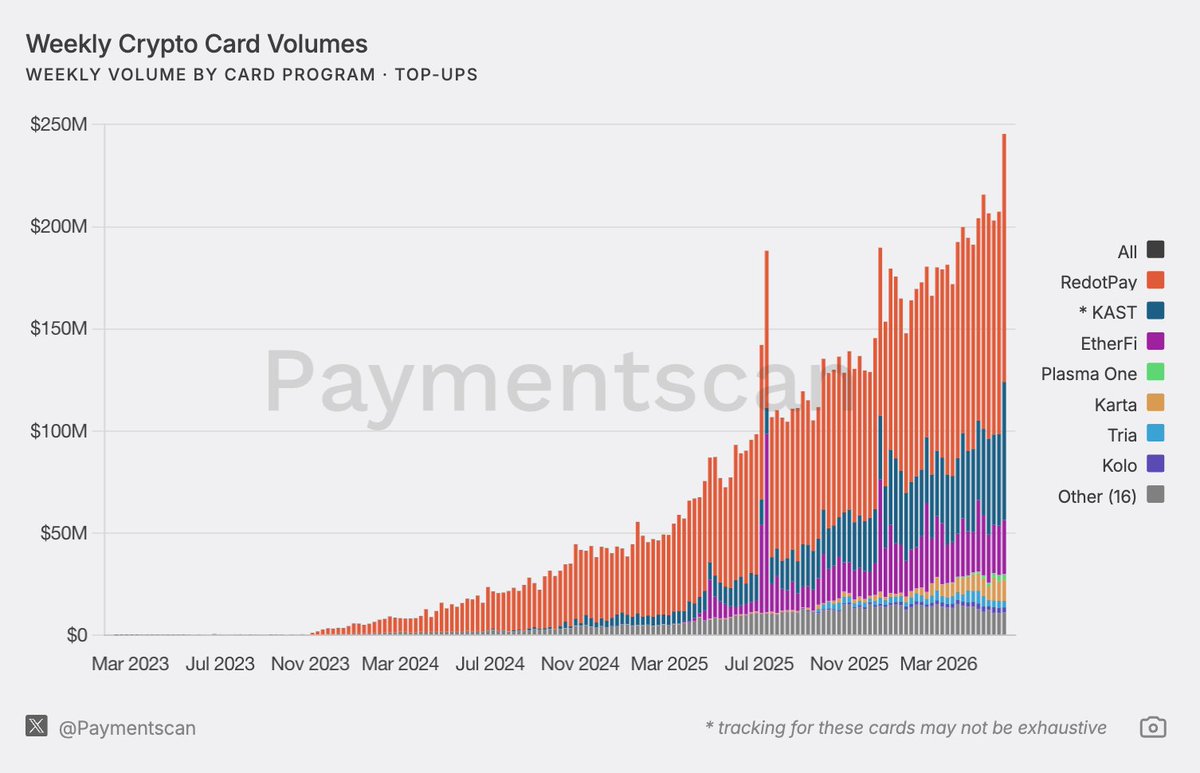
most neobanks will not survive the next 18 months.
not because demand disappears. $245M in top-ups in a single week proves demand is the least of your problems, they will die because of what they built underneath:
i review compliance infrastructure for a living since 2017. here is the full map of what actually holds this market together, layer by layer, and who is powering each one right now
cards
your card program is a three-party compliance relationship: you, your issuer, and the network. the network's enhanced due diligence sits on top of your issuer's requirements. if either loses confidence in your stack, the card stops. not slowly. overnight
@binance lost Visa in Europe July 2023. lost @Mastercard in latam two months later. gone by December. @ready_co gave non-EEA users one hour's notice in June 2026 when their issuer relationship broke. one hour
what the network actually wants to see: account-level OFAC and sanctions screening, not batch, not periodic, continuous. a transaction monitoring system that produces real alerts. a KYC layer defensible across every jurisdiction you operate in. one audit trail running through every product the customer touches
Starlingbank had a system that produced zero individual sanctions alerts for six months. £29M fine. that is the floor
the infrastructure powering this layer right now: @raincards (Visa and Mastercard principal member, BIN sponsor for 200+ programs, one API for issuance, compliance, FX and onchain settlement), @pomelo_latam ($160M raised, powers bbva , santander , @Bancolombia , @WesternUnion , Binance across latam, just launched global stablecoin card across 150+ countries), @marqeta ($383B processing volume in 2025), @lithic, @GalileoFintech, @unit_co_, @treasuryprime, @Adyen, @Stablecoin@eldoradoio@Uglycash
the compliance layer that makes the issuer relationship survivable is what @blend_money is built around: screening, audit trails, per-jurisdiction reporting, the infrastructure that keeps the card program intact at scale
on and off ramps
every ramp is a compliance event before it's a UX event
on-ramp: you are opening a new account. source of funds, identity verification, risk scoring before a single dollar moves
off-ramp: withdrawal with a clean audit trail, documented source of funds, per-jurisdiction reporting. this is where most teams underinvest because users don't see it. regulators do
best practice: per-account screening on every transaction, not customer-level screening on signup and never again. your banking partner will pull a sample during their quarterly review. if the trail isn't clean per transaction, you find out at the worst moment
the infrastructure powering ramps right now: @moonpay (eliminated fees on stablecoin onramps, enterprise stablecoin services live), @Transak (published the Q2 2026 compliance cliff report, most serious public documentation of what payment companies need before july), @Stablecoin (acquired by Stripe for $1.1B, trust charter approved february 2026), @belo_app@AlchemyPay, zerohashx, @Bitso , @RipioApp @daimo @dakota_xyz@RampNetwork@tazapay
earn
(im biased here just a little bit)
the most misunderstood compliance surface in the stack
shared vaults feel like a product architecture decision. they are actually a legal structure decision. commingled user funds create fiduciary exposure, insolvency complexity, and a direct failure point in any serious institutional diligence process
the question that kills shared vault structures is simple: show me the ledger entry for user X's balance. if the answer requires reconstructing it from pool accounting, you don't have an answer
best practice: isolated per user from day one. each account its own ledger entry. yield calculated individually. never commingled. this isn't conservative. it's the only structure that survives the question above from a banking partner, a regulator, or an institutional LP doing diligence on your cap table
this is the architecture @blend_money runs. isolated accounts, clean ledger, never commingled
for the institutional layer on top: @noon_capital brings the DeFi stack diversification and insurance coverage that makes yield products viable for institutions. diversified protocol exposure across @MorphoLabs, @eulerfinance, @pendle_fi, tokenized treasuries, CLOs and private credit. insurance gating on every deployment, no capital deployed without coverage. that is the version that survives institutional diligence
the broader earn infrastructure: @opentrade_io (RWA-backed yield-as-a-service, bank-grade legal structure with bankruptcy-remote SPC, powers Littio, Kredete, Criptan), @OndoFinance, @maplefinance, @goldfinch_fi, @SuperstateInc
in europe, MiCA Article 50 prohibits interest on euro-denominated stablecoins. the compliant path runs through tokenized T-bills and RWA wrappers. yield from an underlying asset, not from the stablecoin itself. whoever builds this first owns european earn
cashback and rewards
every rewards program with monetary value has reporting obligations
(ps @itstuyo set the new standart here: buy now pay maybe)
the cleanest structure: rewards funded from interchange revenue, paid in a regulated stablecoin, accounting that reconciles per user per period, tax-reportable from day one in every jurisdiction
paying rewards in your own token introduces volatility risk for the user and securities classification risk for you. the question "is this a security?" becomes harder to answer the moment the token fluctuates and users expect returns
compliance screening, the layer underneath all of it
most teams assemble this reactively. something breaks, a regulator asks a question, a banking partner flags a transaction. then the compliance stack gets built. that is the wrong order
the teams that survive build it preventively. before the card. before the ramp. before the earn product. one continuous audit trail across every product the customer touches
the point tools doing parts of this well: @chainalysis (blockchain analytics, OFAC and sanctions screening, regulator-accepted in US, EU and UK), @elliptic, @trmlabs, @Sumsubcom (KYC, AML and Travel Rule in one integration, MiCA and FATF ready), @ComplyAdvantage, @notabene_id, @sardine, @unit21inc, @jumio, @Onfido
but point tools create point gaps. your KYC vendor does not talk to your transaction monitoring. your transaction monitoring does not feed your sanctions screening. your sanctions screening does not generate the audit trail your banking partner needs to read. every gap is a reconciliation problem you find at the worst moment
what @blend_money built is the integrated layer. AML screening, OFAC checks, KYC, transaction monitoring, per-jurisdiction reporting, all running together as preventive infrastructure before a single user touches a product. not a compliance dashboard bolted on top. the foundation the card, the ramp and the earn product sit on
IDmerit's February 2026 breach of approximately 1 billion records made this clear: your compliance infrastructure is now a counterparty risk decision, not just a regulatory one
the right order of operations
1) screening and transaction monitoring, then issuer relationship, then card
2) source of funds framework, then ramp, then volume
3) isolated ledger, then earn product, then institutional partners
4)interchange accounting, then rewards, then retention
teams that invert this order ship faster in year one and rebuild in year two. sometimes year two doesn't come
the $245M is not a card story. it's not a yield story. it's a survival story
the neobanks still standing when this market hits $2.45B will be the ones that figured out compliance is not the last thing you build. it's the only thing that lets you build everything else
WaveCrest taught this lesson in 2018. Wirecard taught it in 2020. Ftx in 2022. Binance in 2023. Ready in 2026
the lesson does not change. only the names do.
Querida lamentablemente este DELINCUENTE solo quiere hacerse el tech ahora para lavarse la cara. Leopoldo López es un LADRÓN. Y TRAIDOR de la causa venezolana, uno que por AÑOS SE lucró de la desgracia que vivimos con la inmigración, siendo además cómplice del chavismo. El no vivió NADA de lo que sale a contar afuera. Estuvo “preso” y embarazó a la LADRONA de la mujer, con privilegios infinitos pues nunca fue ningún perseguido solo fue un infiltrado en la causa venezolana.
Agradezco mucho la intención pero los venezolanos RECHAZAMOS que se haga alusión a personajes como Leopoldo López, un verdadero CRIMINAL.
Si un agente de IA hace un pago por ti y algo sale mal, ¿quién responde?
De eso escribí en mi más reciente artículo para @btctechnomag: de lo que pasa cuando un software empieza a tomar decisiones con dinero real.
Las stablecoins ya permiten que estos agentes hagan pago, pero poder ejecutar una operación no resuelve lo que viene después: quién la autorizó, qué podía hacer el agente y qué controles había cuando salió el dinero.
No basta con saber de quién es la cuenta. Hay que poder explicar por qué se hizo cada pago y demostrar que estaba dentro de lo permitido.
En LATAM, esto no depende de que llegue una ley de inteligencia artificial. Ya hay obligaciones de identificación, prevención de lavado y control cambiario que cumplir.
Para las empresas, el reto es ese: no solo hacer que el agente pague, sino poder rendir cuentas por lo que hace.
Venezuela is back in the investment headlines.
But does that mean American companies can now invest freely? Not quite.
Here’s what actually happened: @USTreasury says Venezuela does not currently meet the “country of concern” definition in its proposed rules on American investment in sensitive technologies, including AI and advanced chips.
In plain English, these rules are about where US capital goes and whether it helps develop technologies that could pose a national security risk. They are not a general rulebook for every investment, bank account or payment involving Venezuela.
And that’s the distinction getting lost in the headline: this is NOT a blanket lifting of OFAC sanctions. Some investments in Venezuelan entities could also remain covered through links to other countries of concern.
For investors, banks and fintechs, the practical questions still matter: who receives the money, who owns the business, what the transaction involves, and which restrictions or authorizations apply.
My takeaway: a meaningful policy signal worth watching, but not an automatic reopening of every financial door. And these are still proposed rules, not a final rule already in force.
The @USTreasury just took Venezuela off its proposed outbound investment list.
the rule implements the COINS Act. it makes americans notify treasury before investing in AI, chips, quantum, supercomputing, hypersonics and biotech in countries of concern. AI is banned outright.
treasury’s reasoning: the maduro government “no longer exists” and the current one doesn’t meet the definition.
what it doesn’t touch: OFAC sanctions, those are still in force. today’s opening runs on general licenses, and those can be revoked.
treasury also says some investments in venezuelan entities could still fall under the rule.
it’s a proposal. comments close dec 7.
one less barrier on paper but the sanctions screening still applies.
love this thesis peter, fixed rates are the missing piece for institutional money, like been hearing this in more and more convos but my compliance brain 😅still has three questions before a risk committee signs off on the loop:
1. what happens at month 6 if the loan can’t roll at the same rate?
2. how is the rwa priced while it sits as collateral, and how fast can it actually be redeemed if the loop has to unwind?
3. a 4% spread looped a few times looks great until a credit event hits the underlying, any risk measure here?
ps: im really excited about what guys are doing!
2 months ago, i wrote “Stablecoins are not financial inclusion until they can extend credit.”
Today, @eldoradoio and @talamobile announced a stablecoin-powered credit product. Congrats to both teams!
Exciting to see more builders working on this missing piece.
My thesis goes beyond lending: a stablecoin account should let people receive money, preserve its value, pay, earn and eventually access credit based on their income and economic activity, not just the collateral they already own.
That requires connecting global liquidity with local underwriting, regulated lenders and institutions capable of absorbing the risk. No single company needs to build every layer.
We’ve made dollars easier to access and move. The next step is connecting them to financing for inventory, equipment and working capital.
Sharing the article again below. It explores how those pieces could fit together, and why payments alone aren’t the finish line
👇
the next stablecoin killer product isn’t another card or wallet: it’s credit,
but overcollateralized lending isn’t financial inclusion. it asks emerging-market borrowers to already own the capital they need.
my thesis on the missing credit layer ↓ https://t.co/kX7M2vSIjR