It's great to have this pair of publications both out there now. So many hours but I am happy with the results.
https://t.co/OCr5ir8z1g
https://t.co/lFJIu5xdMM
Lactate is often blamed for athletic fatigue. Now we recognise lactate as an important fuel during exercise. But what about lactate supplements? Do they live up to the claims that are being made and what does the evidence really tell us? Read the blog: https://t.co/5zn29MtLf8
A recent study analyzed the respiratory threshold method using minute ventilation and end-tidal CO2 during cycling tests. Results indicate strong correlations with established thresholds, supporting its use in performance monitoring.
https://t.co/0C8Wgq09rX
Perspectives by J Padilla and @ramirezresearch (@Mizzou) It cannot be that suddenly all research is more transformative and produces greater insights: the influence of #AI on #scientificwriting
https://t.co/XDQGxxjPRz
Research found a distinct breakpoint in blood lactate accumulation during short-duration sprints. The study identified a power output of 795 ± 135 W at which V̇O₂ responses changed, highlighting different exercise intensity zones.
https://t.co/3Hce4MAytJ
In this video, digital subtraction angiography shows severe stenosis of the left renal artery in a patient presenting with hypertension. The renal artery stenosis abates substantially after balloon angioplasty. Full case details: https://t.co/YE5qqSeugy
A study by DoM's Dr. Michael Stickland and team shows cardiopulmonary impairment and pulmonary vascular dysfunction in 23-year-old chronic e-cigarette users. https://t.co/aK9JIOoqQT
We are pleased to announce the winner of our 2026 Mid-Career Researcher Prize, Margie Davenport!
Margie's review will focus on the integrated physiological adaptations in the pregnant athlete ✍️
How reliable is sweat testing? This blog reviews different methods of sweat testing and explains why results should be interpreted as estimates rather than precise values. Click here: https://t.co/ccCyryFLZc
🆕 Physiological and subjective measures of exercise intensity cycling at 55% and 85% of functional threshold power: Findings from a randomised crossover trial
https://t.co/6JilvQS8TF
For years, my colleague, Prof. Martin Gibala, and I have appeared on literally hundreds of podcasts. Today, we dropped our own podcast! As lifetime faculty members of the McMaster Department of Kinesiology, we thought it was time for our take on reality in the world of exercise, nutrition, health, and more.
The Podcast is Real Exercise Science, and you can pick it up on all your favourite platforms.
The goal? Real science, not hype. Not fluff, not the latest paper, but evidence, with scientific humility. But reality means disappointment sometimes. That stuff you heard about protein, lifting, Zone 2, peptides, GLP-1... It's often more than the data shows, extrapolation, overstatement, or downright wrong.
Hard facts, no hype!
Episode 1 dropped today https://t.co/ekPprWMkYn and featured a chat about the updated American College of Sports Medicine position stand in honour of day 1 of the ACSM annual meeting in Salt Lake City!
I'm in Salt Lake City with Marty, and you can hear an amazing update on the position stand https://t.co/uG9pWYdQf9
Wednesday, May 27, 3:15-4:45 MDT - see you there.
Every breath affects more than your lungs.
A new review in @physiol_journal explores how the lungs, heart and blood vessels work together during exercise—including how breathing itself can influence blood flow and fatigue:
https://t.co/RHMkNdfLJT #ArticlesInPress
📷: @istock
The journal reports on a study analyzing systolic blood pressure (SBP) responses during maximal exercise in 6,107 patients. Four distinct SBP trajectories were identified, revealing important clinical implications.
https://t.co/EMyzfQwzfO
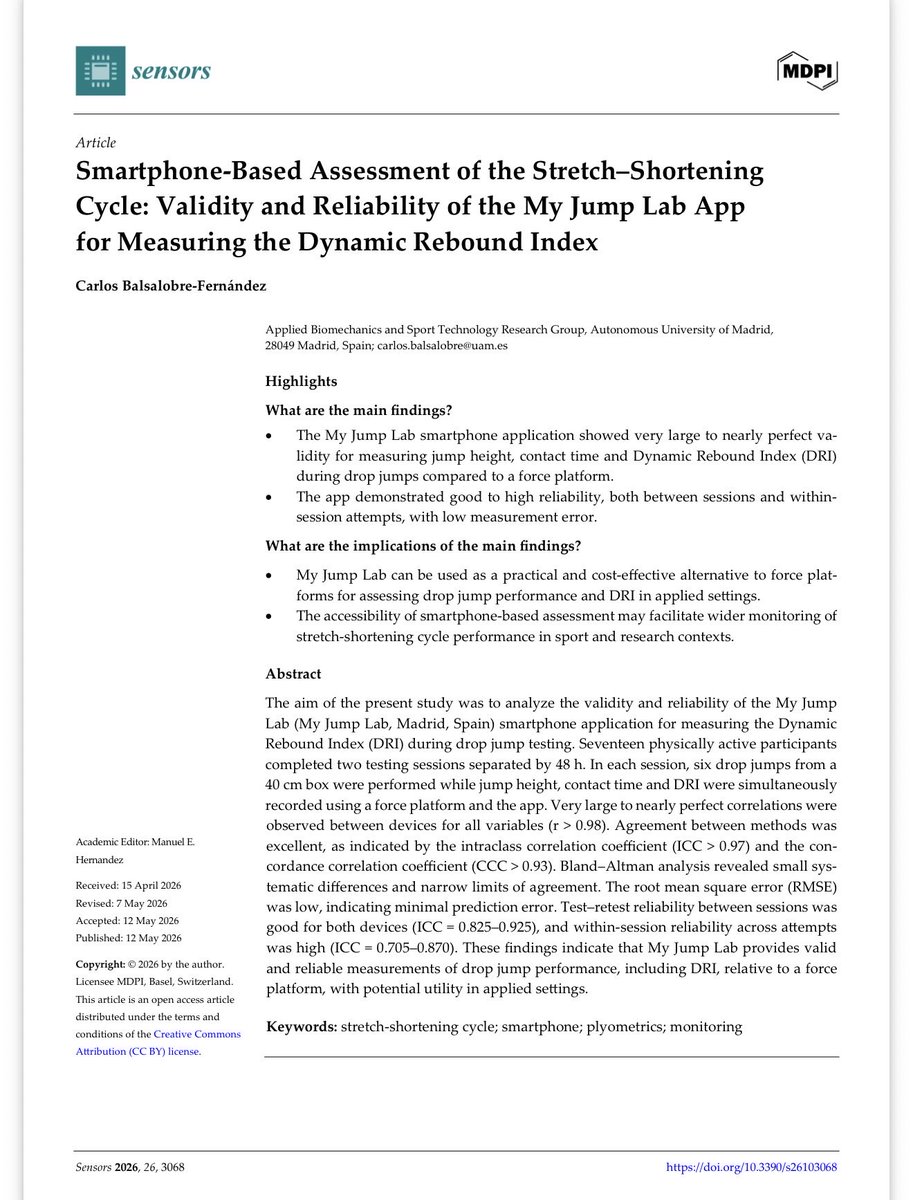
🚨New paper
Validity & reliability of @myjumplab for assessing the Dynamic Rebound Index during drop jumps.
Results vs force platform:
• Jump height: r=0.994
• Contact time: r=0.987
• DRI: r=0.979
🔗Full text: https://t.co/BVSFPOcu6Z
Stiffer runners are typically more economical. But there isn't a universal optimum.
Masson et al. (2026) synthesized peer-reviewed research on stiffness and running through March 2025, covering four scales: whole-body, joint, muscle-tendon, and tissue.
A pooled analysis linked higher whole-body stiffness to better running economy. In one study, plantar-flexor tendon stiffness correlated with 5000 m time at r = 0.76 (Kubo et al., 2010). The most economical runners had a stronger calf and a stiffer Achilles tendon.
The catch: runners naturally settle on a stiffness level that follows an inverted-U curve. Too low and too high are both detrimental. The authors note that an "individually defined optimal stiffness" hasn't been systematically researched.
What moves the needle:
Two 14-week studies of combined strength and endurance training reported stronger triceps surae, higher Achilles tendon stiffness, and better economy. Plyometric programs of 6 to 8 weeks improved economy alongside tendon stiffness gains.
For warm-ups: a plyometric warm-up improved economy. The change tracked an increase in leg stiffness. In male well-trained runners, static stretching before a run was linked to worse economy and a shorter 30-min run distance. The same protocol didn't change economy in female runners.
The honest answer: skip long static stretching before quality work. Use strides or short plyometrics. And don't chase "stiffer at all costs."
Huge thanks to Masson, Millet, and Kerhervé for this work.
Reference: https://t.co/wQDTp2R5fW
Follow for more research breakdowns.
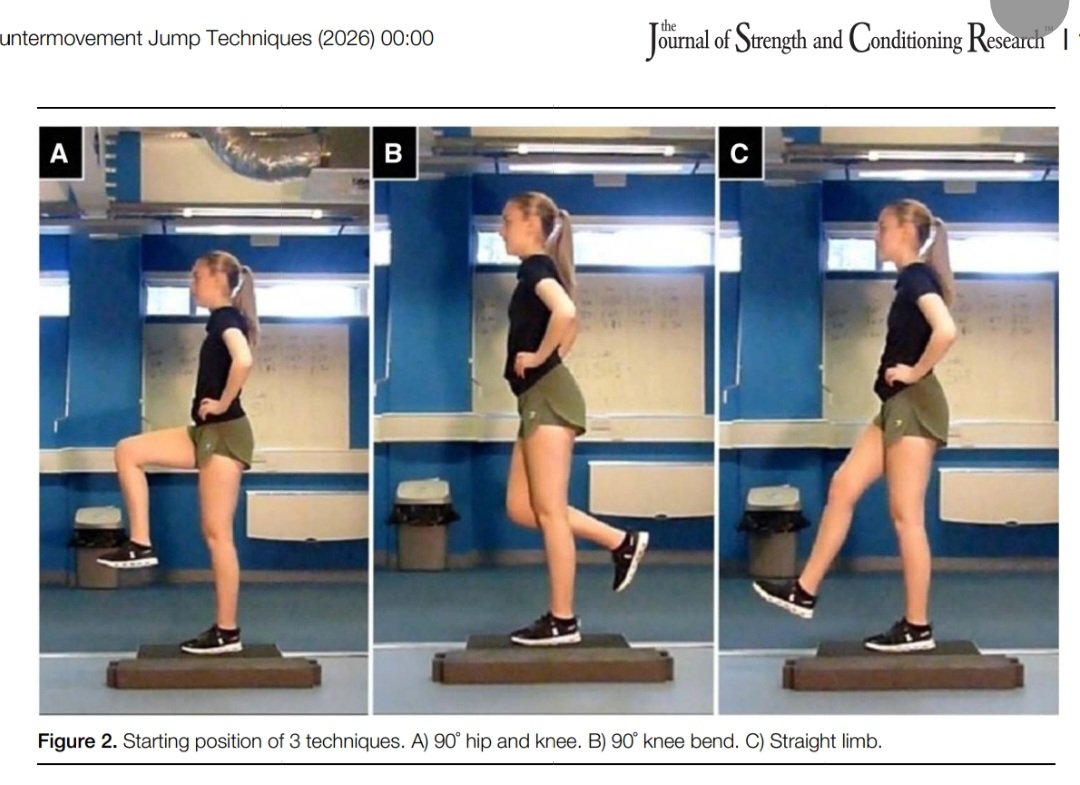
Single Leg CMJ methodology
Comparison of 4 SL-CMJ techniques differing in free-leg position:
A=90° hip & knee
B= 90° knee bend
C= Straight leg
D= Unrestricted limb
Technique choice significantly affects performance and reliability
Clear need for standardization
More 👇👇