MIT just made every AI company's billion dollar bet look embarrassing.
They solved AI memory. Not by building a bigger brain. By teaching it how to read.
The paper dropped on December 31, 2025. Three MIT CSAIL researchers. One idea so obvious it hurts. And a result that makes five years of context window arms racing look like the wrong war entirely.
Here is the problem nobody solved.
Every AI model on the planet has a hard ceiling. A context window. The maximum amount of text it can hold in working memory at once. Cross that line and something ugly happens — something researchers have a clinical name for.
Context rot.
The more you pack into an AI's context, the worse it performs on everything already inside it. Facts blur. Information buried in the middle vanishes. The model does not become more capable as you feed it more. It becomes more confused. You give it your entire codebase and it forgets what it read three files ago. You hand it a 500-page legal document and it loses the clause from page 12 by the time it reaches page 400.
So the industry built a workaround. RAG. Retrieval Augmented Generation. Chop the document into chunks. Store them in a database. Retrieve the relevant ones when needed.
It was always a compromise dressed up as a solution.
The retriever guesses which chunks matter before the AI has read anything. If it guesses wrong — and it does, constantly — the AI never sees the information it needed. The act of chunking destroys every relationship between distant paragraphs. The full picture gets shredded into fragments that the AI then tries to reassemble blindfolded.
Two bad options. One broken industry. Three MIT researchers and a deadline of December 31st.
Here is what they built.
Stop putting the document in the AI's memory at all.
That is the entire idea. That is the breakthrough. Store the document as a Python variable outside the AI's context window entirely. Tell the AI the variable exists and how big it is. Then get out of the way.
When you ask a question, the AI does not try to remember anything. It behaves like a human expert dropped into a library with a computer. It writes code. It searches the document with regular expressions. It slices to the exact section it needs. It scans the structure. It navigates. It finds precisely what is relevant and pulls only that into its active window.
Then it does something that makes this recursive.
When the AI finds relevant material, it spawns smaller sub-AI instances to read and analyze those sections in parallel. Each one focused. Each one fast. Each one reporting back. The root AI synthesizes everything and produces an answer.
No summarization. No deletion. No information loss. No decay. Every byte of the original document remains intact, accessible, and queryable for as long as you need it.
Now here are the numbers.
Standard frontier models on the hardest long-context reasoning benchmarks: scores near zero. Complete collapse. GPT-5 on a benchmark requiring it to track complex code history beyond 75,000 tokens — could not solve even 10% of problems.
RLMs on the same benchmarks: solved them. Dramatically. Double-digit percentage gains over every alternative approach. Successfully handling inputs up to 10 million tokens — 100 times beyond a model's native context window.
Cost per query: comparable to or cheaper than standard massive context calls.
Read that again. One hundred times the context. Better answers. Same price.
The timeline of the arms race makes this sting harder. GPT-3 in 2020: 4,000 tokens. GPT-4: 32,000. Claude 3: 200,000. Gemini: 1 million. Gemini 2: 2 million. Every generation, every company, billions of dollars spent, all betting on the same assumption.
More context equals better performance.
MIT just proved that assumption was wrong the entire time.
Not slightly wrong. Fundamentally wrong. The entire premise of the last five years of context window research — that the solution to AI memory was a bigger window — was the wrong answer to the wrong question.
The right question was never how much can you force an AI to hold in its head.
It was whether you could teach an AI to know where to look.
A human expert handed a 10,000-page archive does not read all 10,000 pages before answering your question. They navigate. They search. They find the relevant section, read it deeply, and synthesize the answer.
RLMs are the first AI architecture that works the same way.
The code is open source. On GitHub right now. Free. No license fees. No API costs. Drop it in as a replacement for your existing LLM API calls and your application does not even notice the difference — except that it suddenly works on inputs it used to fail on entirely.
Prime Intellect — one of the leading AI research labs in the space — has already called RLMs a major research focus and described what comes next: teaching models to manage their own context through reinforcement learning, enabling agents to solve tasks spanning not hours, but weeks and months.
The context window wars are over.
MIT won them by walking away from the battlefield.
Source: Zhang, Kraska, Khattab · MIT CSAIL · arXiv:2512.24601
Paper: https://t.co/n8mGRG6awi
GitHub: https://t.co/TICtCUKxtm
The reason I went all-in into altcoins is quite simple: this is the final window of opportunity for excessive returns on assets.
They've been presented through the commodity and energy sectors.
Now, it's semiconductors.
The moment #Bitcoin breaks through $90-100K, Bitcoin's valuation will likely go way higher than most of us expect it to go.
That's always how markets behave. During excessive bear markets, nobody believes the markets to turn around and they undervalue the upside.
The moment Bitcoin breaks that crucial resistance level, psychologically, the money will start to flood into the crypto markets and retail, and essentially any investor, will be looking for higher yields than Bitcoin alone.
The same old game happens again, where we'll see excessive returns in altcoins in 2027-2028. Perhaps later this year.
That ride is the ride to change your life, and that's the one I'm betting on as we're likely going to face a big financial crisis after that.
Dihadi artists like Zakir Khan,Kullu make their money by milking middleclass dehati tier 2 city humour,"sakth launda",misogynist jokes,mocking posh urban metro culture&when they get rich the first thing they do is to fit into the same high culture they mocked to become successful
For those who did not understand what I mean by my assets I use to protect my wealth. XRP/Bitcion/insurance/silver. Yes I still hold other assets some are speculative as I state all time. Here is the break down for you.
XRP 43%
Bitcoin 40%
WLFI 4%
SOL 3.7%
XLM HBAR, Vechain make up the rest.
I will always be transparent on what I hold.
Much love.
Only the alts can save crypto:
That is where the innovation is, as we need the capacity & speed!
That is where the usage is, as crypto needs fees to pay for decentralization, security & scarcity
That is why the alts will win it all, as economics drives all that we care about!
Crypto is still the opportunity of a lifetime if you can understand the currents!
As only decentralized, scalable, & private chains make this dream a reality
Crypto will replace all of finance & even money itself!
All we have to do is pick the winners for the grand prize: 🧵
That is what makes the future so aligned with the cypherpunk dream: The incentives lead to freedom. That is always what made crypto such a great & worthy endeavor for us to spend our time on
Crypto has made it; it is not going away. Despite the industry being barely recognizable anymore from the old days, when it was just a bunch of fringe revolutionaries trying to change the world
Do I miss those days? Sure, I do. However, we always knew that if crypto were to truly succeed, it would not be able to remain a niche; it had to go mainstream
Today, crypto is corporate & highly institutional, whether we like it or not, that is what crypto's success looks like
As long as we can enshrine the core primitives that made this entire movement worthwhile in the first place, then we have still won:
Decentralization
This can be a contentious issue, as people often treat decentralization as a binary, when in reality it is a complex spectrum with multiple factors that nobody even weights the same
That makes arguments around decentralization often devolve into religiosity, when in reality it can be approached scientifically & objectively:
By measuring various factors, such as stake distribution, Nakamoto Coefficient, validator count, governance design, client distribution, politics, consensus architecture & more
Scalability
Crypto is pointless without decentralization & useless without scalability. We need both attributes to make a real difference
Programmability is also essential, as what is good decentralized money without good decentralized finance to support it?
We see that in BTC, the only way yield can be earned on BTC is to leave the security of BTC's network, most often forcing users into a centralized custodian or much less secure setups
That is how programmability in the form of a Turing-complete Virtual Machine becomes a critical component for any blockchain's success
When we have decentralized scalability & programmability, privacy is also unlocked:
Privacy
Privacy does not need to be built on the L1 directly. Smart contracts deployed on top can do the same thing, think of protocols like Tornado Cash, Railgun, Privacy Cash & Arcium as prominent examples of that today
Making privacy optional is ideal. Not only because we want transparency from larger institutions, but also because the scalability requirements for default privacy are too high to support global finance
That is why having spot & perp markets remain transparent is also preferable to going entirely dark. As individual users can still anonymize & break links in & out of such markets. While most of commerce involving normal people can remain fully private
Helping to strike a healthy middle ground in terms of the engineering trade-offs, while the fee market takes care of prioritization organically & fairly
Crossing The Rubicon
There is now no doubt that crypto will continue to play a more prominent role in the world. Even banks & governments are on board, the very types of institutions crypto was meant to fight
That is still the case; however, these organizations correctly recognize that the best way to remain relevant is to go along rather than continue fighting this latest wave of technological innovation. While also legitimately seeing the benefits for everyone involved!
Compromise
There lies crypto's next greatest challenge: Not to let the watering down of crypto be taken too far
There is a healthy middle ground between compromising too much & too little
Strategically, remaining a staunch niche with a few thousand cypherpunks running nodes on Raspberry Pi's for an unscalable chain out of their basements is not a formula for success
However, neither is accepting chains like Ripple, Tempo & Canton, which are straight-up permissioned!
Conclusion
Navigating these currents successfully is a real challenge, as it depends on having the correct thesis about the future of crypto & the world
Something we have consistently done over at @cybercapital since I founded the company in 2016. Having started my own crypto journey in 2013
The market might seem depressed now, but the fundamentals have never been stronger
As a value investor & a cypherpunk. High revenue & high usage on scalable, decentralized & permissionless blockchain is what gets me the most excited today
That is what success looks like, not self-congratulatory speeches or ad nauseam virtue-signaling about why XYZ community is morally superior to another...
Crypto has come this far by doing, changing the world through the utility it offers people. That is still where crypto's edge lies. That is why SOL & HYPE are paradoxically more cypherpunk than BTC & ETH today!
When advancing the cypherpunk dream depends on adoption, offering a better product becomes the only way to make that dream a reality! 🔥
Crypto is paying a high price for years of altcoin scams and grifts. It can feel like a toxic industry where very little value is created.
It's easy to feel disillusioned and wish you were focusing on AI-related trading, businesses, or working at a startup in that sector. Many companies and investment firms have already begun the rotation out of Crypto. Don't let your apathy make you unproductive; it's your personal responsibility to continue learning about the world. If you feel the call of the wild, then go.
For the ones brave enough to stick around, not only will the risk-reward be as asymmetric as it's been in recent history, the concentration of upside in a handful of assets will make it EASIER to generate massive returns. There is less capital looking at Crypto exposure than ever before. This all changes with a rapid repricing in Bitcoin this year, which I believe is inevitable.
For a long time in Crypto, nothing felt buyable due to an excess of capital being forced to deploy in a sector with limited opportunity. We're in a new regime now.
We're reaching a similar level of apathy that I felt during 2019 and 2022. I almost quit Crypto to go back to TradFi. It's no surprise those were the years where I generated the bulk of my returns (sans Hyperliquid).
Outside of trading, if you're passionate about the space, companies that are still building during this period will be positioned to take advantage of the inevitable reacceleration of this industry. Working at top-tier companies in the space is more accessible than ever due to a shortage of people entering the field.
Don't undervalue your time.
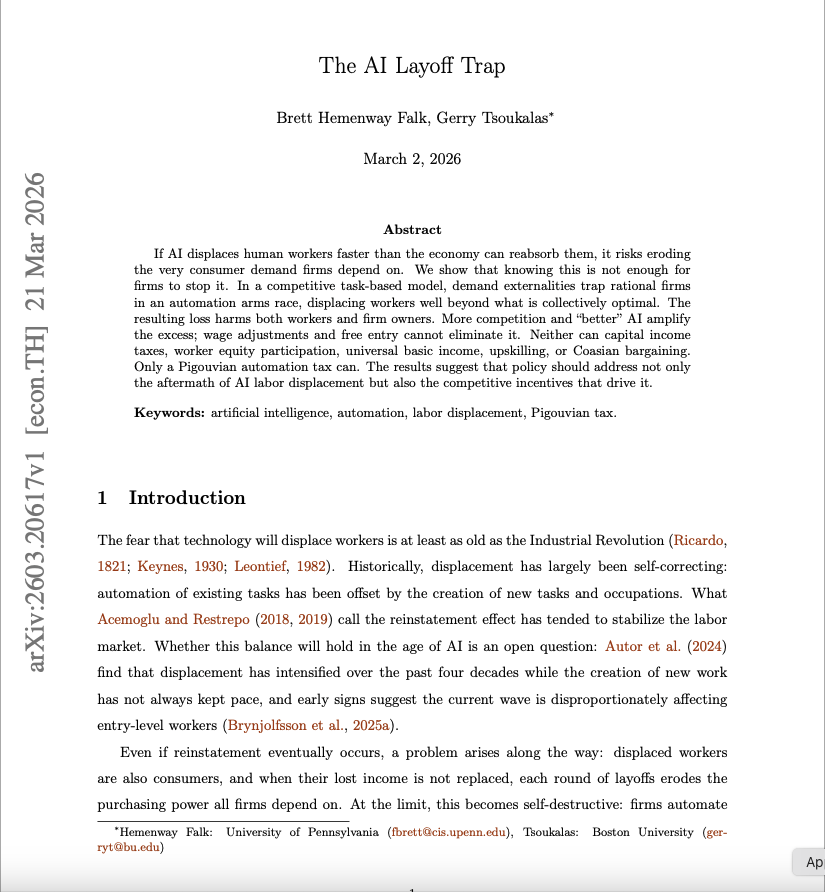
Two economists just published a mathematical proof that AI will destroy the economy.
Not might. Not could. Will — if nothing changes.
The paper is called "The AI Layoff Trap." Published March 2, 2026. Wharton School, University of Pennsylvania. Boston University. Peer reviewed. Mathematically modeled.
The conclusion is one sentence.
"At the limit, firms automate their way to boundless productivity and zero demand."
An economy that produces everything. And sells it to nobody.
Here is how you get there.
A company fires 500 workers and replaces them with AI. A competitor fires 700 to keep up. Another fires 1,000. Every company is behaving rationally. Every company is following the incentives correctly. And every company is building a trap for itself.
Because the workers who were fired were also customers.
When they lose their jobs faster than the economy can absorb them, they stop spending. Consumer demand falls. Companies respond by cutting costs — which means automating more workers — which means less spending — which means more falling demand — which means more automation.
The loop has no natural exit.
The researchers tested every proposed solution. Universal basic income. Capital income taxes. Worker equity participation. Upskilling programs. Corporate coordination agreements.
Every single one failed in the model.
The only intervention that worked: a Pigouvian automation tax — a per-task levy charged every time a company replaces a human with AI, forcing them to price in the demand they are destroying before they pull the trigger.
No government has implemented this. No major economy is seriously discussing it.
Meanwhile the numbers are already tracking the curve. 100,000 tech workers laid off in 2025. 92,000 more in the first months of 2026. Jack Dorsey fired half of Block's workforce and said publicly: "Within the next year, the majority of companies will reach the same conclusion."
Nobody is doing anything wrong. Companies are following their incentives perfectly. That is exactly the problem.
Rational behavior. At scale. Simultaneously. With no mechanism to stop it.
Two economists built the math. The math leads to one place.
Source: Falk & Tsoukalas · Wharton School + Boston University ·
https://t.co/4m8E9jQNYm
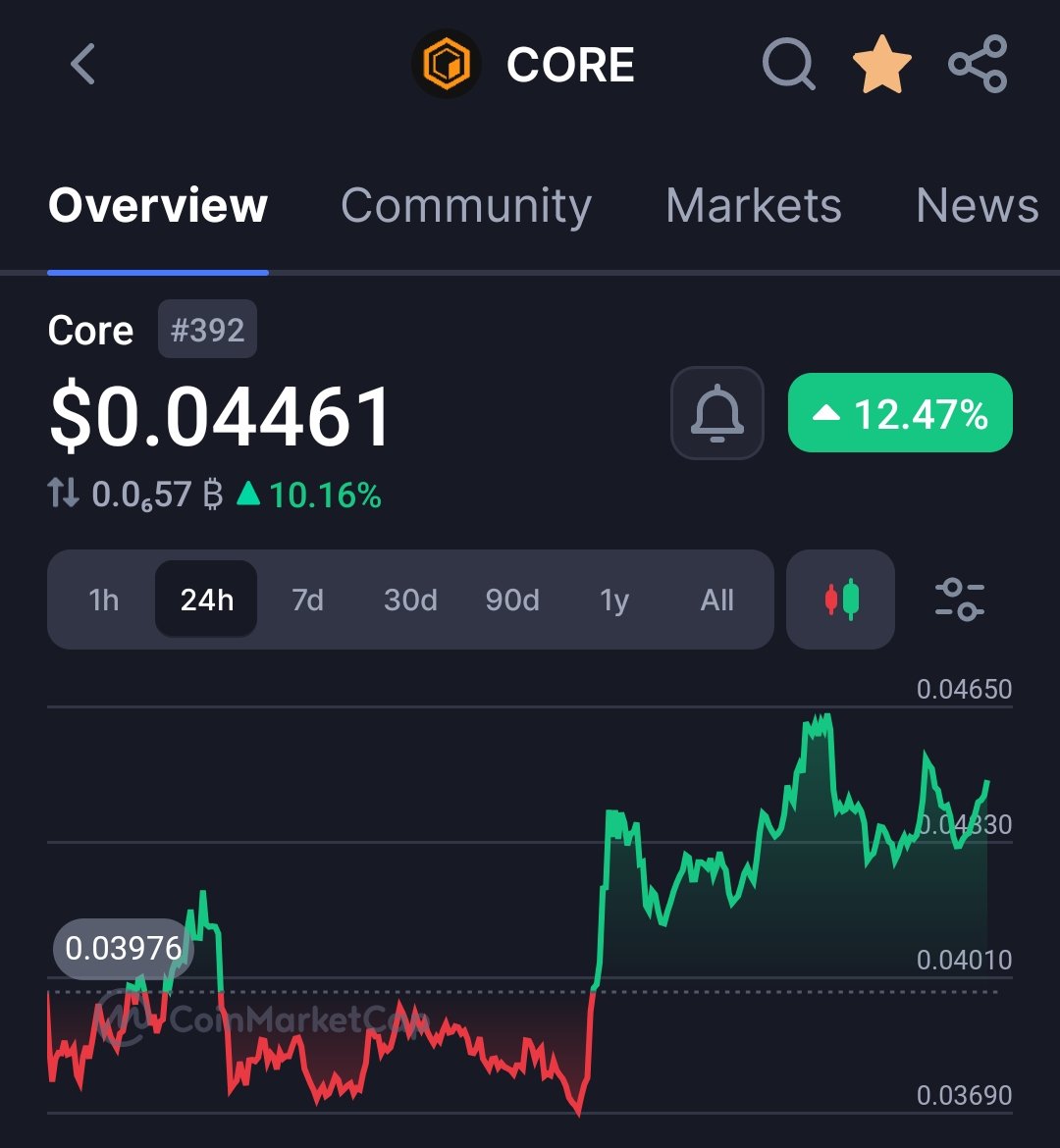
Just secured more $CORE — glad we got out of the $ION scam in time.
Now shifting focus toward $PI and $CORE, and planning to add a few more solid, genuine projects soon.