want to hear another ghost story?? "our model escape the test env" + whatever the next PR move is...feels like Microsoft in the 90s going “yeah we’re building an internet portal too”
Technological progress increases the informational efficiency of the cognitive process. it reduces the weight of old skills and concentrates value on more informative and inferential capabilities. it is like moving from the accumulation of observations to the search for sufficient statistics and efficient estimators, that is, ways of extracting more useful information with less redundancy
Thalatta! Thalatta! Out of Ammo!
The CFR report recommends that the DOD establish “more concrete pathways for information sharing and technology diffusion with the Ukrainian defense industry.”
interesting stuff from KB. Asia FR-4 1.55mm 18/18 now >RMB400/sheet. A realistic EMEA price could exceed €55/m² before the end of 2026, with US pricing even higher due to tariffs.
The anti-datacenter psychosis sweeping through both sides of our national politics might be the worst mass movement I've seen in my lifetime. The magnitude of lies underpinning it, the threat it poses to our economy and civilization, and the sheer scale of its popularity are totally unprecedented. It should be an enduring national shame that the country that invented the airplane, landed on the Moon, and created the Internet is descending into superstitious panic at the very moment growth matters most
from the union workers:
the American dream requires growth and production, not just redistribution
AI and energy are the economy’s productivity and growth engine. to be anti-datacenter is to be anti-labor
Michael Hartnett is 100% right. If Trump loses the Senate in the midterms, the NASDAQ will crash hard. At this point, the Senate is the GOP’s only real battleground.
“Data centers represent the best opportunity in generations for blue-collar workers to attain a portion of the American dream. A decade ago, members of my union, the International Brotherhood of Electrical Workers Local 26, in the Washington, D.C., region, worked about 14 million hours annually. In 2025, we worked 28 million hours, and we’ll most likely top 33 million hours this year. We brought in 600 new apprentices last year alone. That job growth happened because data centers came to Northern Virginia and our members went to work constructing and maintaining them.”
https://t.co/5OOATgxWo3
@chadwahl This will test the real IT/hardware spending of non-tech ((mid/large)) companies. Just kidding. but there’s always been a lot of shit in that category over the years
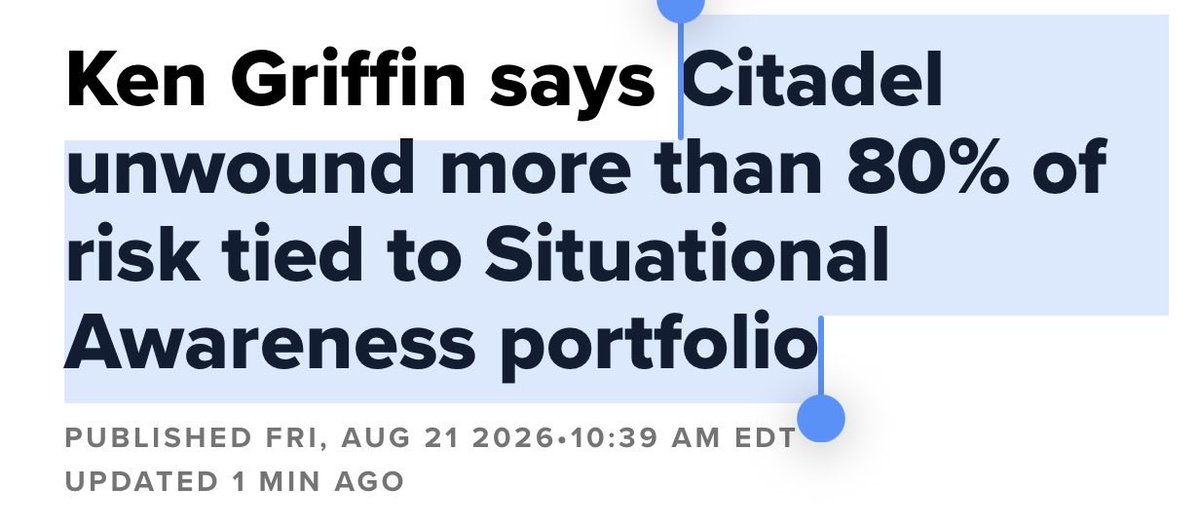
Uhh Citadel?
> Say emergency rate hike. More crashes/liquidations follow
> No rate hike
> Reaches out to buy liquidated hedge fund portfolios
> buys billions of Situational Awareness holdings.
> Says AI bull case is intact
>markets rally
> Sells AI stocks into the buying pressure
I’m just stating the timeline here…
this is basic feature of corporate finance btw. some people do this for a living! any competent analyst already knows they exist & why:: & that's why disclosure and recognition are different concepts. Tbh the nominal $3T isn’t the point either. the gross commitment is not hidden debt. the thing is that you can have less debt below EV but lower EBITDA/FCF above it; are those future payments properly reflected in forward cash flows??
AI Is Not a Product Cycle
The AI bears have a simple story: demand is not there, while the industry is building far too much capacity.
Their latest exhibit is Big Tech’s roughly $ 3T of commitments for chips, data centres, power and leases. Because those items appear in SEC-filing footnotes rather than as current balance-sheet liabilities, they are presented as evidence of hidden excess and impending financial distress.
This is sloppy. An obligation disclosed in an SEC filing is not hidden. It is disclosed. Nor is an item kept off the balance sheet under prevailing accounting rules automatically a concealed liability, an accounting abuse or a fraud. A future purchase commitment is not a bond coming due. An uncommenced lease is not unpaid debt. Calling everything “off balance sheet” is a useful way to make a large number sound sinister. It is not analysis.
The question is straightforward: can these companies meet their obligations if AI demand weakens? That requires examining liquidity, payment schedules, termination rights, repricing provisions, asset redeployment, customer revenues and operating cash flow. A $ 3T gross number answers none of these questions.
The danger, if there is one, is not in a footnote. It is in a funding cascade: contracts that cannot be deferred or reassigned, capacity that cannot be sold, and cash flows that no longer cover commitments. Show that mechanism.
Show that the contracts are take-or-pay. Show utilisation is falling, prices are collapsing, enterprise adoption is stalling, or AI revenues are failing to cover the infrastructure bill.
Until then, the bear case depends on one assertion: perhaps AI demand will not materialise.
That is an unfalsifiable counterfactual, not an investment thesis. It cannot be disproved as stated because it provides no timeframe, measurable benchmark or identified constraint.
It merely shifts the burden of proof: rather than demonstrate that demand is deteriorating, it demands that investors prove a demand shortfall can never occur.
Any emerging technology can be made to look reckless under that standard. The burden should instead sit with those predicting a bust. They should identify the source of it: falling utilisation, collapsing compute prices, slowing adoption, weak AI revenue or a real economic limit on the work AI can perform.
The implicit claim is more radical still: that the global economy is nearing saturation in its demand for compute. Governments have automated enough. Industry has extracted the available efficiencies. Businesses have delegated the tasks worth delegating. Consumers have discovered all the value they will find in cheap, programmable intelligence.
This is not scepticism. It is an astonishingly confident forecast of technological exhaustion.
AI is not a product cycle. It is the construction of an infrastructure layer for programmable intelligence. A chatbot is constrained by human attention. An agent is constrained by the scale of global economic activity.
Compute is becoming a utility. The $ 3T is not proof that the world has bought too much intelligence. It is proof that it is preparing to use far more.
AI will be a culture war. Old America would have won it. not sure today’s America does. & it sure won’t be won with PR. AHAH the fact you even think it can be says everything
AI companies should learn what Mamdani already understands:
The most tried and true PR tactic is just give people stuff
Julius Caesar’s feasts, Rockefeller’s dimes, the Marshall Plan, Oprah’s favorite things, Starlink on United - works every time
Labs and datacenters should build parks, subsidize bills, hold a cookout, sponsor fieldtrips
Companies are spending way more on marketing and lobbying that backfires half the time. Just give people stuff