I'll be speaking at Charlotte Regional Biomedical Sciences Symposium 2026: Collaborations Driving Innovations for Impact on Sep 14 - 14, 2026. I would love to see you there!🎉🎉
Register here: https://t.co/ZA1JIGfOGw
- via #Whova Event Platform
https://t.co/0V8tKmbxvT
Academia cannot be reformed until the PhD has standards again.
The degree should be reserved for the relatively few candidates whose dissertations create important new knowledge - not awarded as a certificate of persistence to nearly everyone who remains in a program long enough.
A system with meaningful standards must permit meaningful failure. Candidates who are unlikely to make a substantial original contribution should be identified early, given a respectable off-ramp, and allowed to enter the job market years sooner.
This would reduce the oversupply of PhDs competing for a tiny number of academic positions and grants. With fewer people trapped in that cutthroat competition, academia would reward fewer of the behaviors produced by desperation and scarcity.
Companies accustomed to an abundant supply of PhD applicants would also have to recruit from the larger pool of capable people who left doctoral programs without the degree. The skills would remain valuable; only the credential would become scarce.
If the PhD once again signified exceptional scholarly, it would resolve many of academia’s current pathologies.
“Spatial Organization of Epigenetic Information by Phase Separation” presented by Xiaojun (XJ) Ren, Ph.D. on Tuesday, April 21, 2026 – 11:00 am – 12:00 pm
1131 Bioinformatics Host: Jill Dowen
Join us for our last seminar of the Spring semester.
It is so nice to see our Molecular Cell paper is out today! Thanks for my students and collaborators. Without you, this is impossible. Thanks for all reviewers! Your constructive comments make the paper much better!!!
Online Now: Self-clustering of three CBX2 molecules drives PRC2 to promote facultative heterochromatinization of Polycomb target genes https://t.co/YHi8dr6Lmg
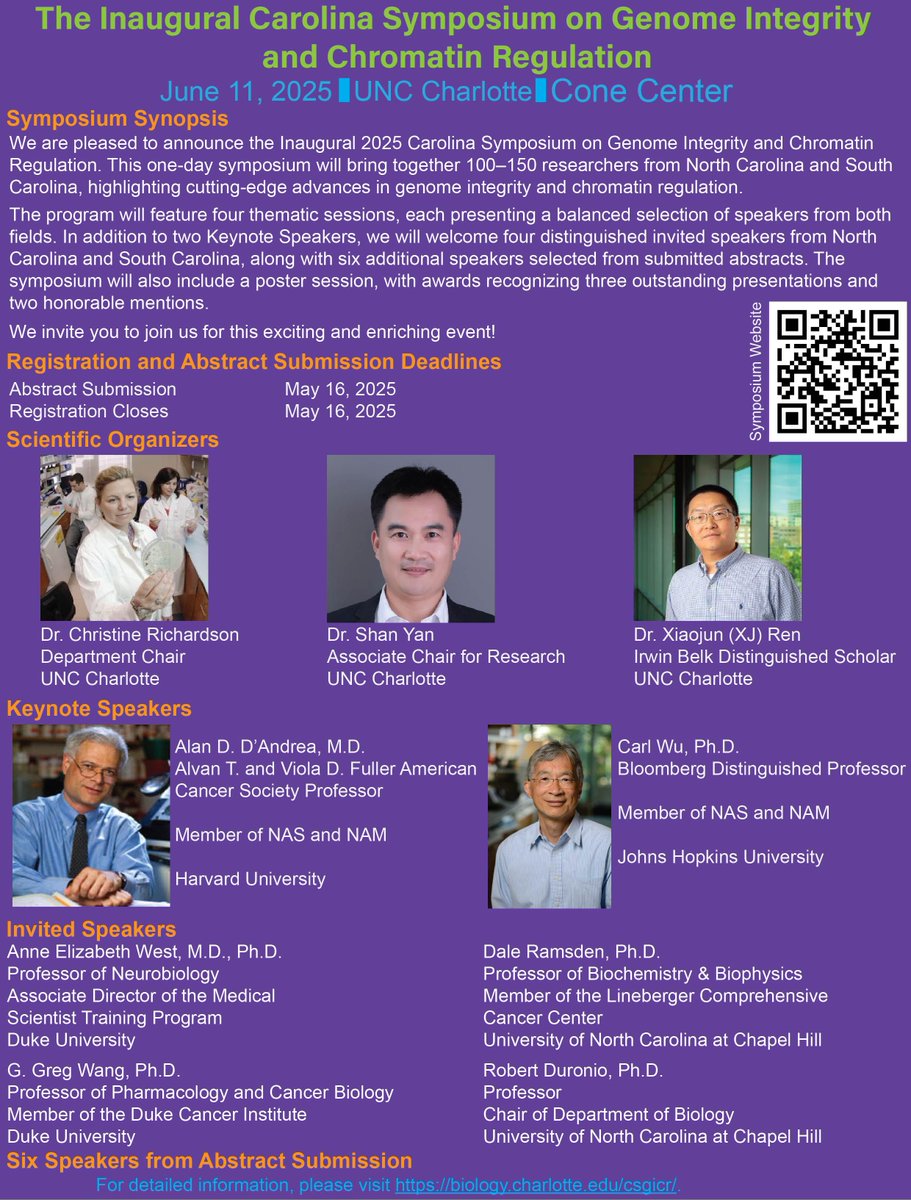
We are pleased to announce the Inaugural 2025 Carolina Symposium on Genome Integrity and Chromatin Regulation on June 11, 2025 @unccharlotte
Free registration, abstract for talk/poster:
https://t.co/ZZpqYeSmg1
Really excited to unveil https://t.co/3DKXXBuxFD, an interactive playground for learning bioinformatics command-line tools like bedtools, bowtie2, and samtools (and more to come!) 🧑💻 🧬
Thanks to @aaronquinlan, @BenLangmead, and @mike_schatz for feedback and tutorial ideas.