Flare Smart Accounts v1.3 is live☀️
XRP to curated vaults, now one signature on XRPL.
Pick a vault, sign once from the wallet you already own. FSA does the rest on @FlareNetworks: mint, deposit, earn.
No separate EVM wallet. No gas token. No manual bridging.
One signature. Non-custodial. XRPFi for all.
🔗 https://t.co/bIfCPEwa8o
History will remember this as the moment a president chose a higher standard of ethics than the law required of him. This agreement bans ALL federal officials — including the President — from issuing or sponsoring a digital asset for profit, with real enforcement and real penalties.
Thank you, @POTUS! Let's get the Clarity Act passed NOW.
A historic moment for crypto.
Kraken Financial has been granted a Federal Reserve master account, making us the first digital asset bank with direct access to the U.S. payments system.
A major step toward connecting crypto infrastructure with the core rails of global finance.
https://t.co/yVgwuJDZge
"Ripple has 300+ bank partnerships, but after 13 years, shouldn't there be billions in daily on-chain volume?"
I think there are a number of reasons why institutions have historically preferred to use digital assets off chain rather than on chain. I think we're close to changing that because institutions are starting to see the benefits of moving on chain. But I agree it has been very slow. Even Ripple can't use the XRPL DEX for payments yet because we can't be sure a terrorist won't provide the liquditity for payment. Features like permissioned domains will address this.
"If XRP is volatile, why use it over stablecoins for transfers?"
There are use cases where volatility isn't a minus, or is even a plus. Generally, for most digital assets the general view is that the upside is worth more than the downside, so as long as you aren't very risk averse, holding it is not really a disadvantage.
"If volatility is not an issue because it’s a bridge currency, what is the incentive to hold it?"
A bridge currency only works if someone is holding it so that you can get it precisely when you need it. But I think that in practice if you don't know what asset you will need to hold next, you may hold the dominant bridge currency because it should be cheaper to exchange into whatever you happen to need next.
"Are bridge currencies still necessary when stablecoins will cover most pairs in the future?"
If one stablecoin wins, then no. You would just use that stablecoin as the bridge currency. But I don't think one stablecoin can win for several reasons, including that a stablecoin can only be stable relative to one particular fiat currency and will always have jurisdictional ties. If we're in a multi-stablecoin world, it still makes sense to have a bridge asset that serves the long tail of tokenized securities, loan portfolios, and so on.
"Why would giants like BlackRock use XRPL for tokenization instead of building their own blockchain? (Robinhood uses Arbitrum and plans their own)"
I'm not sure how much that will really matter so long as we have interoperability and asset portability. Multiple chains are a good form of scalability as well. But I think the best way to see why they might is to ask the same question about Circle -- why don't they launch USDC only on their own blockchain? You can see why that's obviously silly. I think the same kind of logic will apply to tokenized real world assets over the next year or two.
"Geopolitical risk. Why would foreign countries trust a US based private company payment network?"
If you're asking about XRPL, it's not really US based. It has never discriminated against any particular participant and if it ever started to, I would hope people would stop using it. If you mean Ripple's enterprise payment products, we have separately licensed entities in many jurisdictions. But obviously, you're not going to see it in North Korea or Cuba any time soon and their might be, in some cases, pushback to a US company having some control over, say, payments between Pakistan and Saudi Arabia. We build trust and we make hay where the sun shines.
🚨 Just read about a phenomenon I can't stop thinking about:
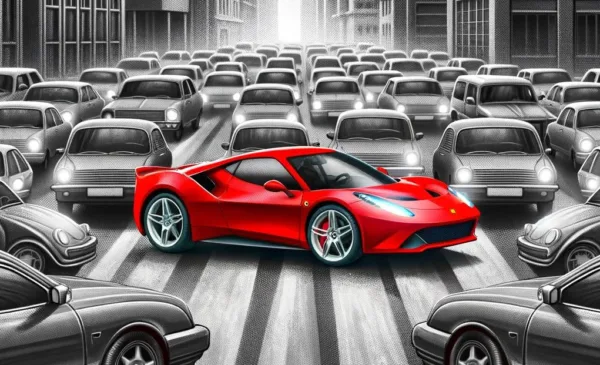
"The Red Car Theory"
Once you understand it, you'll see it EVERYWHERE.
And it will change how you view reality forever.
Here's why: 🧵
At one point in my life, I was personally close to someone whose professional role was to record the official minutes of meetings involving senior executives from central banks and the largest commercial banks. These were formal sessions. Nothing casual. Every statement was intentional and every conclusion documented. Those rooms were where future financial infrastructure was shaped quietly.
Through that proximity, and through my own background in markets, I gained a rare vantage point. What became clear over time was that the debate was no longer about whether blockchain based settlement would be used. That question had already been answered. The unresolved issue was identity, credentialing, and compliance. Without those, no system could ever be trusted at scale.
When representatives from Ripple entered those discussions, the emphasis shifted. The XRP Ledger was not positioned simply as a faster payments rail. It was positioned as a foundation where identity and verifiable credentials could live directly on ledger. That mattered. It addressed the final institutional objection. Settlement without identity is unusable. Settlement with embedded identity becomes infrastructure.
From what I understood then, and still believe now, that was the final gate before a phased transition of global finance and trade could begin. Controlled. Auditable. Regulator aligned.
I am aware this perspective carries sensitivity. But I also speak as someone who has already made enough money by identifying structural shifts early and positioning accordingly. I no longer chase narratives. I look for inevitabilities.
Identity and credential infrastructure is the next major one. There are two clear contenders operating at the level regulators and global banks require. I will not name them. Many of you already know exactly who they are. I am positioned in both.
Some of you have told me that my earlier insights, while accurate, were not always actionable. I’ve taken that on board. That is why I am sharing this now. This is an actionable insight. Whether you act on it or not is entirely up to you.
I’ve already shared far more detail on Telegram than anywhere else.
That channel is where I speak freely before I take this private.
Before any actual Ripple documents or NDAs are discussed, everything moves off public timelines.
If you want the full context before it disappears, you know where to go.
Follow me on Telegram.
Link in bio.
70-year cancer survivor Keith drops a powerful claim: "Cancer cells have ONLY two fuel sources—glucose and glutamine. Cut them off, and tumors starve."
Glucose: From added sugars, simple carbs (bread, pasta, junk food).
Glutamine: Body makes it + in healthy foods—but disrupt cancer's uptake with green tea, mushrooms, turmeric, moringa, and fermented foods (like sauerkraut).
He's reversed all 5 of his chronic diseases without meds, studying 4,000+ papers on epigenetics (lifestyle controlling gene expression).
Watch this eye-opening 1:11 clip.
Starving cancer metabolically: Promising science or oversimplification? Tried these foods for health? Thoughts below—let's discuss respectfully.