Announcing @rox_ai just hit a $1.3B valuation, only 12 months after launch.
@generalcatalyst and @MarchCPs co-led our Series B, joined by @sequoia, @databricks Ventures, @p7ventures, Factory, and others.
We created the Revenue Agent category to help the world's most consequential enterprises grow revenue with agents.
Today, our customers have closed over $7.5 billion in revenue since partnering with Rox.
Our core is the Global 2000: dozens of large public companies across medical devices, manufacturing and financial services.
CEOs are using Rox and rolling it our across their revenue teams. We’re building AI for the real economy, not just tech.
Since launch:
- ARR up 10x
- 25x customer ROI within months
- 700%+ NRR across enterprise accounts
So what is a Revenue Agent?
It’s an AI agent that finds, wins and grows every revenue opportunity for you behind the scenes.
Soon you’ll tell Rox “Generate $50M in opportunities” and it will figure out how.
In practice:
- Fortune 500 medical devices company: Rox finds rural hospitals with new funding and preps everything reps need to win, down to the joint funding proposal. That’s $200M in pipeline and $24M closed-won in months.
- Top-3 US payroll provider: Rox reaches millions of small businesses, like your local pizza shop. Reps just show up to the meeting, and winning a customer now costs 80% less.
- Global IT services business: $300M+ in qualified pipeline in 8 weeks.
All of this is built on our elite applied AI team of ~50 researchers in SF. Nobody else has a team like it.
Gartner named us the only Visionary in the 2026 Gartner® Magic Quadrant™ for Revenue Action Orchestration.
We’re the fastest-growing company in GTM, with the highest ROI of any AI spend.
With this round, we’re doubling down on our mission:
Accelerating the world's revenue.
Learn more: https://t.co/sG9j562MZl
A few weeks ago we shared our research on evals with @cognition & @braintrust. Now meet the team that built it:
@gopalkgoel1, @XuBriGuy, and @AksharSarvesh share how our production traces become evals automatically.
If problems like this excite you, we’re hiring: https://t.co/qs7neUoy7b
It’s great to be bitter lesson pilled!
We realized this several months back and rewrote our entire Rox agent harness- we designed around models getting 10x smarter and switched to simple declarative tools over imperative workflows.
Better on evals and simpler to reason over!
Anthropic is now recommending that companies REMOVE unnecessary subagents from their AI systems.
This is a pretty significant shift in agent architecture, with their team finding that a single agent equipped with skills can frequently outperform complex multi-agent systems, and one customer seeing roughly 2x faster execution.
The emerging rules of thumb:
→ Skills: Teach the agent HOW to do something, including procedures, expertise, and instructions.
→ Tools / MCP: Give the agent the ability to DO things through APIs, actions, and live data.
→ Subagents: Use for parallel work, isolated context, or tasks a single agent struggles with.
The interesting part is progressive disclosure. Instead of spawning specialized agents or stuffing everything into a giant prompt, one agent discovers and loads skills and tools as needed.
Their advice is to fold existing subagents into the main loop, turn their instructions into skills, expose their actions as tools, and run evals to see if performance holds up.
As models have gotten smarter, improving agent architecture is becoming less about what you can add and more about what you can delete.
https://t.co/DNq60Skkmc
An early milestone for us in building a self improving product!
Very tricky to get an eval matching production.
We've invested in ergonomic observability and full-fledged copies of our product for coding agents.
Excited to leverage this playbook further across Rox
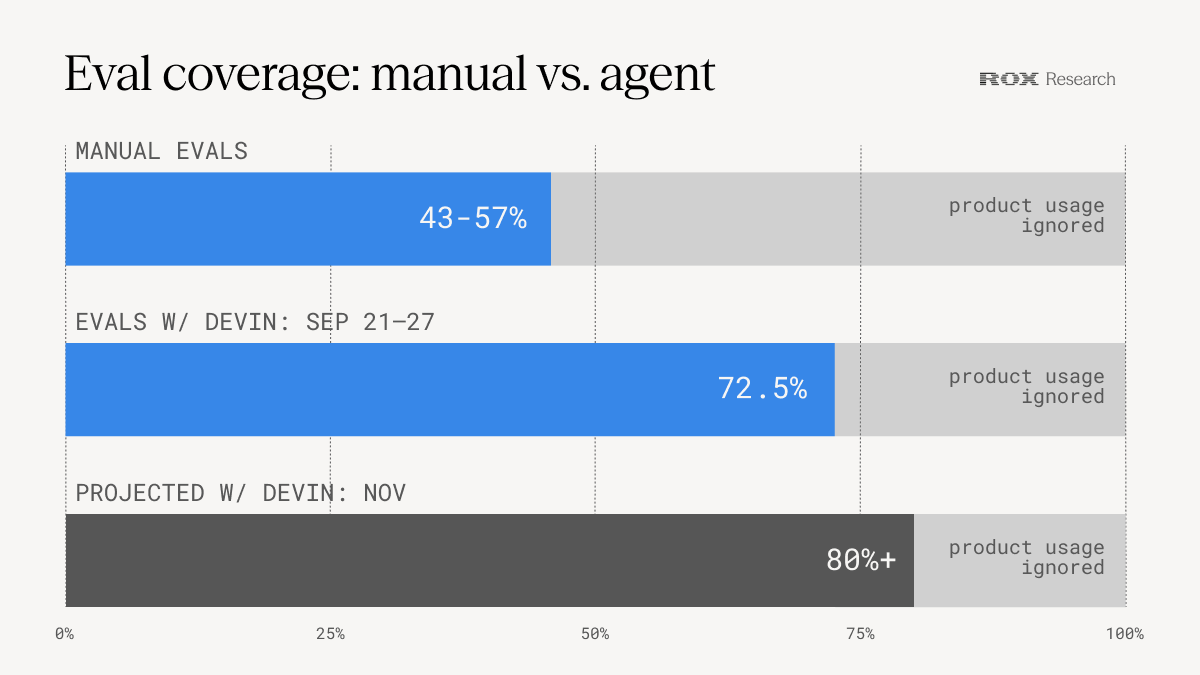
Nobody at Rox writes evals anymore.
Devin now QAs our agent every week, on real traffic.
It reads real conversations with our agent, rebuilds each failure in a full copy of Rox, and turns it into an eval. We just review the PR.
The eval suite already covers 72% of real usage happening in the product, vs. 43–57% for the evals we used to write by hand.
And it’s growing week over week with Devin.
Built with @cognition and @braintrust:
Introducing ask-web: Rox’s in-house web search agent.
ask-web sits on the cost-per-accuracy pareto frontier of the hyper-parameter grid when compared to frontier labs and commercial search agent providers.
The agent delivers 91.3% accuracy at 1.03 cents per query on real production prompts.
It has been running in production for more than 6 months with continuous evals.
Inference partners: @togethercompute, @baseten, @modal
Commercial Search vendors benchmarked: @perplexity_ai, @ExaAILabs, @p0.
Frontier Search vendors benchmarked: @OpenAI, @AnthropicAI
Exa, OpenAI and Anthropic excel on accuracy. Parallel and Perplexity are cost-efficient.
Here’s the breakdown:
There's a movement happening across college campuses.
70% of Stanford singles, 50%+ at Penn, Princeton, Yale. All opting out of the swipe.
Date Drop matches become real dates 10x more often than Tinder.
The Wall Street Journal covered it today.
https://t.co/4StAfAnR6c