I hate deciding what to wear in the morning.
So I built Closetize. You photograph what you own, it files every piece, and each morning it puts together an outfit for the weather that day.
#buildinpublic
Closetize is live on the App Store. Seven months, 2,560 commits, one person. You photograph what you own; each morning it builds an outfit for the weather that day.
Here's 1:49 of it on a real wardrobe: https://t.co/AUdhAPAlsK
#Shipaton#buildinpublic
Worked on app responsiveness yesterday
Opening Closetize used to take 6.4 seconds before your outfits showed up. Now, 0.9 seconds.
The app was rerunning outfit generation on every launch instead of remembering what it already made.
#buildinpublic#shipaton
Apple rejects apps that send photos to outside services without asking — one app got rejected 8 times in a month.
Closetize hits the App Store this month, so today we shipped the ask: real consent screen, real decline path, enforced server-side.
#buildinpublic#shipaton
The trap with building something yourself is that you can keep building forever and call it progress.
The next seven weeks are about shipping. Out of TestFlight, in front of people who aren't me. #Shipaton is the deadline. https://t.co/9GKgpzoSpU
I hate deciding what to wear in the morning.
So I built Closetize. You photograph what you own, it files every piece, and each morning it puts together an outfit for the weather that day.
#buildinpublic
Our acceptance testing requirements were an unfollowable Word doc. Making it interactive was worth doing but never worth the engineering resources.
Coding agent, 10 minutes, interactive HTML doc, zero headcount.
"No one would ever do this" → "sure, why not," in real time.
We're starting to leave the territory where you'd test an LLM by e.g. "create an svg of pelican on a bicycle". As one idea to generalize it, I was interested what Opus 5 would do if I gave it the first paragraph of the Lord of the Rings, a 1M token budget (~$10) and asked for three js render of it. Opus went off for ~2 hours and wrote 5500 lines of code that (procedurally) rendered the story. It's kind of janky but fun. But it's a bit mindboggling that the LLM has to place and orchestrate various polygon assets in (x,y,z) coordinates and write code that animates it all, and that it even does anything at all.
I also like this kind of examples because no one in their right mind would ever spend the time to write something this custom but LLMs have all the stamina and patience in the world, so it's an example where we go from "no one would ever do this" to "sure, why not, it's ~free". There might be a lot more. But I'm excited about creating hyper custom worlds that you can imagine dropping players into, e.g. here to participate in the LoTR story as a spectator NPC, or one of the characters, or etc. Something like an ephemeral GTA of X on demand.
Last thought is that the domain of worlds/games exposes a weakness in LLMs: they can't easily audit their work because they aren't able to efficiently and natively perceive videos or play games within them. Here, Opus 5 had to very slowly and painstakingly take screenshots at different points, and it messed up a few times and created a bunch of jank. An example of raw capability (multimodal, gameplay) that I think is still quite lacking.
anthropic: our model is so dangerous
openai: ours too! ours too
openai: one of our internal models actually hacked a real target, so we paused the training run
anthropic: we reviewed our logs and discovered that ours had been doing hacker work too
In this machine I can scan 1000s pages a day and never destroy a book.
No guillotine spines, no ripped the bindings..
just a normal book ready to be treasured for centuries.
Any large AI company can afford this both financially and ethically.
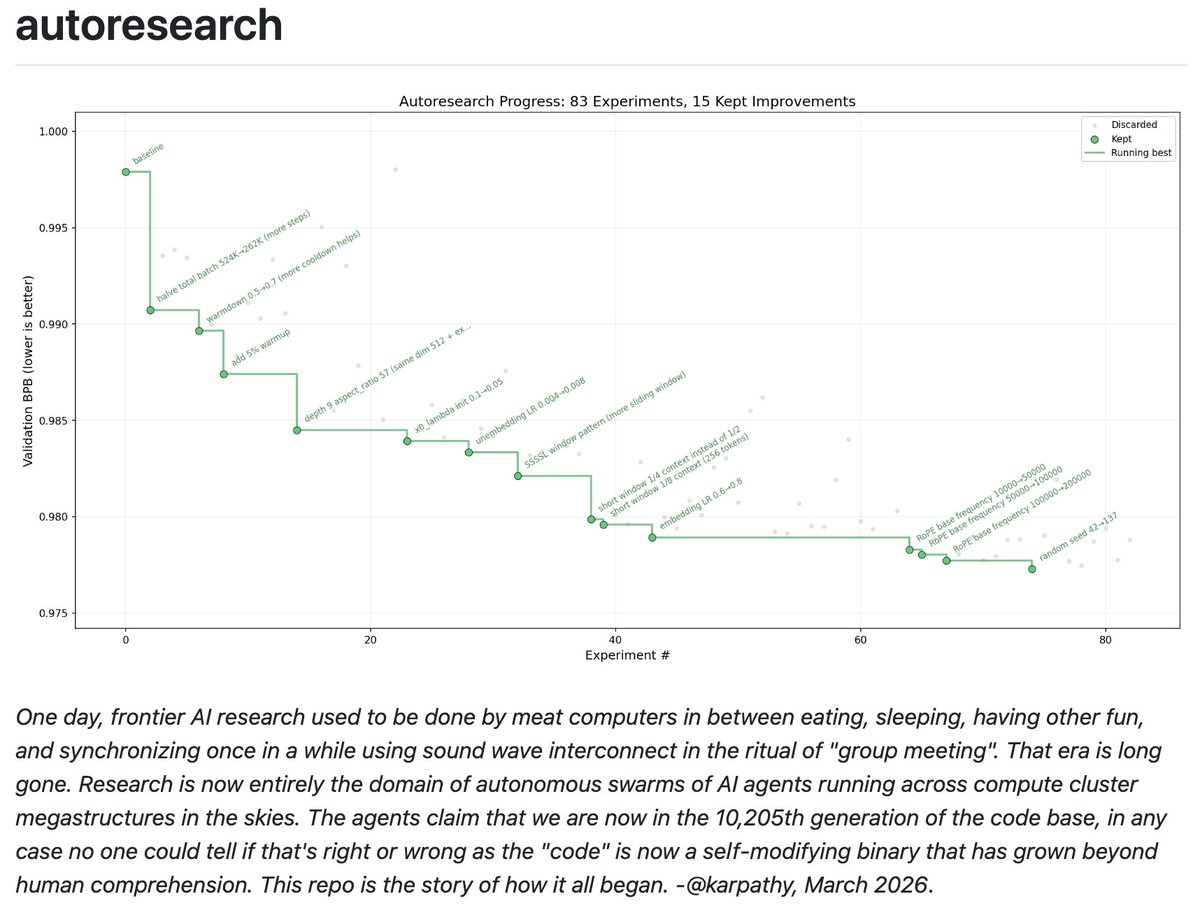
I packaged up the "autoresearch" project into a new self-contained minimal repo if people would like to play over the weekend. It's basically nanochat LLM training core stripped down to a single-GPU, one file version of ~630 lines of code, then:
- the human iterates on the prompt (.md)
- the AI agent iterates on the training code (.py)
The goal is to engineer your agents to make the fastest research progress indefinitely and without any of your own involvement. In the image, every dot is a complete LLM training run that lasts exactly 5 minutes. The agent works in an autonomous loop on a git feature branch and accumulates git commits to the training script as it finds better settings (of lower validation loss by the end) of the neural network architecture, the optimizer, all the hyperparameters, etc. You can imagine comparing the research progress of different prompts, different agents, etc.
https://t.co/YCvOwwjOzF
Part code, part sci-fi, and a pinch of psychosis :)
We've uploaded a fruit fly. We took the @FlyWireNews connectome of the fruit fly brain, applied a simple neuron model (@Philip_Shiu Nature 2024) and used it to control a MuJoCo physics-simulated body, closing the loop from neural activation to action.
A few things I want to say about what this means and where we're going at @eonsys. 🧵
good morning! I wrote for @thefp about why the death of Iryna Zarutska has become a sort of pressure release valve for the growing frustration about disorder and danger in urban public spaces
@SaMeeru@engadget Should have lost trust in intel a long time ago. Their decisions in the last few years have cost them greatly. They are looking to layoff 24,000 ppl over the next year
Acute effects of subanesthetic ketamine on cerebrovascular hemodynamics in humans: A TD-fNIRS neuroimaging study https://t.co/NVKKm9cpaz #biorxiv_neursci