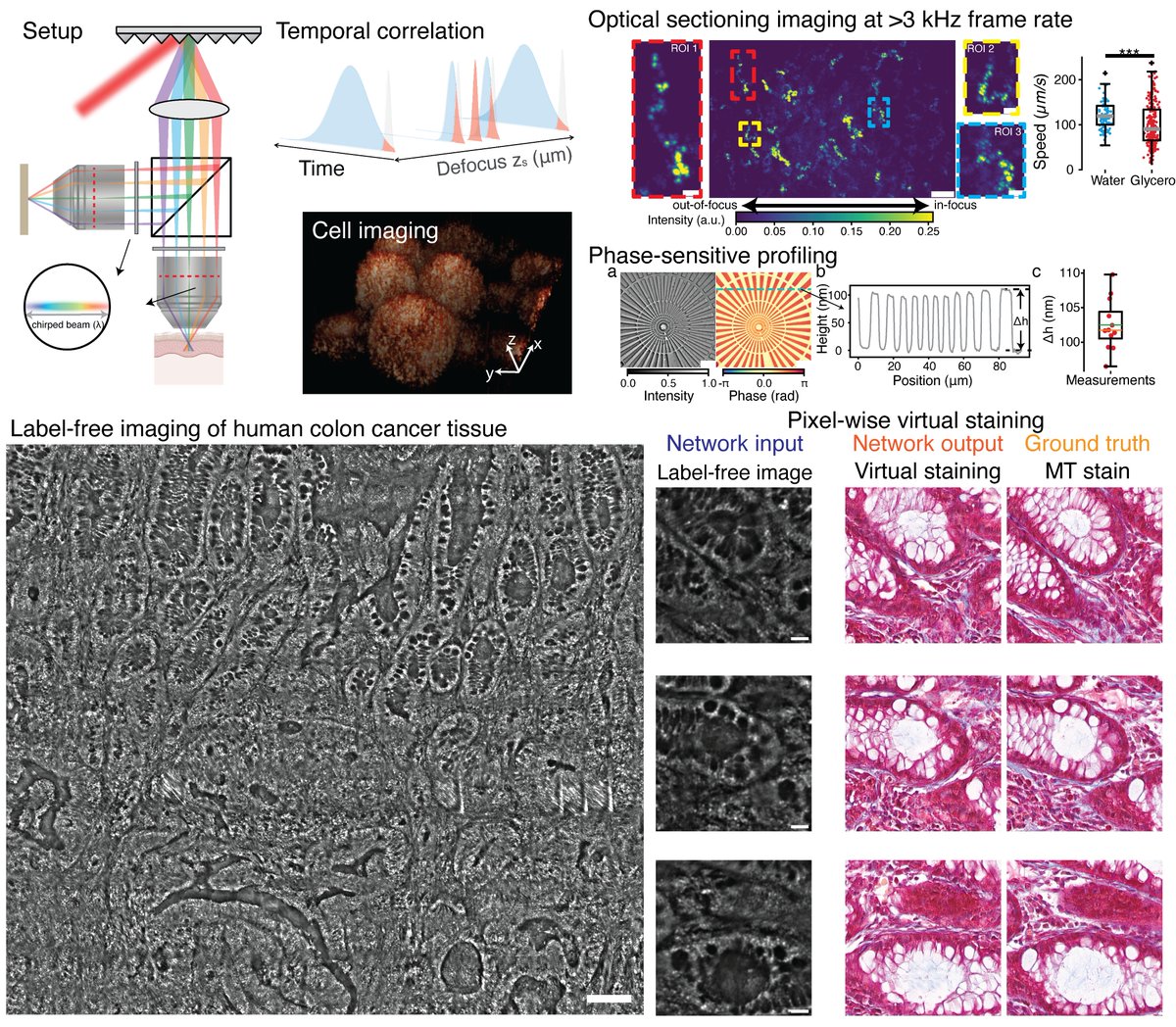
I am thrilled to share our recent work. We introduce a temporal focusing-enabled QPM (TF-QPM) — a new paradigm for high-speed, label-free 3D quantitative phase imaging (QPI) in reflection mode.
By exploring temporal focusing beyond multiphoton fluorescence microscopy into label-free imaging, we achieve single-shot volumetric imaging with sub-micron sectioning, a step towards rapid 3D label-free imaging with subcellular details without needs of mechanical scanning and/or multiplexed acquisitions. We demonstrated:
⚡ 3,709 Hz frame rates (camera limited only, given enough photons)
🔬 Diffraction-limited resolution
🧠 phase-sensitive dynamics in 3D
This addresses challenges the QPI field has long struggled with: capturing fast biological processes in intact, label-free systems with both spatial and temporal precision at 3D, and as simple as possible!
Powered by deep learning, It also enabled pixel-to-pixel virtual staining in 3D tissues at matched resolution to whole-slide histopathological outcome, and at much faster volumetric throughput. We see this as a bridge between optical physics, live-cell imaging, and computational pathology — and a step toward fully label-free, real-time 3D phenotyping.
we see the potential of this technology for high throughput cell and tissue characterization. Thanks to its straightforward approach, we anticipate a possible design for compact and point-of-care devices for rapid in vivo and in situ tissue pathological analysis. The potential of scanless 3D imaging makes it more suitable in translational and clinical settings.
Full manuscript available at https://t.co/uiasT7aaoy
Ed Boyden - one of the elite scientists of our era - comes on the pod to talks brains, creating whole simulations of living things and where AI and humans will merge.
Ed started at MIT at 16 and had two undergrad degrees and a masters degree four years later. He's been on an incredible run ever since.
His lab at MIT is a constant source of major bio-tech talent, and his accomplishments in terms of breakthrough science are incredible.
@brexHQ and @e1ventures allow us to bring these big brains to you.
Timestamps
0:00 Intro
1:20 Ed Boyden’s Lab Legacy
3:54 Converting Biology into Physics
7:22 Engineering a Prodigy
12:58 Mapping the Mind
16:14 The Baby Diaper Trick
21:49 Building a Model of Life
25:28 AI vs. Human Thought
31:27 The Unwritten Wisdom of Biology
40:42 Inside the Skull
43:36 Solar Panels for the Eye
52:29 Holographic Projections
56:05 The Future of Augmentation
1:02:05 The State of Science
This year is the 10th anniversary of the Google Research’s Connectomics team! In celebration, today with @MCB_Harvard we’re publishing a 1.4 petabyte human brain connectome with 57k cells and 150M synapses in @ScienceMagazine → https://t.co/D4aSrKdFZq & https://t.co/rG0FeVz1zQ
3️⃣ Advanced Classification & Translation
Find out how AI can classify types of biological samples and translate label-free images to furnish detailed subcellular and histochemical information.
How cell mechanics influences everything: Ming Guo seeks connections between a cell’s physical form and its biological function, which could illuminate ways to halt abnormal cell growth. https://t.co/Rj9ryq5kEW
Today we're releasing the Segment Anything Model (SAM) — a step toward the first foundation model for image segmentation.
SAM is capable of one-click segmentation of any object from any photo or video + zero-shot transfer to other segmentation tasks ➡️ https://t.co/qYUoePrWVi
Incredible work from @SchillerLab group on stiffness induced changes in the phosphorylation landscape in fibroblasts. Wealth of data and hits that will be of interests to many of us. Also intriguing list of upstream kinases with some surprising candidates (there or not there😉)
The newest deconvolution notebook I am working on shows how to get good deconvolution results even on truncated objects. The full notebook can be found here https://t.co/uancbv01z7




![LightSciAppl's tweet photo. #LSA_Highlight: [Research Article] Mapping nanoscale topographic features in thick tissues with speckle diffraction tomography. @MIT @CUHKofficial @BU_Tweets #Imaging_and_sensing #Interference_microscopy
https://t.co/8JMMvj890W https://t.co/AwIRHDV0tQ](https://pbs.twimg.com/media/F4MOOWwboAAI0KD.jpg)