It's fun to make predictions. Here's a new one:
Anthropic has solved a Millennium Prize Problem.
And I'll be even more specific.
Claude has solved Navier–Stokes.
It is out for expert review.
And to give myself a hard deadline, they will announce it before the IPO.
Before spending tens of thousands on an innovation exec, get this.
Innovation comes down to two things: addition or subtraction.
What can you subtract from the customer experience that reduces friction?
What can you add in a way that increases the value of the journey?
Revolut went the subtraction route. It pulled a lot of traditional banking structure that did not make sense for the customer, and focused on a card and a simple experience.
I recently saw a company take the addition path in a brilliant way.
Products like Readwise already help you revisit material you saved to read later. This company added a physical layer: it organizes the articles and delivers a magazine to your house. You read it on the sofa, with a coffee, without another screen fighting for your attention.
That caught me because nobody can stand more distraction. There is too much digital in too many things.
I would look at innovation as a decision about the journey. Sometimes you remove the parts that lost their meaning. Sometimes you add a physical, sensory, or nostalgic layer that makes the product more valuable.
I think that mix of digital and physical is a pretty good bet.
since you guys loved the exploding tesla..
I used GPT-6 Astra to create a 3D website that pulls apart the male anatomy into 2,234 modeled pieces!
we are in a renaissance of learning
Been receiving lots of questions about international travel.
We will reimburse 100% of travel including international flights.
You have no disadvantage reimbursement-wise for applying from further away.
The goal of this event is to promote responsible use of AI in math. We are committed to:
> Equity. We welcome participants from all backgrounds. We admit applicants on the basis of their perceived mathematical ability. We cover travel expenses.
> Transparency. We will record and open source all AI chat logs produced at this event.
> Understanding. We require participants to present their results orally and answer questions from our judges.
> Verification. We will publish results, presentations, and chat logs to https://t.co/X7jhXB2sEf for the entire mathematical community to review.
We partnered with @AnthropicAI@OpenAI
to host the world's first math hackathon.
40 hours, $2M compute - solve, understand, and present an open problem.
Applications are live: https://t.co/3oSEmPPohL
Checking that a major mathematical proof is correct can take years. Formalization—converting the mathematical reasoning into a form computer proof assistants like Lean can verify—can help.
Last month, Claude completed the first formalized proof of Fermat’s Last Theorem, one of the most famous theorems of all time. This was a project experts thought would take many years. It is the largest Lean proof ever written.
Fermat’s Last Theorem was first proven in 1995 by Sir Andrew Wiles, more than 350 years after it was conjectured. Our proof, which totals over 13 million lines of code, provides machine verification. More importantly, it proves over 29,000 other theorems that the proof requires, across many areas of math which had never before been formalized.
We see this as a major step in the long process of firming up the core of mathematical knowledge, building on work from three centuries of mathematicians and hundreds of contributors to Lean and Mathlib. We are optimistic that AI-assisted verification of mathematical proofs will help reduce the burden of refereeing mathematics in an era where more proofs are being produced than ever before.
You can read about the process on our Science Blog: https://t.co/ryYnDEAU6J
And see the complete proof on GitHub: https://t.co/wlYMXYnofz
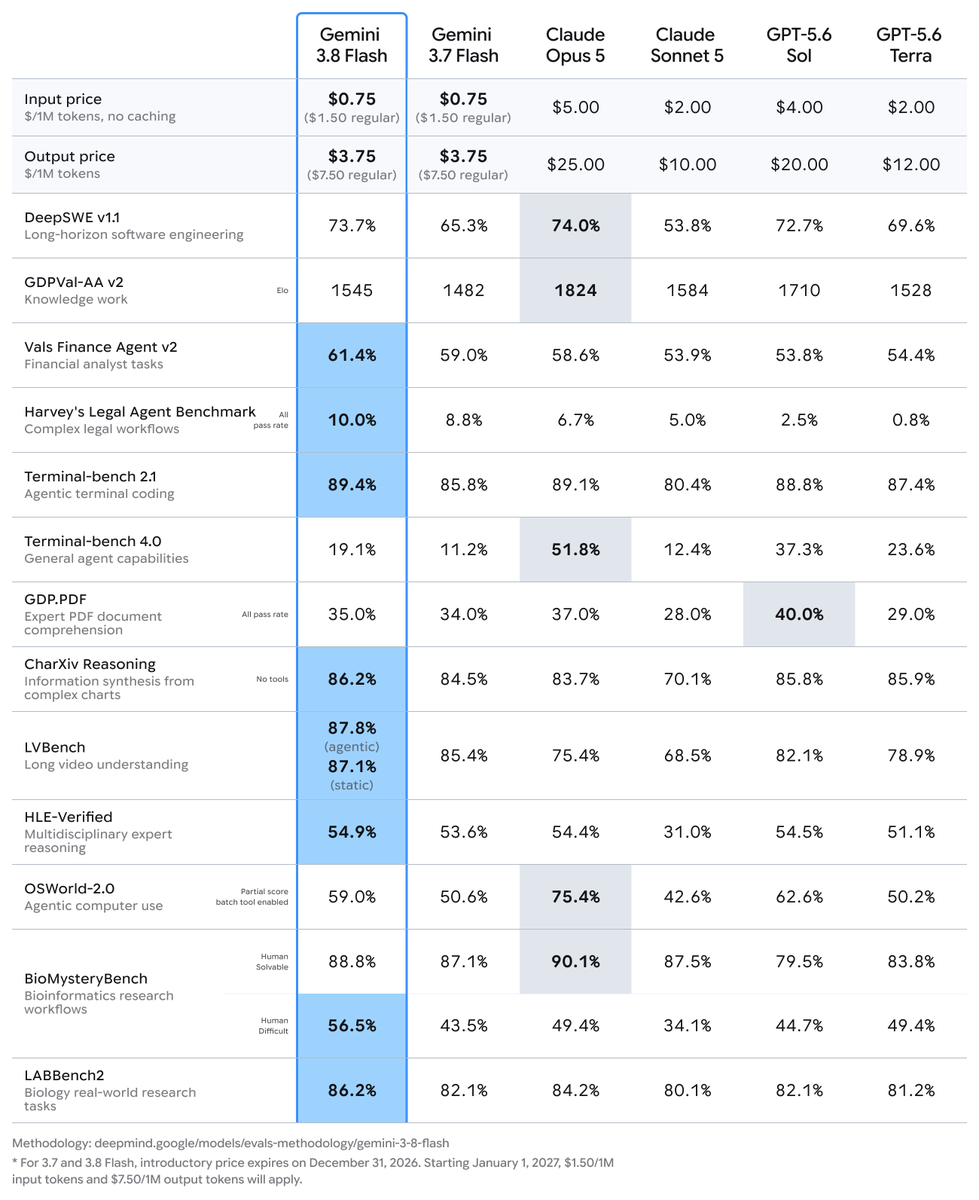
Today we’re introducing a new 3.8 Flash model, our 3rd Flash release in just 6 wks.
It delivers significant leaps from 3.7 Flash across software engineering, agentic tasks, and multi-step reasoning. On DeepSWE v1.1, it outperforms most larger frontier models in autonomously solving complex engineering problems end to end, at a fraction of the cost.
More details here: https://t.co/4YkKkdKQvu
Big news for student creators 👀
With Google Flow, you can create things like event flyers, presentation graphics, cool headshots, or possibly even the next viral rush video.
And now, students can unlock higher access with an exclusive offer. Terms apply.
🔗 https://t.co/rHa3VOseId
I'm so excited that our @theworldlabs team has achieved a major milestone today! Introducing Atlas - a first of its kind multimodal world model trained from scratch! 🚀
Atlas is capable of generating frames with pixel-perfect camera control, reconstructing large scenes from as few as one single input image, simulating space-time by reframing videos, natively outputting 3D spaces from one or more input images, composing multiple posed images into a consistent 3d world, and more! This is the best camera conditioned world model ever, opening doors to many possible use cases from VFX to robotics. I'm so so so proud of our team!♥️
By positioning multiple input views within the model's spatial context, Atlas allows you to generate image and video frames with precise control.
Here, we hand-designed a camera trajectory to generate a 1 minute video at 1440p resolution from seven reference images.
Introducing Atlas:
The world's first multimodal world model that generates image and video frames with pixel-perfect camera control and reconstructs them in 3D.
Model the world, move the camera, and simulate space & time.
The best way I have seen to raise AI fluency inside a company: put the agents in the work groups.
Tobi Lütke explained the logic when Shopify launched River, their internal agent. I already had this in my head looking at where Anthropic is going with Claude in Slack.
If every AI interaction happens in a private window, only the person at the keyboard learns.
That is how most companies use AI today. Single player.
People talking separately to ChatGPT, Claude, some copilot. Each one tests prompts, finds where it fails, learns to fix the output.
That knowledge dies in the same window.
When the agent works in a public Slack channel or a WhatsApp group, the dynamic changes.
Someone delegates a task. The agent starts executing. Someone else adds context. Someone corrects a bad call. Everyone can watch how it happened.
Going multiplayer is probably the smartest move if you want the organization's AI maturity to actually change.
@berprecht Problems, solving problems, piecing together patterns, connecting—the movement of water, wind, and sand—this will always be a human endeavor, at the very least providing the initial spark.
The gym compensates for work that no longer exercises the body.
AI may create the cognitive version of the same problem.
Every small moment of mental friction can now be delegated to a model: summarize this, review that, organize my decision.
We gain speed. We also practice the path from uncertainty to judgment less often.
GPS did this to navigation. AI may do it to reasoning.
If work stops exercising the mind, who builds the gym for thought?
Most people ask ChatGPT for answers. I make it quiz me.
/quiz me: 1 question at a time
/question predictor: finds the test's key 20%
/story mode: turns lessons into stories
Get all 5:
https://t.co/pboQrEVuXm
Over the past several months, we’ve been meeting with authors and publishers to better understand how AI can help people get the most out of their books 📚.
Today we’re launching Expert Intelligence, a new way to get insights about your favorite titles from the authors you love, directly in @Gemini_Notebook. With Expert Intelligence, you can:
▪️Add purchased @GooglePlay ebooks to your Gemini notebook
▪️Ask questions, generate quizzes, or create Audio Overviews based on your ebooks
▪️Combine author insights with your own notes
We have a limited window to strengthen cyber defenses, and together with organizations including @AnthropicAI, @awscloud, @Google, @Microsoft, and @Oracle, we're calling for a global effort to give defenders the tools, resources, and support to protect the infrastructure we all depend on.
If we act decisively, we can turn today's AI advances into lasting improvements in security and make our digital world safer for everyone.
https://t.co/f33JRVCiJb
Brazilians send 215 million messages to ChatGPT every day.
That makes Brazil one of the most active countries on the platform. That tracks.
Last week, the first-ever OpenAI Creators Day happened in São Paulo. As it should.
I got to come home, introduce ChatGPT Work and our GPT-5.6 models, and see what some of Brazil’s most creative people were already cooking up with AI.
The chefs were literally cooking: recipes, cakes, new cocktails. I met musicians, video creators building storyboards, 3D-printing creators, and a woman who renovated an entire boat and now lives on it.
The numbers are big, but the range of ideas was kind of insane. We Brazilians will always find a way to make tech feel less like tech and more like culture.
Getting to be home for this one felt very full circle 🇧🇷