Professor of Social Policy, Inequality, and Opportunity at University of Oxford. Director, Inequality Programme at INET Oxford. Fellow at Nuffield College.
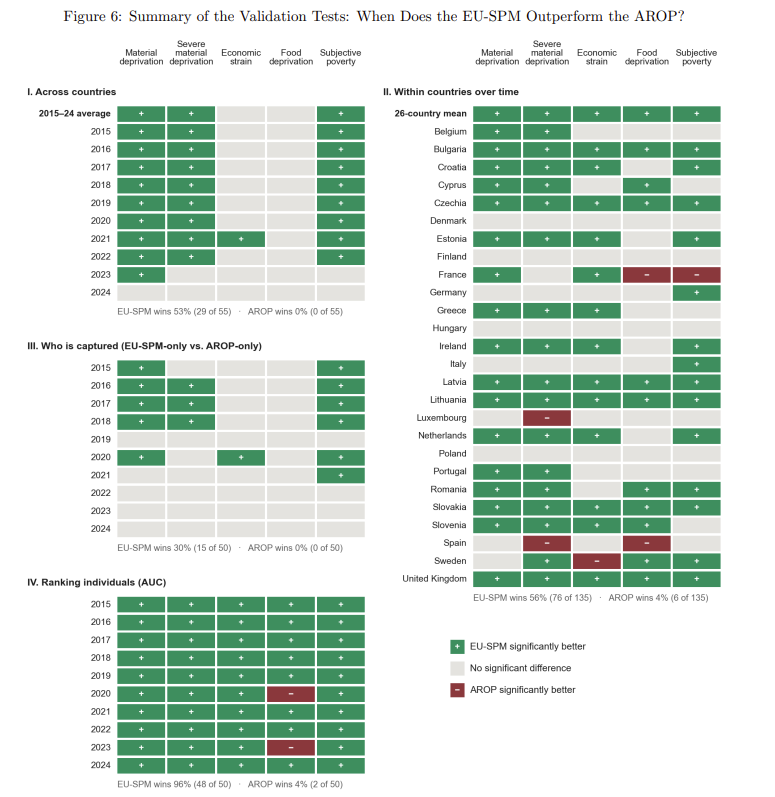
The European Union measures poverty as HH income below 60% of the national median. In a new paper, we introduce an alternative, the European Supplemental Poverty Measure (EU-SPM), and show that it vastly outperforms the EU’s measure across a wide range of validation tests.
We'll be building on this work in the coming months to enhance our understanding of levels and trends and poverty in the EU, and for comparisons of the EU to the US using a common SPM concept. All comments are very welcome, either here or via email. Paper: https://t.co/AfAIyI1zvY
The EU-SPM tracks deprivation and subjective poverty much more closely than the EU's AROP. The mean within-country (across time) correlation between the EU-SPM and deprivation is 0.55, against -0.04 for the AROP. Of 290 validation tests, the EU-SPM wins 168 and the AROP wins 8.
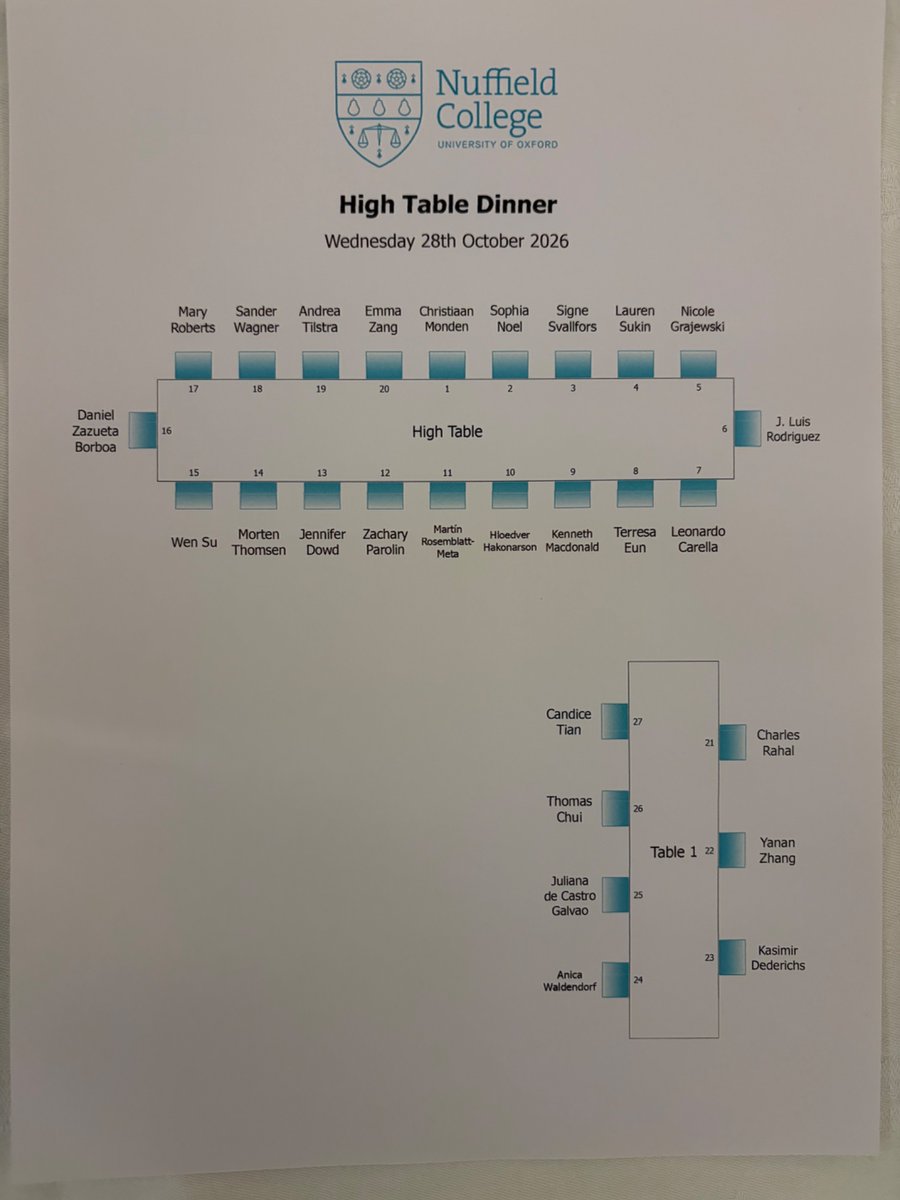
What a wonderful time visiting Oxford! I was especially impressed by the vibrant community, the great conversations, and the memorable high table dinner. Such a special experience!
A big thank you to @ZParolin for being such a fantastic host. You’ve really set the bar high for hospitality! Feeling grateful for the warm welcome, inspiring exchanges, and wonderful memories. Hope to be back soon!
Some fresh content for the fully refundable CTC labor supply impact debate!
Rather than looking at the 2021 expansion or basing solely on simulations, this one leverages state CTC adoptions. 👀 https://t.co/zAXQcjf6Lw
"The housing shortage in the United States not only drives up rents, it is also a significant driver of poverty." The @nytimes summarizes my collaboration Pew, which quantifies how high housing costs lead to higher poverty rates for 10 U.S. states. https://t.co/ZCxwnusyVY
What do you think determines your pay? What do you think *should* determine it? We asked 1,000 U.S. workers about their pay beliefs to test whether support for the meritocracy lives on. TLDR: it does! With complications. (DM/email if you’re paywalled).
https://t.co/QeZNy8xUMn.
Are inequality researchers too concerned with the ultra-rich? Proud to take part in the Atkinson Conference at Nuffield College (Oxford). On Sep 10, I’ll discuss with Mike Brewer moderated by Juliana de Castro Galvao. Info: https://t.co/iaxEGMKukQ
Seeking nomination of timely topics for Point/Counterpoint in @JPAM_DC!📢📢
As the new Managing Editor, I’m eager to broaden the range of voices represented.
See: https://t.co/5CC0hWF1zV
@JCribbEcon@TomWatersEcon Really interesting. Not a 1-to-1 comparison below, but we're seeing similar patterns in the US: more employed young adults living with parents today (with implications for trends in personal earnings vs. HH income inequality, the focus of this paper: https://t.co/Pn2skycJs0)
Feeling deprived of academic talks over the summer? This Thursday I'm presenting new work with @ZParolin for the Oxford Metrics & Models seminar. Online talk and all are welcome! 2pm in Oxford, 7am Colorado. Happy to share the MS Teams link with you.
We are looking for journalists and other writers to write reported features for Works in Progress.
There are a lot of important stories in the world that we’d like to cover that don't work as our typical essays, because they require on-the-ground information and insights that only a reporter can uncover. Things like:
• Why has crime dropped so much in Washington, DC?
• What is really happening in Milei’s Argentina? What about Bukele's El Salvador?
• Why don't ASML and TSMC raise their prices?
The type of person we are looking for will have already published features like these at a major publication. The work will be on a freelance basis (although we may offer salaried staff writer positions in the future) and pay will be competitive with major publications.
If you’re the right person to do this, please send a hundred words on yourself and a story you'd like to cover, as well as examples of previous work, to [email protected]
🧵 New working paper out today: "Measuring the Regional Economic Cost of Brexit: Evidence as of 2026" w @edenhofer_jacob@fetzert & @ShizhuoWangEcon
Here's what the data say about who paid the price in these 10 years from the referendum
1/…
Interesting paper! (that I'd argue supports the UI Theory of Everything™️)
Policy discussions on how unemployment benefits impact job transitions often are too one-dimensional -- singling out how more generous UI can delay returns to work -- without considering other dynamics...
Blue states cannot redistribute their way out of housing shortages. Here's my take for @TheArgumentMag based on several analyses of how housing costs affect poverty rates. ⬇️
Blue states have built some of the country’s most generous safety net programs. But in places like California and New York, those gains are being swallowed by the cost of housing.
That’s the core problem: Poverty isn’t just about how much money people have. It’s also about how much it costs to meet basic needs.
Cash transfers, SNAP, and the Child Tax Credit still matter, but in high-cost states, redistribution can only go so far if rent keeps rising faster than income.
Read Zach Parolin on why building more housing is an anti-poverty strategy: https://t.co/rpUfK4Oisu
“Redistribution is important. But it is not enough.” It is not enough because, in high-cost regions, income transfers are increasingly inefficient at reducing poverty [...] “Abundance” is, itself, an anti-poverty strategy.
A must-read from @ZParolin: https://t.co/aDJ5nWrU5M
The Atkinson Conference on Economic and Social Inequality will take place on 10-11 September at Nuffield College (Oxford).
▶️Plenaries: Philippe Aghion, @JanetGornick & roundable moderated by FT's Sarah O'Connor.
🚩CfP Deadline: 22 May.
Join us in Oxford: https://t.co/6u0ZYmiLQG