"There is now unambiguous, solid economic evidence, not just abstract economic theory, that rent control would make the affordability problems facing [Massachusetts] worse, not better."
- Jon Gruber, Chairman of the Economics Department at MIT
For the second year in a row, the overwhelming majority of new generation assets added to American grids has been solar+storage. They are fast to deploy, scalable, reliable, and affordable.
I was at an event on AI for science yesterday, a panel discussion here at NeurIPS. The panelists discussed how they plan to replace humans at all levels in the scientific process. So I stood up and protested that what they are doing is evil. Look around you, I said. The room is filled with researchers of various kinds, most of them young. They are here because they love research and want to contribute to advancing human knowledge. If you take the human out of the loop, meaning that humans no longer have any role in scientific research, you're depriving them of the activity they love and a key source of meaning in their lives. And we all want to do something meaningful. Why, I asked, do you want to take the opportunity to contribute to science away from us?
My question changed the course of the panel, and set the tone for the rest of the discussion. Afterwards, a number of attendees came up to me, either to thank me for putting what they felt into words, or to ask if I really meant what I said. So I thought I would return to the question here.
One of the panelists asked whether I would really prefer the joy of doing science to finding a cure for cancer and enabling immortality. I answered that we will eventually cure cancer and at some point probably be able to choose immortality. Science is already making great progress with humans at the helm. We'll get fusion power and space travel some day as well. Maybe cutting humans out of the loop could speed up this process, but I don't think it would be worth it. I think it is of crucial importance that we humans are in charge of our own progress. Expanding humanity's collective knowledge is, I think, the most meaningful thing we can do. If humans could not usefully contribute to science anymore, this would be a disaster. So, no. I do not think it worth it to find a cure for cancer faster if that means we can never do science again.
Many of those who came up to talk to me last night, those who asked me whether I was being serious or just trolling, thought that the premise was absurd. Of course there would always be room for humans in science. There will always be tasks only humans can do, insight only humans have, and so on. Therefore, we should welcome AI. Research is hard, and we need all the help we can get. I responded that I hoped they were right. That is, I truly hope there will always be parts of the research process which humans will be essential for. But what I was arguing against was not what we might call "weak science automation", where humans stay in the loop in important roles, but "strong science automation", where humans are redundant.
Others thought it was immature to argue about this, because full science automation is not on the horizon. Again, I hope they are right. But I see no harm in discussing it now. And I certainly don't think we need research on science automation to go any further.
Yet others remarked that this was a pointless argument. Science automation is coming whether we want it or not, and we'd better get used to it. The train is coming, and we can get on it or stand in its way. I think that is a remarkably cowardly argument. It is up to us as a society to decide how we use the technology we develop. It's not a train, it's a truck, and we'd better grab the steering wheel.
One of the panelists made a chess analogy, arguing that lots of people play chess even though computers are now much better than humans at chess. So we might engage in science as a kind of hobby, even though the real science is done by computers. We would be playing around far from the frontier, perhaps filling in the blanks that AI systems don't care about. That was, to put it mildly, not a satisfying answer. While I love games, I certainly do not consider game-playing as meaningful as advancing human knowledge. Thanks, but no thanks.
Overall, though, it was striking that most of those I talked to thanked me for raising the point, as I articulated worries that they already had. One of them remarked that if you work on automating science and are not even a little bit worried about the end goal, you are a psychopath. I would add that another possibility is that you don't really believe in what you are doing.
Some might ask why I make this argument about science and not, for example, about visual art, music, or game design. That's because yesterday's event was about AI for science. But I think the same argument applies to all domains of human creative and intellectual expression. Making human intellectual or creative work redundant is something we should avoid when we can, and we should absolutely avoid it if there are no equally meaningful new roles for humans to transition into.
You could further argue that working on cutting humans out of meaningful creative work such as scientific research is incredibly egoistic. You get the intellectual satisfaction of inventing new AI methods, but the next generation don't get a chance to contribute. Why do you want to rob your children (academic and biological) of the chance to engage in the most meaningful activity in the world?
So what do I believe in, given that I am an AI researcher who actively works on the kind of AI methods used for automating science? I believe that AI tools that help us be more productive and creative are great, but that AI tools that replace us are bad. I love science, and I am afraid of a future where we are pushed back into the dark ages because we can no longer contribute to science. Human agency, including in creative processes, is vital and must be safeguarded at almost any cost.
I don't exactly know how to steer AI development and AI usage so that we get new tools but are not replaced. But I know that it is of paramount importance.
Because of the power density advantages of ammonia over renewables and batteries, Amogy is targeting power needing industries like maritime shipping, power generation, construction, and mining. https://t.co/bWEmPDtCzD
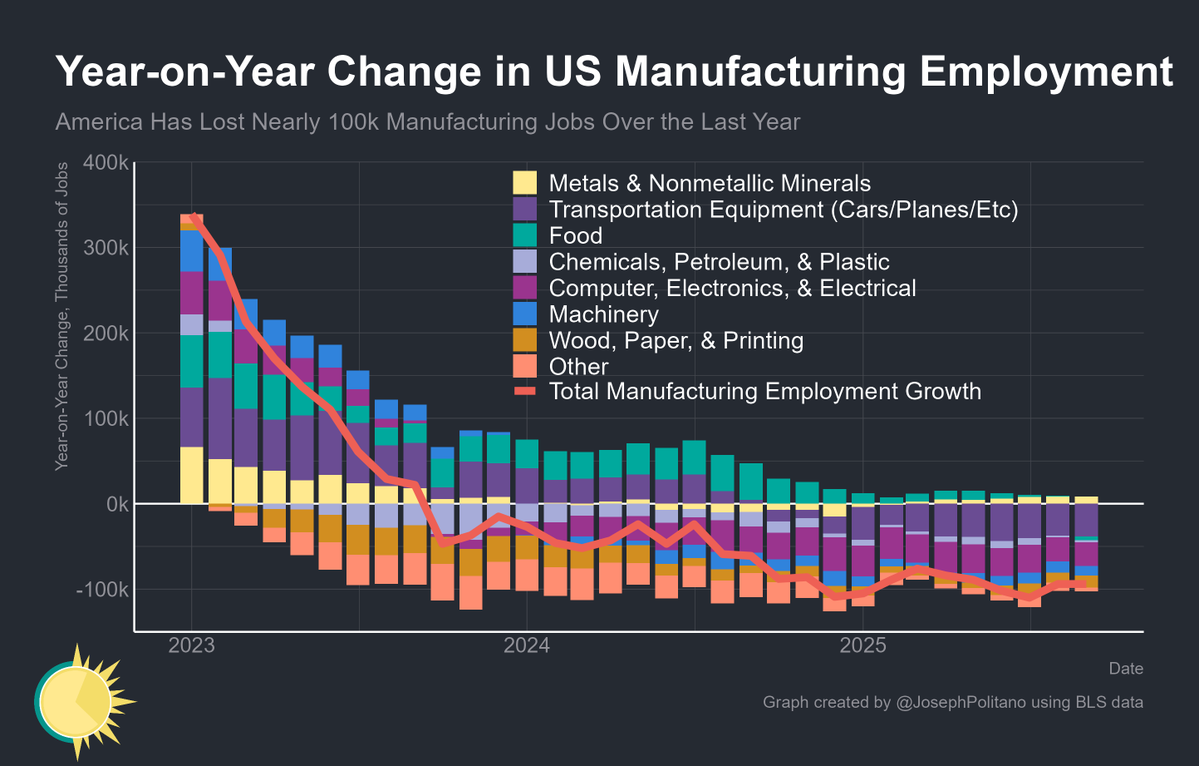
The US continues to lose manufacturing jobs—payrolls are down 94k over the last year, & another 6k jobs were lost in September
Transportation (especially auto manufacturing) and electronics/electrical manufacturing are the biggest losers, but almost no subsectors are doing well
“This is a pragmatic solution that’s not trying to reshape the world as we dream of it. It’s looking at the problem at hand today and fixing it,” Cameron Halliday says. https://t.co/oMtg3kFVNv
Today the U.S. needs another technological breakthrough to secure domestic supplies of metals like lithium, cobalt, copper, and rare earth elements, which are needed for everything from batteries to jet engines and electric motors. Nth Cycle thinks it has a solution. https://t.co/1B0PaUmBxf
The anti-solar talking points from @SecretaryWright continue to be absurd.
He says he'd make a bet that solar never reaches 10% of global energy within the next 50 years.
But it's already at 3% and growing by 1% every two years.
Would love to take that bet, it's easy money.
China has clearly noted the fact that WW2 didn't end until the combined bombing offensive focused on and destroyed the Axis powers' oil supplies. The war was unwinnable for Germany and Japan from mid 1942 on the basis of industrial production, but both had sufficient raw materials stockpiled to maintain production of weapons until about 1947. But in 1944, their oil supply was finally strangled and their war effort collapsed within months.
China is currently far ahead on industrial production and maximizing the rate of the on-shoring of their energy production.
Today, anyone could shut down the Straits of Malacca. By 2030, China will no longer depend on it. With enough solar power, they can internalize mass production of energy, oil, silicon, metals, and everything else they could possibly need.
The US easily has the financial power to buy all the production of Chinese solar factories and deploy them in the US, to ensure our children have near infinite free energy. But we've decided to privilege the aesthetic value of 200 million acres of featureless lifeless uninhabitable desert over ensuring that American values ensure freedom for humanity in the eternal future light cone.
What's the plan here? Just hand the next millennium to China on a silver platter?
Scientists at the University of Florida have created a breakthrough mRNA cancer vaccine that erased deadly brain tumors in early human trials without chemo or radiation. Tested on four glioblastoma patients, the vaccine reprogrammed their immune systems within 48 hours to attack the tumor. Built from each patient’s own tumor cells and delivered via lipid nanoparticles, it showed success similar to earlier tests in mice and dogs. It is now moving into Phase 1 pediatric trials.
Foundation Alloy creates high-performance metals using a novel process that doesn’t rely on melting raw materials. The MIT alumni behind the company say its alloys can be made twice as strong as traditional metals with 10 times faster product development. https://t.co/DrWxuTOJUO