Excited to find practical ways to squeeze insights out of large scale data.
Currently at the Children's Hospital Zurich
[email protected]
@votti.bsky.social
@arjunrajlab @LuciaScience Another great collection of open illustration resources can be found in:
https://t.co/L1cT0gslwa
together with @inkscape or https://t.co/F73xP5rQ88 generating nice (and free) vector illustrations is rather straight forward 🎉
Having a list of genes and wondering what they have in common? Here overrepresentation analysis may be your friend!
Having a scored list of genes and wondering if there are some Gene Set distributed in a non-random way in your score? Here gene set enrichment is one way to go!
Looking for an easy to use, well documented solution to do these two kind of analyses?
Bioconductor's ClusterProfiler seems like a great way to start!
The link to the Online Book by the authors with tons of practical examples: https://t.co/8rpyx7Ydn0
@pj_saez@NatureComms I think the novel part here is more the drop based antigen retrival?
ScWestern itself is already 10 years old:
https://t.co/OPp9NqQ7Ou
To be fair: I have never encountered ScWesterns in other publications...
@christlet@inkscape Also embedding
.svg plots (instead of including) can be useful to arrange ploys from R/python exported as svg.
Then inksape is can be used for the overal layout and plots auto-update if re-exported.
@christlet@inkscape The great thing with #Inkscape as a skill is that it sticks for life - even if you change jobs and loose access to licenses.
It is also super versatile: apart from science I've used it for my wedding invitation, poster for sports club, logos, menu cards etc
@HKibirige Awesome to see that plotnine keeps getting better - thanks so much 😍
I really love how it gives a familiar, efficient high level interface to matplotlib but still allows for "low level" matplotib adjustments if needed. Even tools like AdjustText work (https://t.co/LV1Lk6UZ66) ☺️
@c_rands@lpachter@vitaliikl@maelouisewoods@satijalab@fabian_theis No and what is really complex about biology is there are MULTIPLE RIGHT answers, different UMAPs and clusters can highlight different true and important aspects of biology. Of course there could be bad, spurious nonsense answers, but also many correct and valuable answers
@johanneskoester Maybe a note that for reproducibility (and to prevent hard to diagnose bugs) the user should consider implementing all updates:
a) transactions on task level (all updates of the task either fail or suceed. No partial updates possible upon premature failure of the task.)
@cwcyau@BioMickWatson That it exactly what makes text generative AI such a great business model - without buying an AI solution we soon won't manage to parse the heaps of empty information thrown at us by other AI solutions 🙁
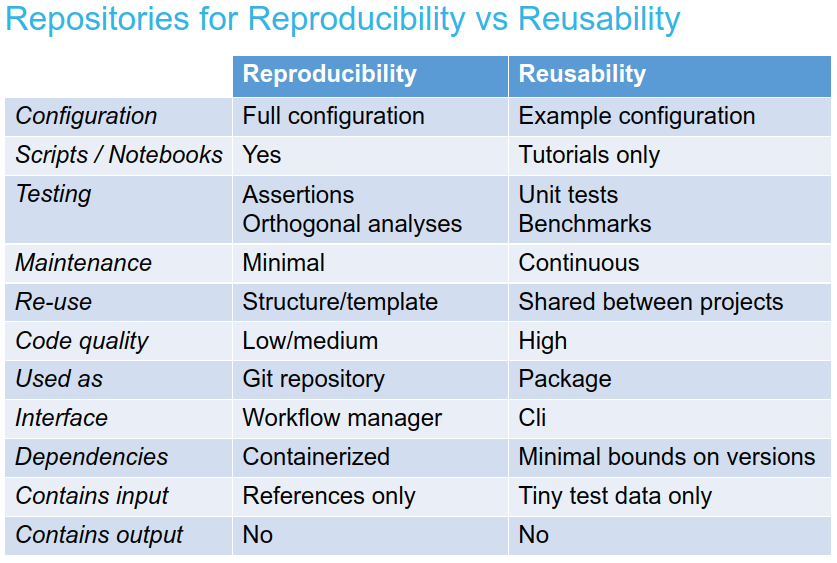
An interesting aspect of reproducible data analysis in science is that by itself it does not necessarily imply reusability.
Creating a data analysis repository with "reproducibility" vs "reusability" in mind implies quite different contents, standards and considerations.
@slavov_n@slavovLab Reminds me of effects we have seen in correlations of signaling molecules during timecourses: changes in the kinetics of responses due to differences in base state resulting in transiently induced correlations/relationships: https://t.co/fIKiIZAZRE