The Longest Equation in Physics
The model Lagrangian is a mathematical expression that summarizes the Standard Model of particle physics, which is the most successful theory of the fundamental interactions between elementary particles. It is composed of four different parts, each describing a different aspect of the Standard Model.
The model Lagrangian is written in a compact notation that uses symbols and operators from quantum field theory, such as covariant derivatives, field strength tensors, Dirac matrices, and gauge group generators. It also uses various constants and parameters that are determined by experiments, such as coupling constants, masses, and mixing angles.
It is one of the longest equations in physics because it contains many terms and factors that account for all the possible interactions and symmetries of the Standard Model.
It was transcribed by Thomas Gutierrez who derived it from Martinus Veltman's Diagrammatica: The Path to Feynman Diagrams.
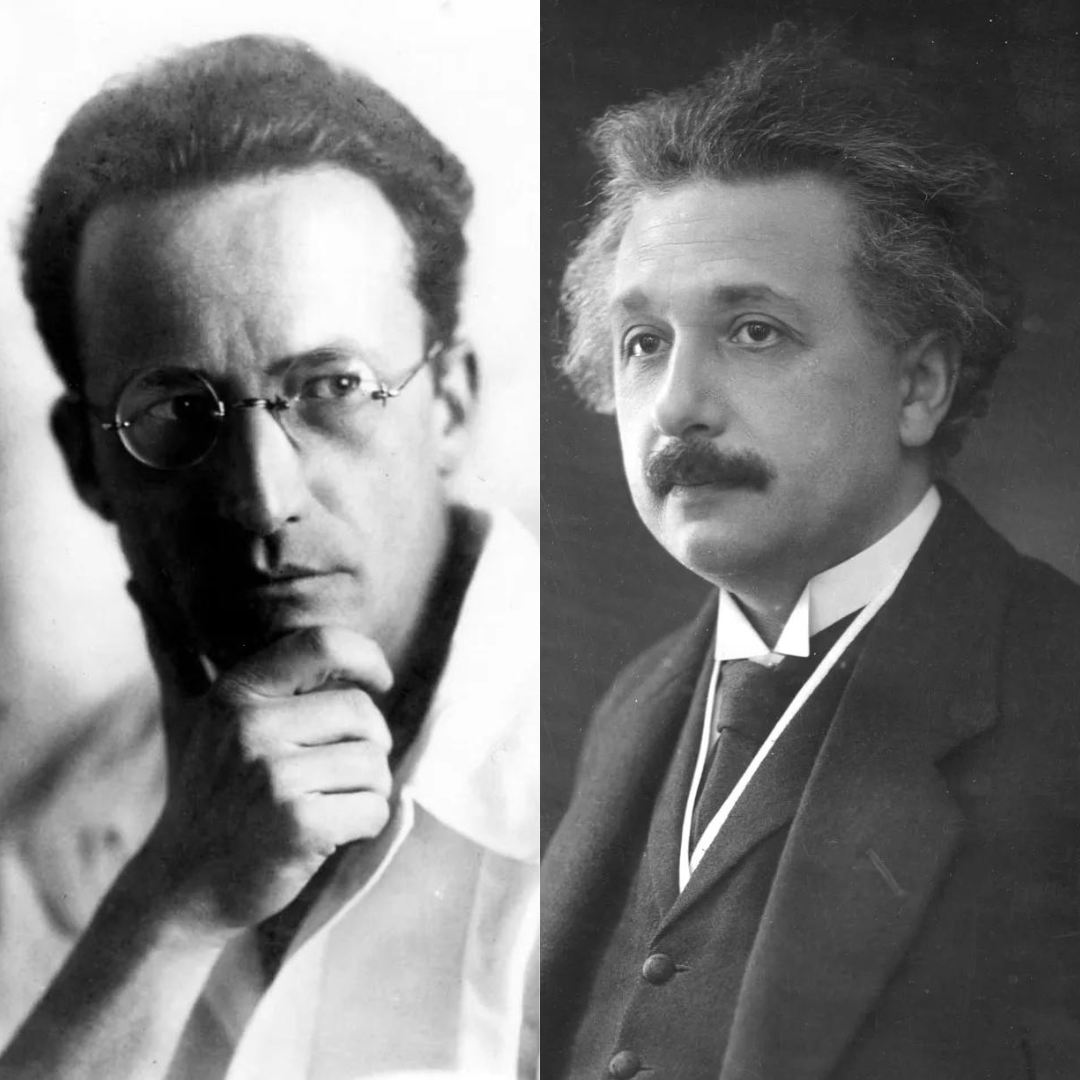
1950: A. Einstein's Letter to Erwin Schrödinger where he talks about the famous Schrödinger's cat thought experiment ✉️
Dear Schrödinger,
You are the only contemporary physicist, besides Laue, who sees that one cannot get around the assumption of reality—if only one is honest. Most of them simply do not see what sort of risky game they are playing with reality—reality as something independent of what is experimentally established. They somehow believe that the quantum theory provides a description of reality, and even a complete description; this interpretation is, however, refuted, most elegantly by your system of radioactive atom + Geiger counter + amplifier + charge of gun powder + cat in a box, in which the ψ-function of the system contains the cat both alive and blown to bits. Is the state of the cat to be created only when a physicist investigates the situation at some definite time? Nobody really doubts that the presence or absence of the cat is something independent of the act of observation. But then the description by means of the ψ-function is certainly incomplete, and there must be a more complete description. If one wants to consider the quantum theory as final (in principle), then one must believe that a more complete description would be useless because there would be no laws for it. If that were so then physics could only claim the interest of shopkeepers and engineers; the whole thing would be a wretched bungle.
You are completely right to emphasize that the complete description cannot be built on the concept of acceleration, nor, it seems to me, can it be built on the particle concept. Only one of the tools of our trade remains—the field concept, but God knows whether this will stand firm. I think it is worthwhile to hold on to this, i.e. the continuum, as long as one has no really sound arguments against it.
But it seems certain to me that the fundamentally statistical character of the theory is simply a consequence of the incompleteness of the description. This says nothing about the deterministic character of the theory; that is a thoroughly nebulous concept anyway, so long as one does not know how much has to be given in order to determine the initial state.
It is rather rough to see that we are still in the stage of our swaddling clothes, and it is not surprising that the fellows struggle against admitting it.
Best regards!
Yours,
A. Einstein
Genepil, the Queen consort of Mongolia, resided in Mongolia. A photograph from January 1st, 1923 captures her presence. She held the title of the last queen consort, being married to Bogd Khan, the ruler of the Bogd Khaganate, until his passing on April 17th, 1924, which coincided with the abolition of the monarchy. Tragically, she fell victim to the Stalinist purges and was killed in May, 1938.
Following the demise of Queen Dondogdulam in 1923, Bogd Khan sought a new partner and selected Genepil from a group of young women aged 18 to 20, chosen by the King's advisors. Although Genepil was already married, her marriage held no significance, as it was only in name. Despite Bogd Khan being 53 years old, nearly blind, immobile, and plagued by illness, Genepil was given assurance that she would eventually be allowed to reunite with her first husband.
She spent a year living with Bogd Khan until his death on April 17, 1924, when the monarchy was abolished. Subsequently, she departed from the Mongolian court and returned to her family. It remains unclear whether she reconciled with her first husband or remarried.
In 1937, due to her association with the old regime, Genepil and her family were arrested. Tragically, she met her demise in May, 1938, when she was executed as part of the systematic destruction of Mongolian culture during the Stalinist era. This period witnessed the widespread killing of numerous individuals, including shamans and Buddhist lamas.
Call for papers for a special issue ‘Bernard Stiegler and the Philosophy of Education III: Critical Philosophy, Technology, Education’
Special Issue Editor Prof. Dr Joff P.N. Bradley, Teikyo University, Tokyo, Japan
Abstract deadline June 1st, 2023.
https://t.co/JhZlQ9mtfb
Eines der ertragreichsten Leben in der deutschen Philosophie ist zu Ende gegangen: Dieter Henrich war noch bis ins hohe Alter ein produktiver Autor. https://t.co/KwbxRnGY28
Eines der ertragreichsten Leben in der deutschen Philosophie ist zu Ende gegangen: Dieter Henrich war noch bis ins hohe Alter ein produktiver Autor. https://t.co/CMnyLh0mMP