holy shit, this unhinged launch video we made won an award!
This didn’t get nearly enough views when it went up so you should watch it now
https://t.co/H0wLhY7uzj
Muse Spark Open, a coding-optimized open weight model from @Meta, is now available on Modal.
Muse Spark Open is the most capable US open weight model to date and is trained specifically for agentic coding and long-horizon tasks; it supports native multimodal understanding and supports a 1M token context window.
Modal, CuspAI, LanceDB and 5 other Zero Prime portcos are hiring for technical roles across AI/infra right now. Here are the freshest, all posted in the last 3 weeks:
@modal | cloud infra for AI
➔ Analytics Engineer (NYC / Stockholm / SF) https://t.co/6WASQJFDTR
➔ Member of Technical Staff, Storage (Stockholm) https://t.co/X24dNdAQFN
➔ Member of Technical Staff, SDK (Stockholm) https://t.co/EwVGREBrN9
➔ Member of Technical Staff, Inference Runtime (SF) https://t.co/G91cOUfamx
@cusp_ai | AI-powered materials discovery
➔ Research Engineer, Materials Foundation Models (Cambridge UK / Amsterdam / London / Berlin) https://t.co/ZIfraonugs
@hexanalytics | the analytics platform for humans and agents
➔ AI Engineer Intern (SF) https://t.co/U329WY83H9
➔ Engineering Director, AI Engineering (SF / NYC) https://t.co/i4aOkOEMkI
@lancedb | multimodal lakehouse for AI
➔ Documentation Engineer (US / Canada) https://t.co/f28w4Wi5Bo
➔ Senior System Test Engineer (US / Canada) https://t.co/V6EhT4mJyq
@LightningAI | full-stack AI infrastructure platform
➔ Senior Infrastructure Operations Engineer, EMEA (London) https://t.co/LDZTGA9247
@runware | unified AI inference API
➔ Creative Engineer / AI Creative Technologist (UK / Spain / France) https://t.co/2cQi2kZfmt
➔ Senior / Lead Cooling Systems Design Engineer (Bucharest) https://t.co/b1ngjOc3q5
@Freshpaint_app | healthcare marketing performance & compliance platform
➔ Enterprise Implementation Engineer (US, remote) https://t.co/w7ZgR5T1Hn
@higgsfield | AI-native creative suite
➔ Data Scientist, Antifraud (Kazakhstan) https://t.co/age1M6Aylr
➔ Data Analyst, Antifraud (Kazakhstan) https://t.co/6nTqCBQFzT
We're hiring too, for @ZeroPrimeVC and @AICouncilConf (SF, in person):
➔ Growth Marketer https://t.co/Ksak3FikPS
➔ Chief of Staff https://t.co/LLBza4ynv2
Happy SF Tech Week Day 1 ☀️
Looking forward to Wednesday morning at First Pour 🍵 with @ZeroPrimeVC: matcha, pastries + great conversation with founders and researchers building in AI and software.
See you there if you're coming!
https://t.co/LjxKCWBudA
Next Wednesday morning @TheoryVC & @ZeroPrimeVC are taking over one of SF's best-kept matcha secrets in SoMa as part of SF @Techweek_.
Drop by anytime between 8am and noon, get caffeinated with us, and meet other founders and builders across AI and software.
We'd love to see you.
RSVP Required: https://t.co/6RoZemUDGB
I’m hiring a Chief of Staff to help build the next chapter of @AICouncilConf & @ZeroPrimeVC.
Most of your time will go toward running and growing AI Council. You’ll also work closely with me across both orgs to get important work done.
This is for an unusually capable generalist. The scope is intentionally broad and expected to grow. The right person will earn ownership quickly and can develop toward broader operating leadership over time.
Full time, in person in San Francisco (office near Jackson Square).
Base salary of $150,000–$180,000, based on experience.
Role and application details: https://t.co/LLBza4yVkA
If someone comes to mind, send this their way.
Build your own harness.
This is a seriously good paper from NVIDIA on self-improving agent harnesses.
The paper is called SoL-Pi, out of NVIDIA, NTU and MIT.
Every coding agent runs inside a harness. That's the layer that reads files, runs commands, manages memory and talks to the model. Humans tune it by hand, reading long execution logs and turning what they notice into code changes.
They handed the job to an AI instead.
A research AI watched a coding agent work, proposed changes to the harness, tested them, and kept only what saved tokens without hurting results. It ran about 150 research directions across roughly 500 environments, more than 3,000 runs and over 60,000 agent-environment interactions.
Four fixes survived.
1. The agent edits a file and runs the test in one call instead of two.
2. It compresses its memory when a subtask finishes, and only if that's cheaper than keeping everything.
3. It sends big tool outputs in full twice, then swaps them for a 1KB excerpt with a handle to pull the rest on demand.
4. A cheap model summarizes build and test logs, and a verifier rejects the summary if it drops evidence.
None of that touches the model. It's all in the software around it.
On EdgeBench, a 51-task benchmark, token traffic dropped 44.7 to 49% and API cost fell by about a third against Pi, the harness it was built on. Against the native harnesses it came in 50% cheaper than Codex on GPT-5.6 Sol and 54.3% cheaper than Claude Code on Opus 5. Scores held at roughly 94% of the baseline.
They built all of it on GPT-5.6 Sol, then dropped it onto Opus 5 with zero changes. It still used 44.7% fewer tokens.
The cost conversation so far has been about cheaper models. This paper says a big chunk of the waste sits in the software around the model, and an AI finds it faster than we do.
Their next move is running the search again with the cheaper harness, so a cheaper agent funds the search for an even cheaper one.
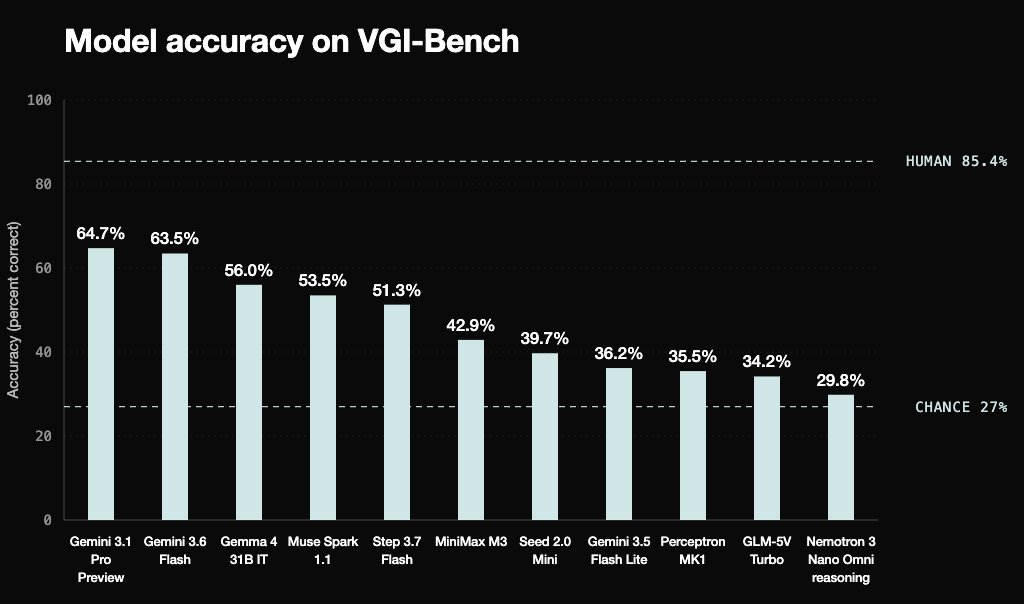
Introducing VGI-Bench: a multimodal, holistic benchmark probing 12 distinct visual and audio-visual skills.
550 human-curated questions, designed to mitigate the common mistakes in today's video benchmarks and expose pragmatic failures of state-of-the-art models.
Best model: 64.73%. Humans: 84.5%.