"You need to make yourself a big target for luck, and the way to do that is to be curious. Try lots of things, meet lots of people, read lots of books, ask lots of questions."
— Paul Graham, How to Do Great Work
https://t.co/AyIk5fnKZL
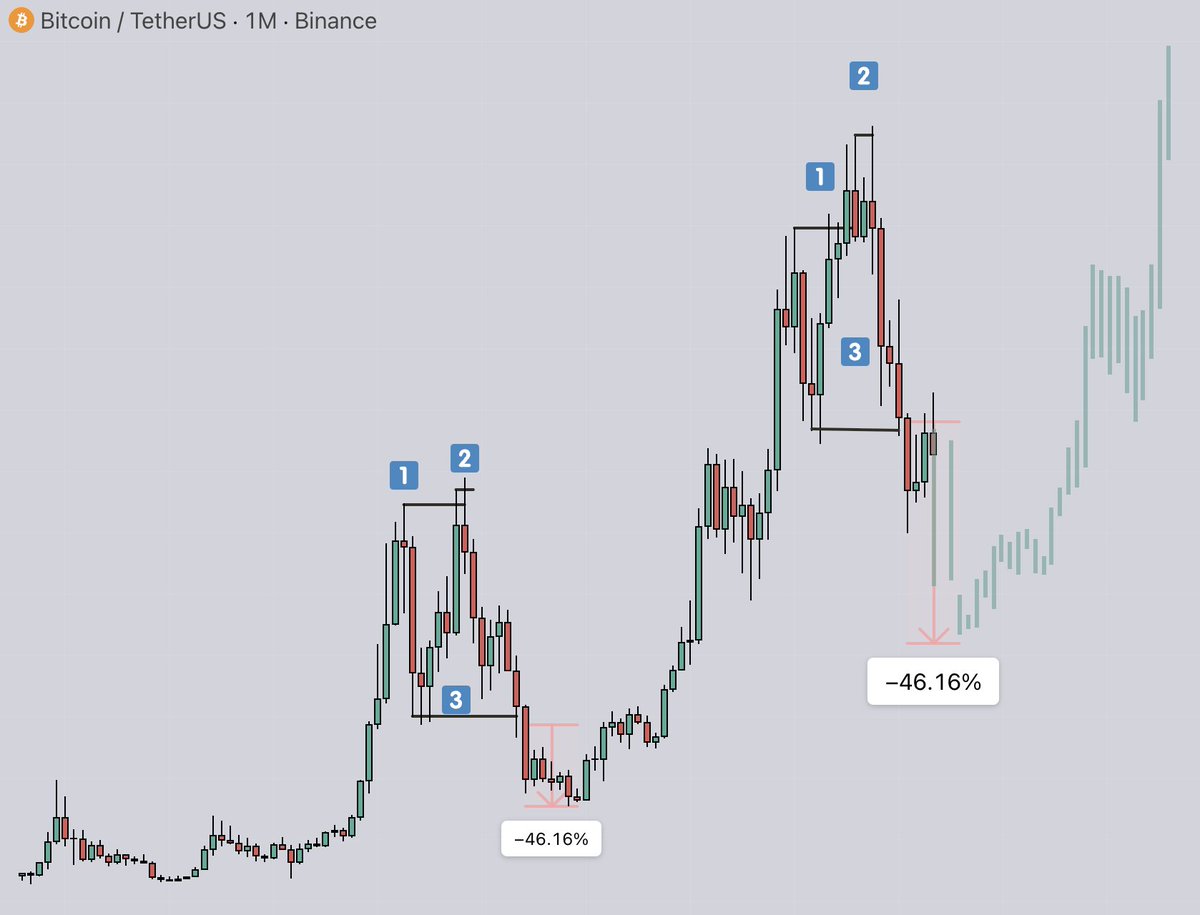
O último Bull Market do $BTC entregou 7× desde o fundo de 2022.
O de 2019–2021 entregou 18×.
Todo mundo culpou o halving fraco. Ou o Bitcoin virando "ativo institucional". Ou a narrativa perdendo força.
A explicação real é outra. Mais simples.
E mais quantificável. 🧵👇
Demis Hassabis wants to do something no civilization has ever been able to do.
Run reality more than once.
Hassabis: “AI itself will maybe unlock new sciences… the one I’m particularly excited about is AI for simulations.”
Every economy ever built. Every policy ever enacted. Every war ever fought.
Happened exactly once. Against the entire human population. With no way to run it again.
Hassabis: “If you raise interest rates by half a percent, you have to do it in the real world and then see what happens. You can have theories, but you can’t run it thousands of times.”
Every major decision in the history of civilization was a single experiment run on billions of people with no control group and no second attempt.
We called the results knowledge.
They were the scars of bets we were never allowed to place twice.
Hassabis: “Why aren’t they just sciences like physics today? Because the problem is they’re emergent systems… it’s very hard to do repeated controlled experiments.”
Physics became physics because you can drop a ball a thousand times and get the same answer.
You cannot drop a civilization and get any answer at all. You just get the wreckage and call it a lesson.
Hassabis wants to change that.
Hassabis: “If you could simulate things really accurately, then maybe there’s sort of new sciences to be done where you can rigorously sample from a very accurate simulator.”
Simulate an economy. Crash it. Rebuild it. Adjust the inputs. Run it again.
Do for civilization what the laboratory did for chemistry.
But that word “accurately” is doing more work than anyone is willing to examine.
To simulate a society well enough to learn from it, you have to simulate the people inside it.
Not averages. Not abstractions. Agents with preferences and fears and breaking points.
The more accurate the simulation gets, the less separates it from the thing it represents.
The line between physics and economics was never about the nature of what was being studied.
It was about the limits of the thing doing the studying.
Humans were never too complex to predict. We were too complex to calculate.
AI does not create new science. It collapses every science into one.
Everything computable becomes predictable. Everything predictable becomes simulable.
And past a certain resolution, the gap between a simulated world and a real one stops being a technical question.
It becomes a philosophical question no one is prepared to answer.
A simulation you can tell apart from reality is a simulation that has not finished improving.
The people inside a perfect one would not wonder whether their world was generated.
They would feel exactly the way you feel right now. Reading this. Certain they are real.
That certainty is not evidence. It is exactly what a successful simulation would produce.
Hassabis: “That will allow us to make much better decisions in these, today, what are very uncertain domains.”
What he is building is not a forecasting tool.
It is the quiet proof that “real” was only ever a word for what we had not yet learned to compute.
And that word is about to lose its meaning.
BTC IS REPEATING THE SAME CYCLE PATTERN!
BTC cycle has a 100% hit rate over the last 9 years:
396 days down, then 1035 days up.
We are in the middle of 396-day bear phase rn.
Means BTC must go lower and bottom around ~4 months.
Turn on notifs, I'll call the cycle bottom.
In 2023, Stanford professor Graham Weaver gave his last lecture on how to destroy fear & live a wildly ambitious life.
His frameworks:
- Suffering is inevitable
- Signup for "10 years" test
- "Not me" & "Not now" traps
13 lessons on how to build an asymmetric life:
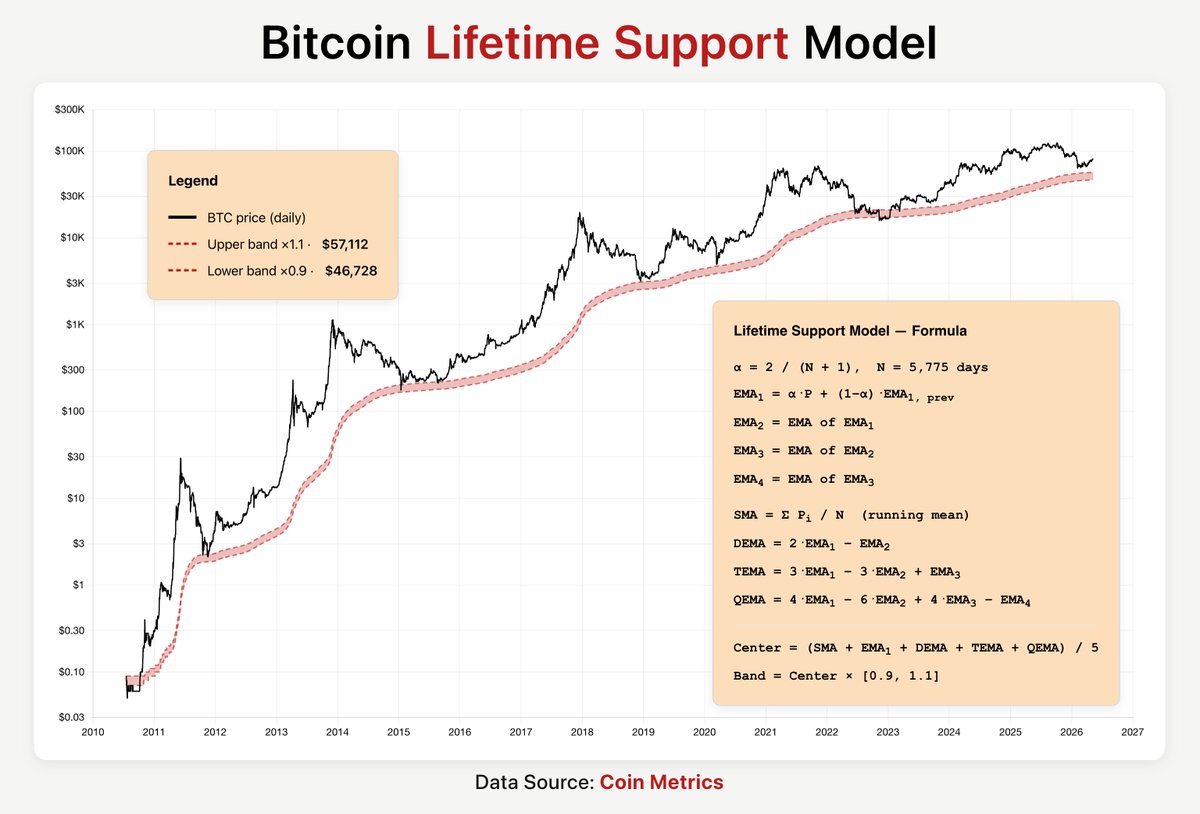
New Bitcoin Floor Model!
Simple and elegant.
Equal-weighted average of BTC's lifetime SMA, single EMA, double EMA (DEMA), triple EMA (TEMA), and quadruple EMA (QEMA), then plot a ±10% band around that average.
Upper band ×1.1 = $57,112
Lower band ×0.9 = $46,728
I do the exact same work and consume a very stable a amount of tokens everyday, and never had an issue with hitting limits of my $100 claude plan, not even close actually. But today I got the 95% warning on the 5-hour limit for the first time... and I still had at least 3 more hours of work left to do!