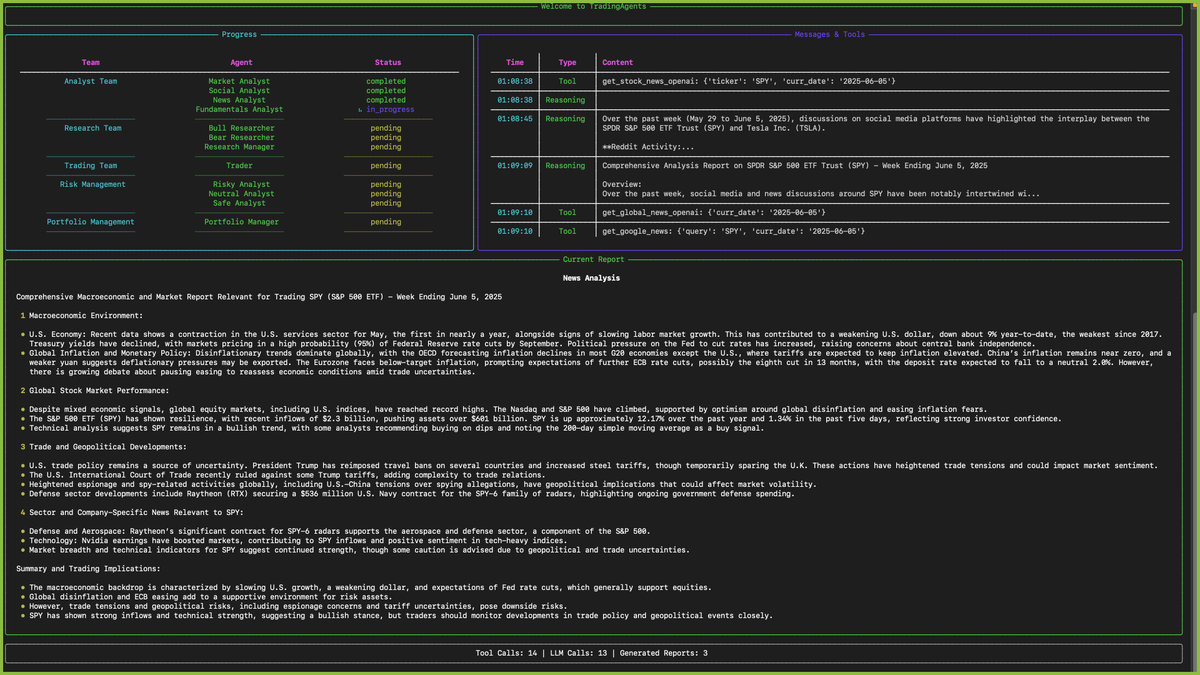
This paper turns traditional algorithmic trading into a network of AI agents that design, trade, and check strategies.
In tests, that setup beats S&P500 stocks and Bitcoin buy-and-hold while keeping price swings and worst losses noticeably lower.
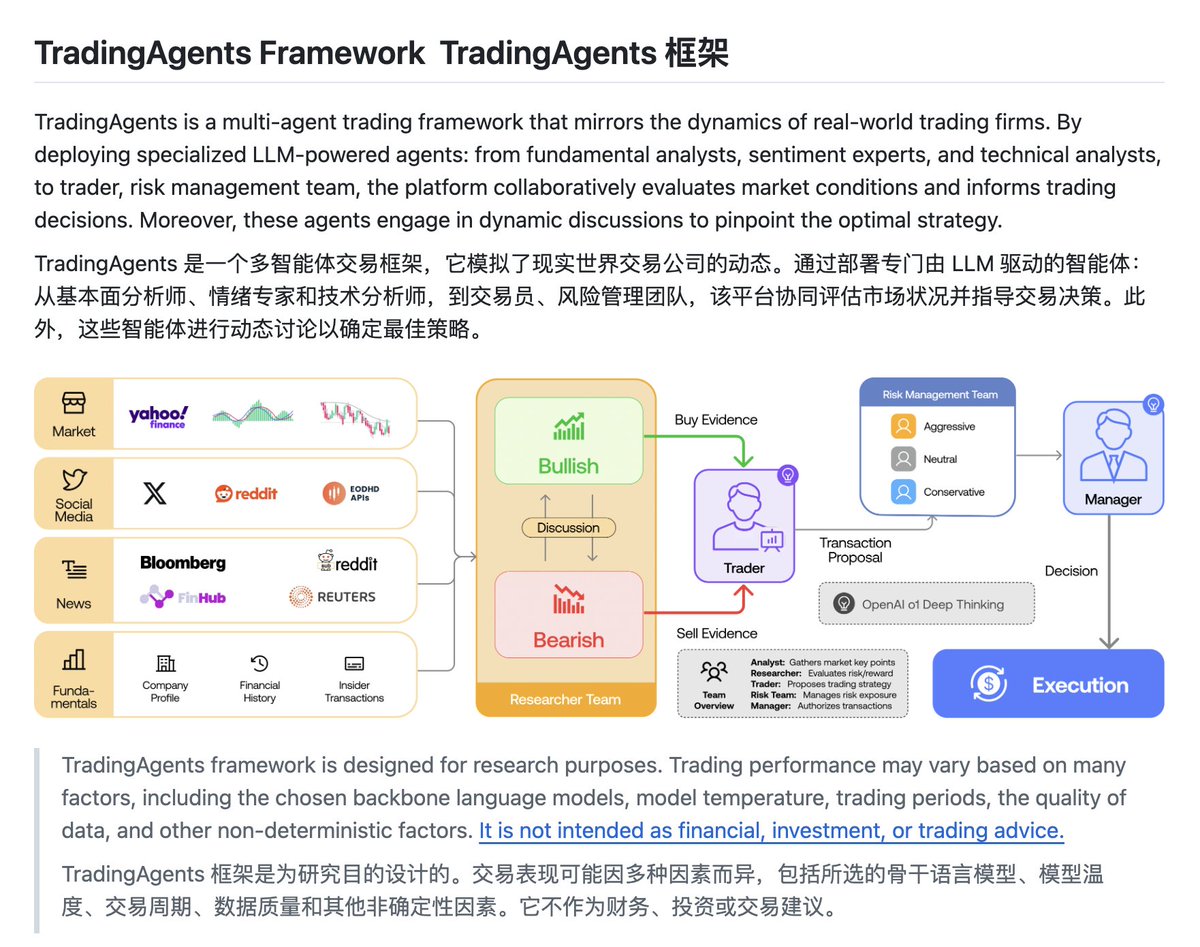
The authors start from a trading pipeline where different blocks clean data, build signals, control risk, construct portfolios, execute orders, and evaluate performance, which usually needs specialist teams.
They turn each block into its own agent, then use a planner and orchestrator to send task messages between data, alpha, risk, portfolio, execution, backtest, audit, and memory agents.
Large language models like GPT-4o or Llama3 suggest signal ideas and plans, but code tools handle all numbers, training, and backtests so models never touch test returns.
A memory agent keeps short summaries, file links, and safe statistics under hashed IDs, giving later runs context and an audit trail without storing raw prices.
In a 7-stock test and a fast Bitcoin test, the agent system earns more than benchmarks while also reducing return swings and worst peak-to-trough loss.
Overall, this makes trading workflows reusable and safer.
----
Paper Link – arxiv. org/abs/2512.02227
Paper Title: "Orchestration Framework for Financial Agents: From Algorithmic Trading to Agentic Trading"
What's missing to build useful deep research agents?
Deep research agents promise analyst-level reports through automated search and synthesis. However, current systems fall short of genuinely useful research.
The question is: where exactly do they fail?
This new paper introduces FINDER, a benchmark of 100 human-curated research tasks with 419 structured checklist items for evaluating report quality. Unlike QA benchmarks, FINDER focuses on comprehensive report generation.
The researchers analyzed approximately 1,000 reports from mainstream deep research agents. Their findings challenge assumptions about where these deep research systems struggle.
Current agents don't struggle with task comprehension. They fail at evidence integration, verification, and reasoning-resilient planning. They understand what you're asking. They just can't synthesize the answer reliably.
The paper introduces DEFT, the first failure taxonomy for deep research agents. It identifies 14 distinct failure modes across three categories: reasoning failures, retrieval failures, and generation failures.
This systematic breakdown reveals that the gap between current capabilities and useful research isn't about smarter search or better language models. It's about the reasoning architecture that connects retrieval to synthesis.
(bookmark it)
Paper: https://t.co/gAA7feYHm1
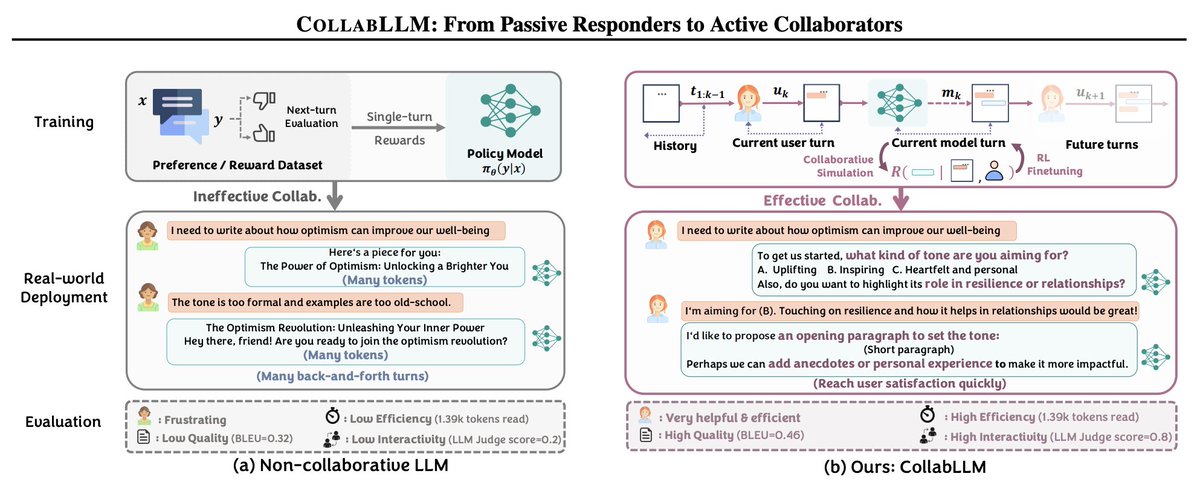
🏆Thrilled that #CollabLLM won the #ICML2025 Outstanding Paper Award!
We propose a new approach to optimize human-AI collaboration, which is critical for agents. Congratulations to my fantastic co-authors; great job @ShirleyYXWu and Michel Galley driving the project!👏
Though not attending #ICML2025 in person, I'm super excited to share 3 accepted papers:
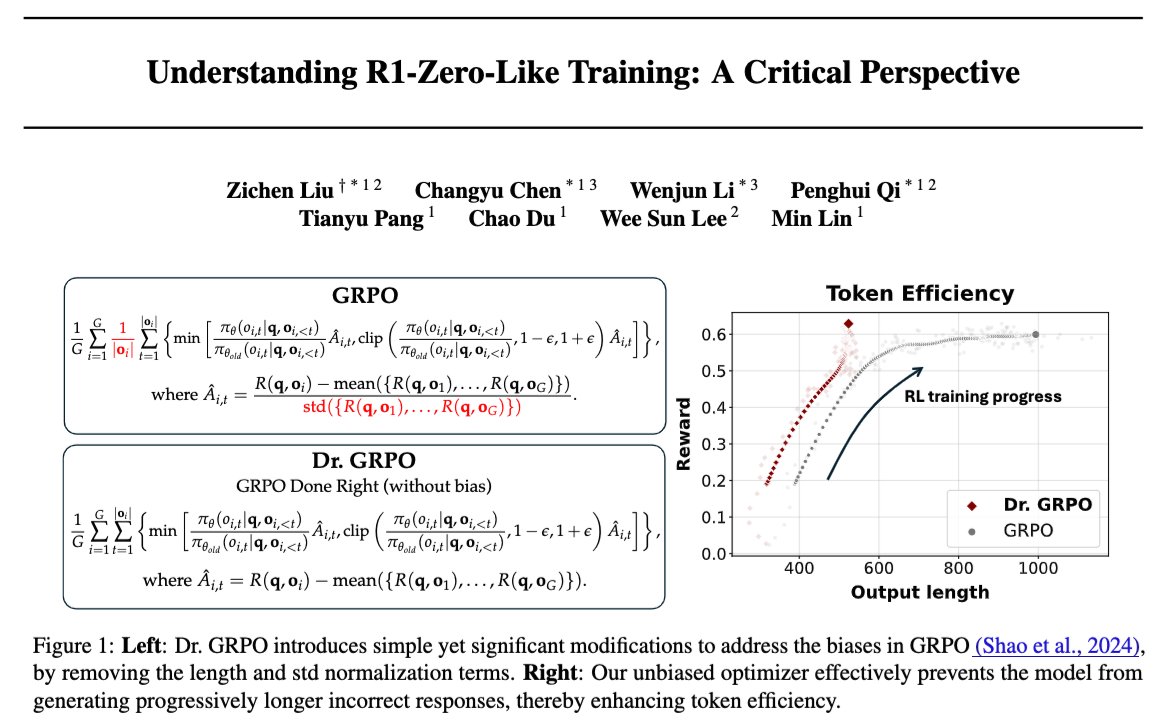
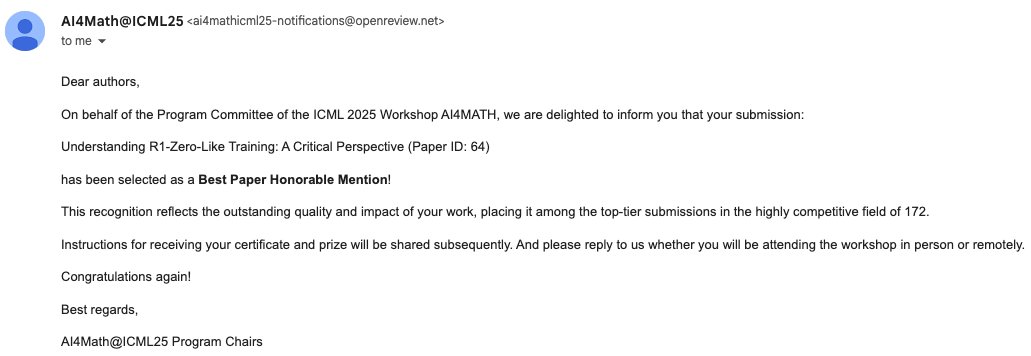
1.🎊Best Paper Honorable Mention @ AI4MATH workshop: Understanding R1-Zero-Like Training: A Critical Perspective (a.k.a Dr. GRPO but I think the paper is more than this loss fix)
2. Main Conference Spotlight: Continual Reinforcement Learning by Planning with Online World Models; I worked on the continual learning topic for one year before diving into RL for LLMs https://t.co/zuUy0BV3ny
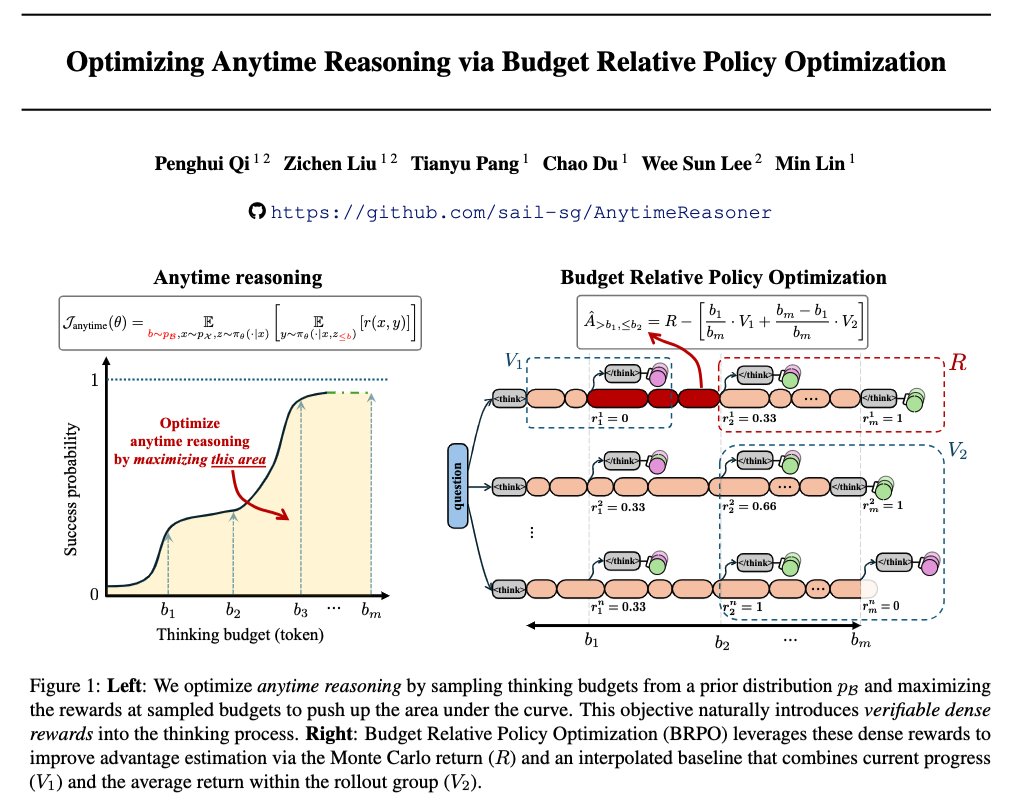
3. AI4MATH Workshop Poster: Optimizing Anytime Reasoning via Budget Relative Policy Optimization; a dense reward training framework that controls thinking budget (a cool feature of Gemini 2.5 Pro)
Announcing DeepSWE 🤖: our fully open-sourced, SOTA software engineering agent trained purely with RL on top of Qwen3-32B. DeepSWE achieves 59% on SWEBench-Verified with test-time scaling (and 42.2% Pass@1), topping the SWEBench leaderboard for open-weight models.
Built in collaboration with the @Agentica_ team.
💪 DeepSWE is trained with rLLM, Agentica’s modular RL post-training framework for agents. rLLM makes it easy to build, train, and deploy RL-tuned agents on real-world workloads — from software engineering to web navigation and beyond.
🤗 As always, we’re open-sourcing everything: not just the model, but the training code (rLLM), dataset (R2EGym), and training recipe for full reproducibility.
🔥 Train DeepSWE yourself. Extend it. Build your own local agents. No secrets, no barriers.
DeepSWE and rLLM mark our major shift: from training language reasoners to building language agents that can truly learn from experience.
We believe the future of AI lies in experience-driven learning — and we’re here to democratize it.
Welcome to the era of experience. 🌍
Finally had a bit of time to jot down some thoughts on this solid, open data engineering work from @essential_ai.
This work brings Essential-Web, a 24T-token pre-training corpus, to the open-source community. I've always appreciated open-source research, as it can significantly promote AI democratisation. Beyond the data release, this work also provides guidance on building a systematic Taxonomy of Categories for web documents to support data governance, with impressive levels of detail—including even scripts. This technical report, in my view, deserves multiple careful readings.
Notably, it also—finally—acknowledges our contributions to curating math pre-training corpora, such as MegaMath. I sincerely appreciate that☺️. Especially given that several orgs have used our data from our recent work or referenced our work without extending the appropriate credit. Let’s be honest: conducting research and doing real engineering work on data is far from trivial—yet it’s often dismissed as lacking novelty. 😅
That said, I do have some respectful disagreements regarding the experiments on data quality comparisons—particularly in the math domain (cc @AndrewHojel@ashVaswani). In our MegaMath paper, we showed that even the full MegaMath-Web corpus outperforms OpenWebMath in a 55B-token continual pretraining setup (see Figure 2). Also, I’d recommend clarifying how the top 10% of MegaMath-Web documents were selected. Furthermore, I observed that several existing domain-specific datasets (e.g., code and medical) show performance comparable to the DCLM baselines reported in this paper. I believe this might raise similar concerns for others as well.
There’s also a common misunderstanding—especially among folks who aren’t hands-on in pretraining data engineering—about types of pretraining corpora.
In my view, there are two major types:
1. True pretraining corpora, meant to lay the foundational knowledge for LMs.
2. Mid-training corpora, used in later stages (e.g., during LR decay) with focused curation, smaller in scale, and tailored for specific capabilities or benchmarks.
For instance:
- FineWeb is a broad-coverage true pretraining corpus.
- FineWeb-Edu is curated for high educational value, ideal for mid-training and great for benchmarks like MMLU.
In the context of the math domain:
- MegaMath-Web = a true pretraining corpus (about 100 Common Crawl dumps from 2014–2024).
- FineMath (3+, 4+) = a mid-training corpus, filtered via edu-style classifiers.
So what’s the “educational” version of MegaMath-Web? That would be MegaMath-Web-Pro—we used the same edu classifier as FineMath to extract high-ed value docs, followed by LLM-based refinement for noise reduction.
But to be clear: simply filtering MegaMath-Web by math_score isn’t equivalent to using the edu classifier. These are different metrics. It’s important for fair comparisons.
Given that EAI-TAXONOMY Math w/ FM and FineMath-3plus are reported in Table 3, I believe MegaMath-Web-Pro also deserves inclusion.
(cc @youjiacheng —thanks for the kind mention today and recognition of our work!)
Another way to evaluate math corpus quality?
Check out our recent work: OctoThinker.
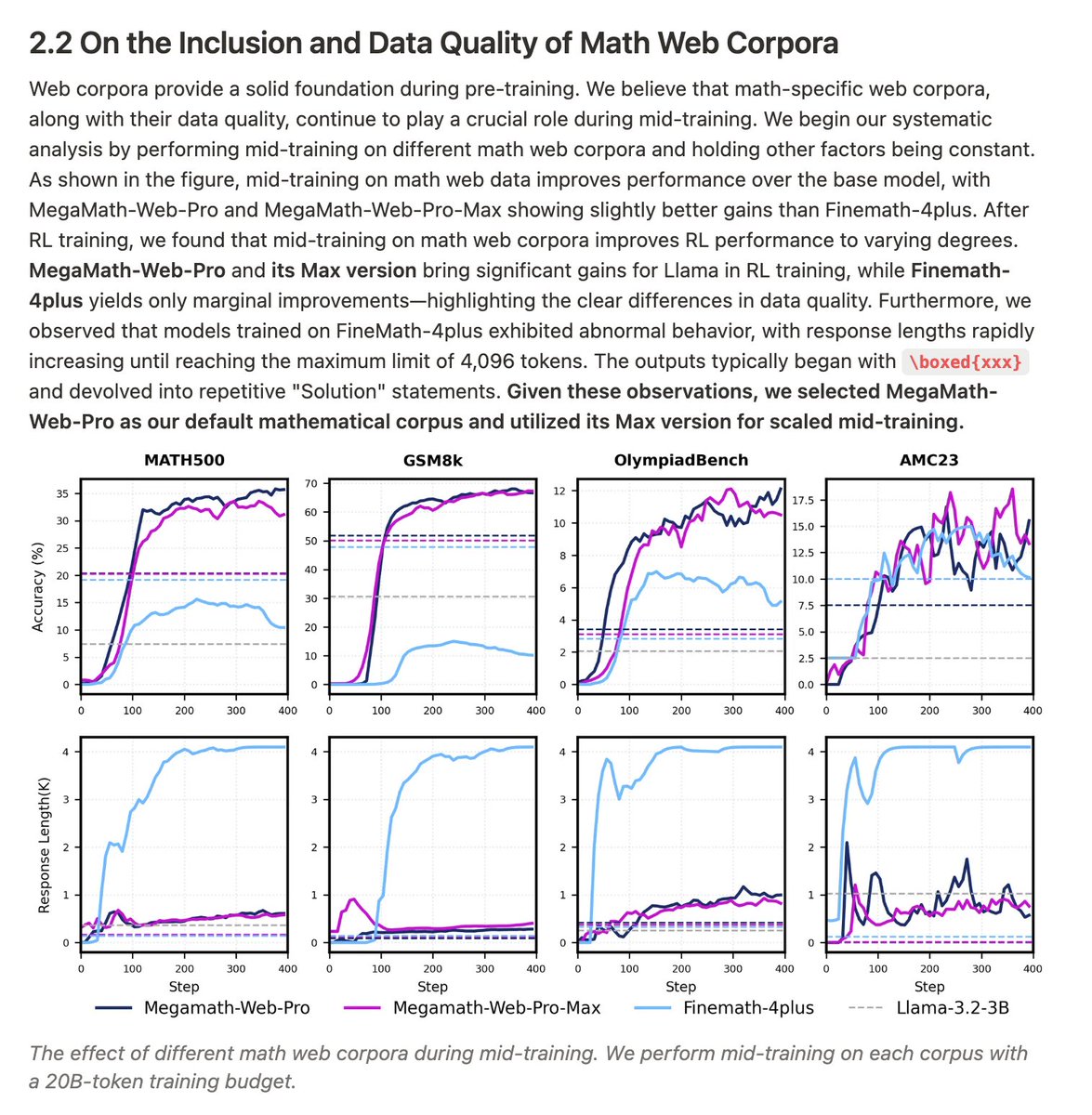
We found that mid-training on MegaMath-Web-Pro (and soon, MegaMath-Web-Pro-Max) significantly boosts RL scaling—outperforming FineMath-4+. (See third figure attached.)
Blog here: https://t.co/pgHe4yCA3I
The tech report + MegaMath-Web-Pro-Max open release is coming late this week or early next. Still working hard on it—stay tuned!
Finally, I want to shout out to the amazing data engineering work from @huggingface (cc @LoubnaBenAllal1). Their contributions—FineWeb, FineWeb-Edu, FineMath, Nanotron—are hugely appreciated. Their curation, technical depth, and open-source spirit inspired much of our own work, including ProX (https://t.co/WPvYLONFG3) and MegaMath. Thank you!
If you’re building models and need high-quality corpora—feel free to explore ours:
MathPile: https://t.co/ciuGaFvJDe
DCLM-Pro: https://t.co/7749Pc5xfk
FineWeb-Pro: https://t.co/njdto6ia65
MegaMath: https://t.co/VIdyPlEx30
More is coming—let’s keep brainstorming & building. 🚀
🚀 Excited to introduce our latest work GRESO: a method that identifies and skips millions of uninformative prompts before rollout and achieves up to 2.0x wall-clock time speedup in training.
More rollouts lead to better model performance, but they’re also a major bottleneck in RL ⚠️—and not every prompt is worth the cost. Why waste resources on the rollout of uninformative data?
🔗 Blog: https://t.co/Yspx6AT7rv
📄 Paper: https://t.co/Uqedh29GhA
💻 GitHub: https://t.co/mEtluCagUD