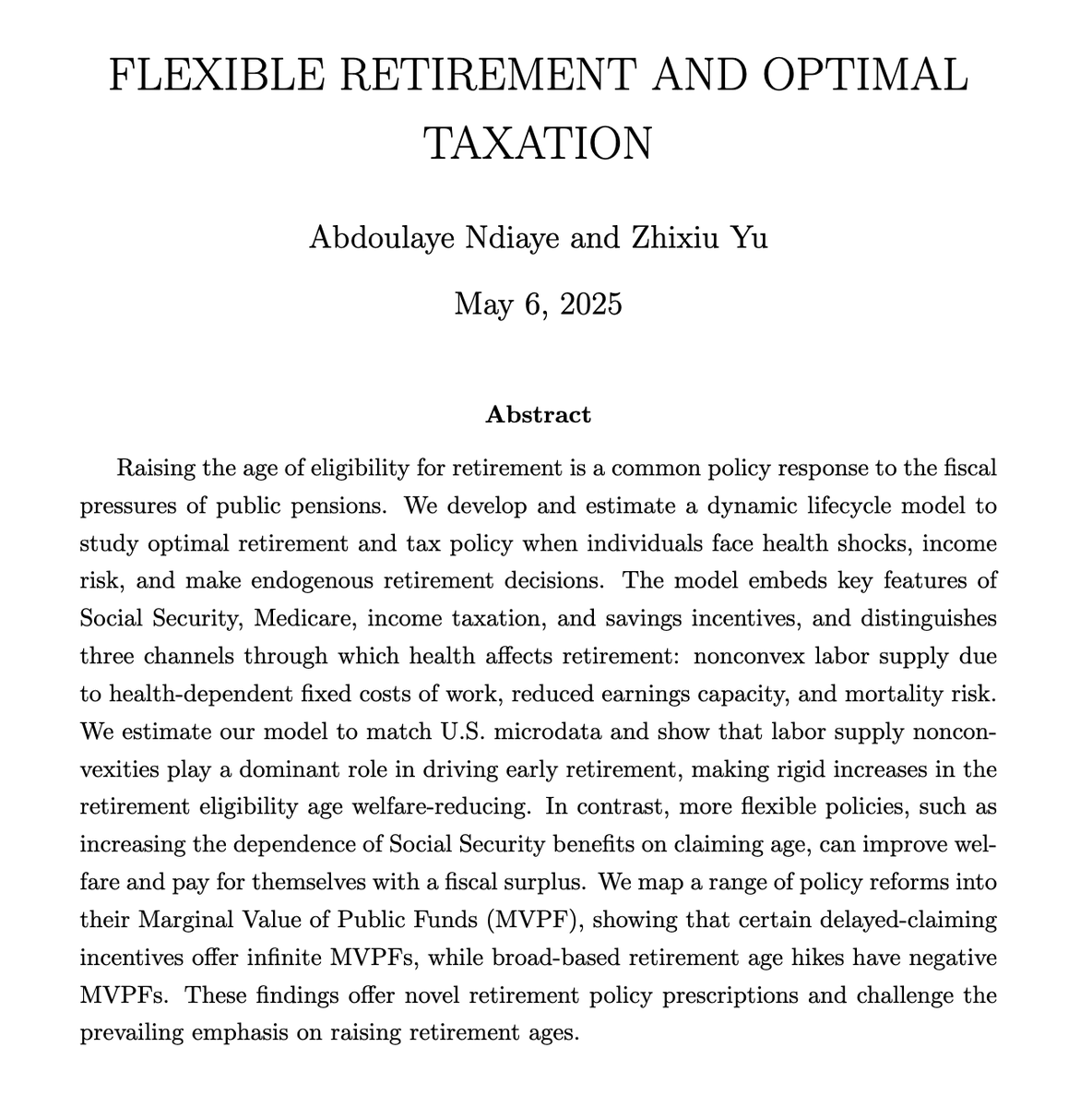
What is the optimal retirement and tax policy when individuals face health shocks and risk to their income? In a new paper, @and_joy_ @NYUSternEcon and @ZhixiuYu7@LSU compare flexible retirement policies to retirement age increases. Read more: https://t.co/HVM915da0H
In a new working paper, HCEO member @ZhixiuYu7 and coauthor @AbdouNdiayeNYU model the dynamics of retirement and identify novel, welfare-enhancing retirement policy prescriptions. https://t.co/4AfRRpBP4U
Here is a policy simulator accompanying our paper, where you can simulate the effects of a combination of Social Security and other retirement policy reforms.
🔗: https://t.co/2qqrcUkGI5
Thx to Adrien Jalouneix for research assistance.
On a personal note, I've had a blast working on a major revision of this paper with @ZhixiuYu7. In the process, we have each had our other real-life baby to care for.
A few days ago, I told you about the public finance research of the newest John Bates Clark medalist 🏅 Stefanie Stantcheva. There are important open questions in that research, such as, what are the best retirement policies?
My paper with Zhixiu YU answers that question. A 🧵
Recently published paper in the @JPubEcon :
"Why Are Older Men Working More? The Role of Social Security"
Vol 231 (Mar 2024)
by Zhixiu Yu (@ZhixiuYu7 @LSUOursoCollege )
https://t.co/d0KwlV6Vtk
To what extent do Social Security reforms account for the rise in the labor supply of older workers?
The Retirement Earnings Test reform is the main driver. Disparities in labor responses by health status are driven by the work disincentives provided by disability benefits.