Differentiable rendering made SIMPLE❗️
Differentiating physically based renderers is hard: Dirac-delta discontinuities arise at object silhouette. Our #SIGGRAPHAsia2024 work shows how a simple relaxation can rescue the day, enabling easy 3D reconstruction and relighting! (1/N)
We built our 3D coding harness earlier this year (https://t.co/ZFSMjKfjny), back when none of the models we tested could really hit the bar.
Revisiting it now with stronger models like Astra, we’re seeing a sharp threshold: below it, the harness helps a lot. above it, almost not at all. This is mostly the same across all model providers.
A small warning for everyone building “agents”: all of today’s scaffolding will eventually get eaten by the base model.
Also, we're not done playing with this. Sharing more interesting stuff soon :)
I didn't get what GPT-6 meant for robotics until I actually tried it.
GPT-6 Astra just does physical ICL out of the box.
we drop a recording of a human doing a novel task into 𝗰𝗼𝗱𝗲𝘅 app. Prompt it to drive a robot arm the same way.
It just works on the first pass!
Open-source video generation is now faster than playback without compromising quality.
Introducing Video Delta Net (VDN): hybrid attention for live text-to-video with near-lossless quality.
VDN accelerates Minimax-H3 by 75 - 90 x, generating 14 seconds of 768p video in 11 seconds on 8× NVIDIA B200 GPUs.
Checkpoints + training/inference code + Technical Blog ⬇️
(1/6)
We live in a multimodal world. We see, talk, act, and dream.
Yet most LLMs still start with language pretraining. Why not train them natively with multimodal I/O from scratch?
Because it’s SUPER HARD, adding modalities triggers training instability, design complexity, and often modal competition
So what’s the path forward?
Introducing: Towards Physics of Multimodal Pretraining (https://t.co/xgfbdDPFq4)
We unpack the underlying mechanics of multimodal pretraining across 4 aspects: Knowledge Flow, Modality Synergy, Early Unification, and Recipe.
Today, we’re introducing [schema]: a harness reaching 99% RHAE with Opus 4.8 + Fable 5 and 95.35% with GPT-5.6 Sol on ARC-AGI-3 Public set.
[schema] makes an LLM think like a physicist. 🧵
Children learn from play. Can robots do the same?
We propose 𝐏𝐥𝐚𝐲𝐟𝐮𝐥 𝐀𝐠𝐞𝐧𝐭𝐢𝐜 𝐑𝐨𝐛𝐨𝐭 𝐋𝐞𝐚𝐫𝐧𝐢𝐧𝐠, a paradigm that gives embodied coding agents a play stage before downstream tasks arrive, and instantiate it with 𝐑𝐀𝐓𝐬 (Robotics Agent Teams), where robots discover reusable skills through curious play.
Co-led with @jiaxin_ge_
New Mixture of Densities for modeling depth discontinuities 🤓☝️
We previously explored a Mixture of Experts approach in this direction : https://t.co/ohQlWqhtnF, and excited to see new ideas emerging in this niche but important problem.
Excited to share "Modeling Depth Ambiguity" (MDA), our multiview reconstruction model for **flying-point-free** depth.
Cleaner boundaries, little overhead, works across backbones, and naturally extends to sky and glass.
🌐 https://t.co/ggDsfcVkX8
📄 https://t.co/fffpq23MFX
This January, I decided to give it a shot and wrote my first paper
Today, I am happy to share that it was accepted by #SIGGRAPH2026
SAD is a differentiable image representation with soft, anisotropic partitioning, with up to 20x faster encoding time🧵
https://t.co/qhzxVZUvZ2
Most multi-view reconstruction models need full supervision. We show they can self-improve without any ground truth labels.
Introducing SelfEvo: Self-Improving 4D Perception via Self-Distillation. Up to +36.5% in video depth, +20.1% in camera estimation, zero annotation.
Most multi-view reconstruction models need full supervision. We show they can self-improve without any ground truth labels.
Introducing SelfEvo: Self-Improving 4D Perception via Self-Distillation. Up to +36.5% in video depth, +20.1% in camera estimation, zero annotation.
𝗢𝗻𝗲 𝗺𝗲𝗺𝗼𝗿𝘆 𝗰𝗮𝗻’𝘁 𝗿𝘂𝗹𝗲 𝘁𝗵𝗲𝗺 𝗮𝗹𝗹.
We present 𝗟𝗼𝗚𝗲𝗥, a new 𝗵𝘆𝗯𝗿𝗶𝗱 𝗺𝗲𝗺𝗼𝗿𝘆 architecture for long-context geometric reconstruction.
LoGeR enables stable reconstruction over up to 𝟭𝟬𝗸 𝗳𝗿𝗮𝗺𝗲𝘀 / 𝗸𝗶𝗹𝗼𝗺𝗲𝘁𝗲𝗿 𝘀𝗰𝗮𝗹𝗲, with 𝗹𝗶𝗻𝗲𝗮𝗿-𝘁𝗶𝗺𝗲 𝘀𝗰𝗮𝗹𝗶𝗻𝗴 in sequence length, 𝗳𝘂𝗹𝗹𝘆 𝗳𝗲𝗲𝗱𝗳𝗼𝗿𝘄𝗮𝗿𝗱 inference, and 𝗻𝗼 𝗽𝗼𝘀𝘁-𝗼𝗽𝘁𝗶𝗺𝗶𝘇𝗮𝘁𝗶𝗼𝗻.
Yet it matches or surpasses strong optimization-based pipelines. (1/5)
@GoogleDeepMind@Berkeley_AI
Train Beyond Language. We bet on the visual world as the critical next step alongside and beyond language modeling. So, we studied building foundation models from scratch with vision.
We share our exploration: visual representations, data, world modeling, architecture, and scaling behavior! [1/9]
✨Thinking with Blender~
Meet VIGA: a multimodal agent that autonomously codes 3D/4D blender scenes from any image, with no human, no training!
@berkeley_ai#LLMs#Blender#Agent 🧵1/6
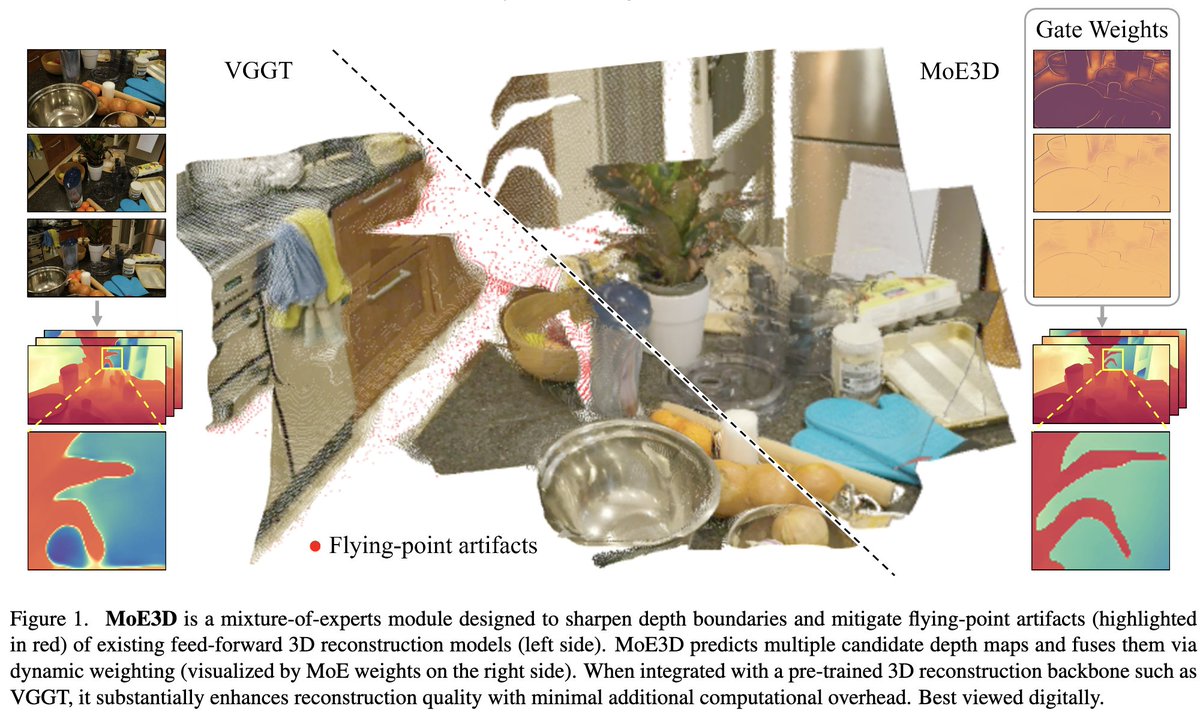
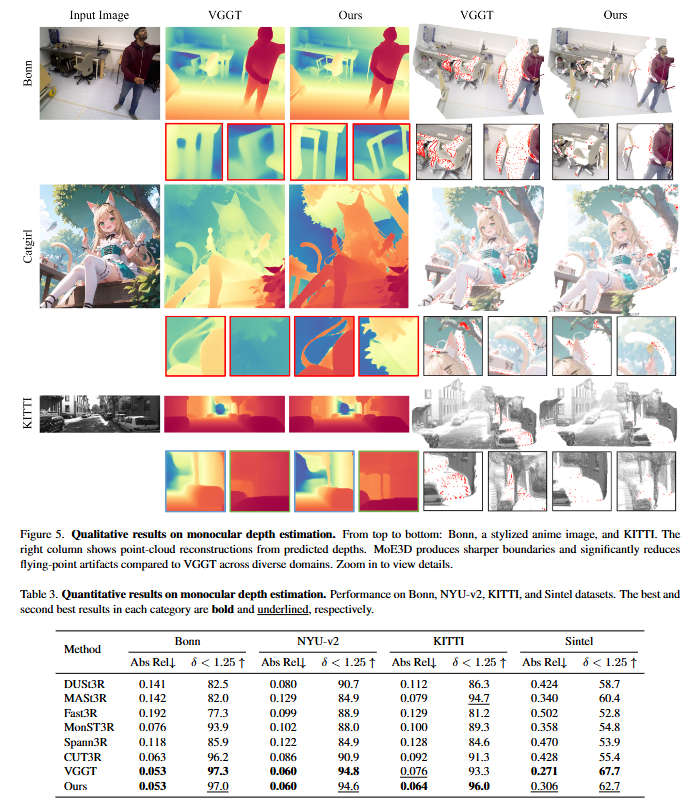
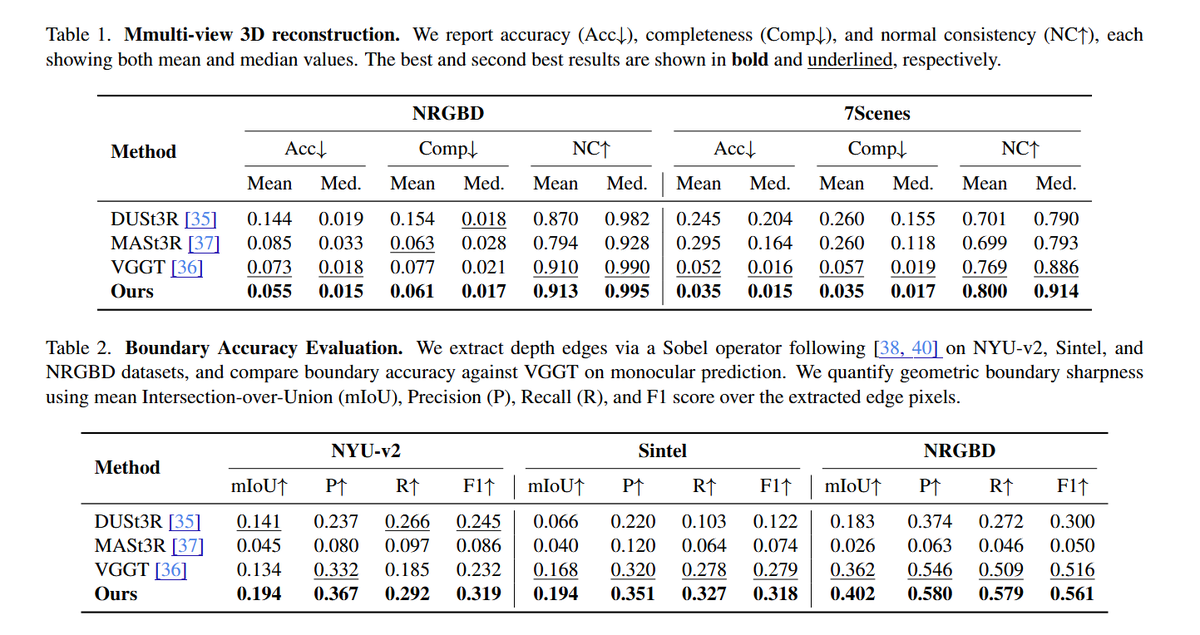
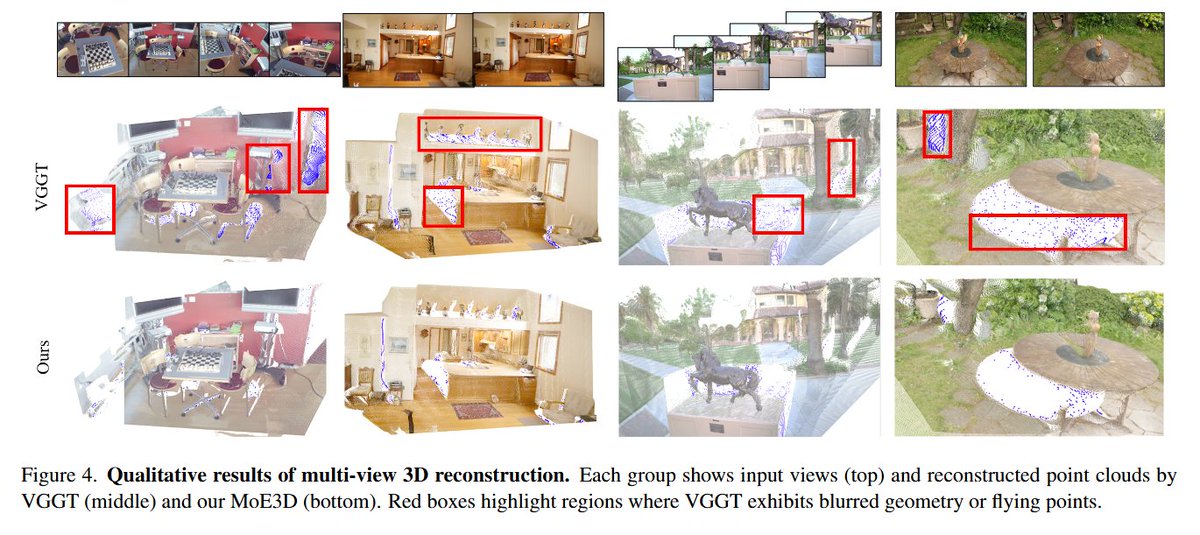
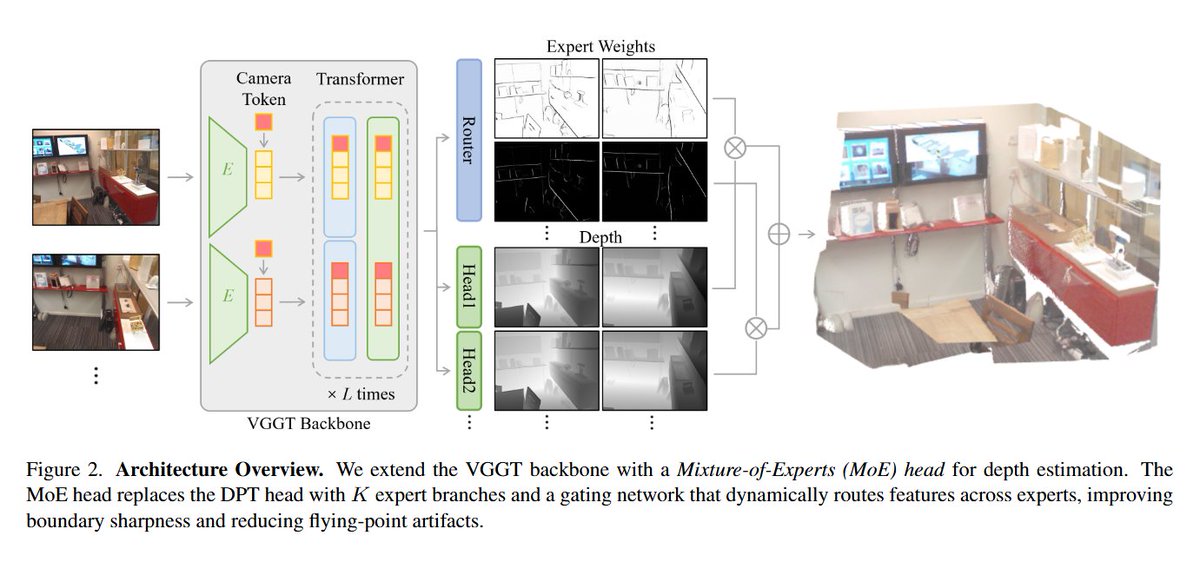
Wang et al., "MoE3D: A Mixture-of-Experts Module for 3D Reconstruction"
Flying pixels in DPT-based models are coming from the fact that DPT modules are convolutional. Introducing MoEs allows you to circumvent that. So...sort of bilateral filtering?
MoE3D: A Mixture-of-Experts Module for 3D Reconstruction
@Zichen2501, @AngCao3, Liam J. Wang, @jjpark3D
tl;dr: multiple depth predictions and weights->softmax weighting-based fusion->depth estimation
https://t.co/XBUFdC5dQJ
MoE3D: A Mixture-of-Experts Module for 3D Reconstruction
@Zichen2501, @AngCao3, Liam J. Wang, @jjpark3D
tl;dr: multiple depth predictions and weights->softmax weighting-based fusion->depth estimation
https://t.co/XBUFdC5dQJ




![TongPetersb's tweet photo. Train Beyond Language. We bet on the visual world as the critical next step alongside and beyond language modeling. So, we studied building foundation models from scratch with vision.
We share our exploration: visual representations, data, world modeling, architecture, and scaling behavior! [1/9]](https://pbs.twimg.com/media/HClL4cFbEAA3PHP.png)