1/4 Today we released two new link prediction models developed over the past 12m. We solve many problems that prevent GNNs succeeding at link prediction by adding a message passing mechanism that uses sketches of subgraphs.
https://t.co/0G6qTl5BiR
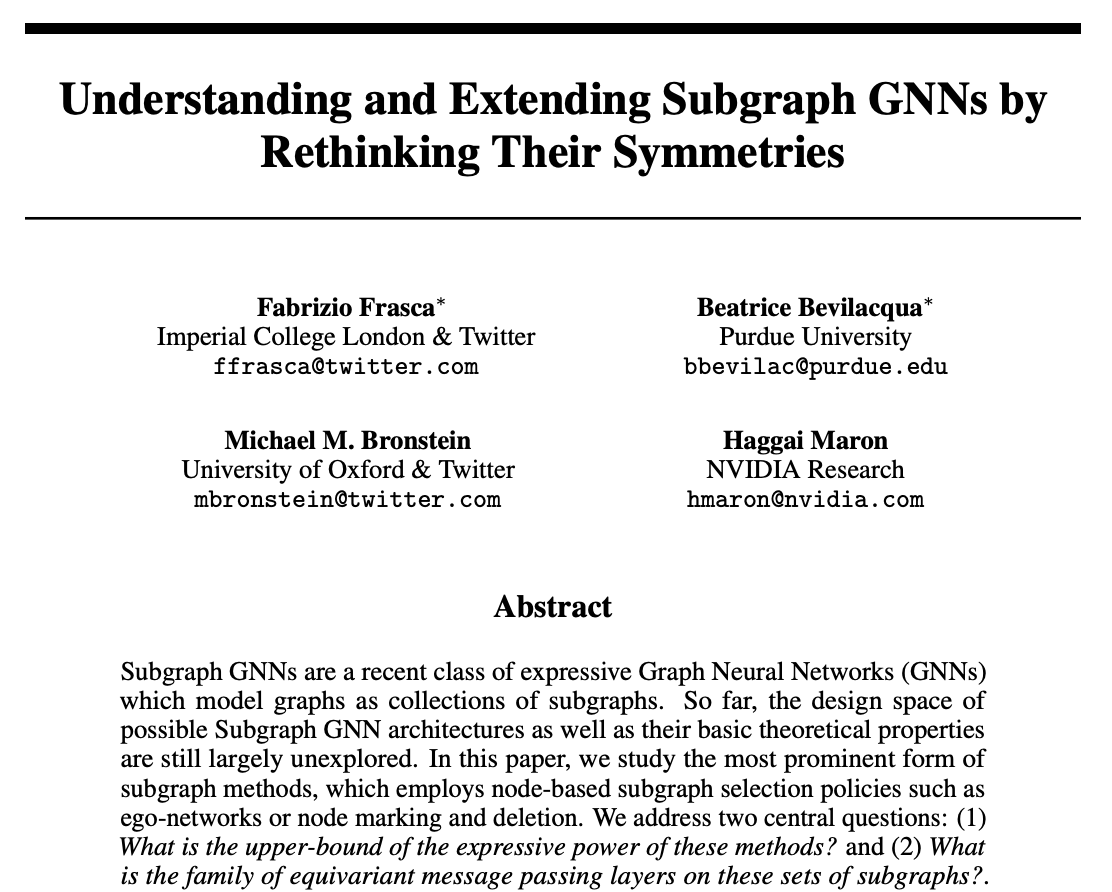
Overwhelmed by a plethora of similar, expressive GNN architectures? Symmetries and equivariance to the rescue again! 🧵
A fresh, unifying perspective on Subgraph GNNs appearing at #NeurIPS2022 😊
Joint work with: @beabevi_ * @mmbronstein@HaggaiMaron – https://t.co/rpbEXXVqV1
@Airbnb is using our SIGN method in production to compute graph-based user embeddings, leading to "notable performance gains".
Why was it chosen? Scalability, simplicity and predictive performance.
https://t.co/N1itGDSRqy
@AirbnbEng
@play_eFootball Hi, could you please fix the button config on mobile. When I change the Defend buttons, the Attack buttons change too. Unplayable now. This did not happen in previous version.
The code for our Feature Propagation method to learn on graphs with partially missing node features is now available!
https://t.co/TBbkU08szM
Co-authors: @hennesseeeeee@migorinova @b_p_chamberlain @epomqo@mmbronstein @TwitterEng
Excited to be presenting our work on GNNs for graphs with missing node features at the amazing Graph ML reading group hosted by @HannesStaerk!
See you tomorrow at 4pm GMT: https://t.co/z6M0QZ3MXO
Paper explanation: https://t.co/01PznbXnm7
Blog post: https://t.co/lSCNNQ9d0l
A recording of my talk @Harvard@HarvardCMSA showing our recent works @Twitter#Cortex on novel models for learning on graphs inspired by differential geometry, physics, and PDEs:
https://t.co/fCxj0jPxUg
While most GNNs assume a full set of features for all nodes, real-world graphs often have partially missing node features. In a new blog post with @mmbronstein, we discuss how we can learn on such graphs using Feature Propagation (10 min read) 📝
https://t.co/lSCNNQ9d0l
An annual round of predictions in Geometric and Graph ML coauthored with @PetarV_93 based on input from the leading experts in the field.
Longread on @TDataScience
https://t.co/uSf4l6fRXx
I am beyond excited to present our research at @NeurIPSConf on Monday at 5pm EST. Come by to find out how real humans respond to AI explanations and how to make explanations better. Work done with @b_mittelstadt@danbusbridge and Dr Grant Blank.
Learn about the state of the art in Hyperparameter Tuning! @otterkoala from Twitter Cortex will present the follow up analysis of our 2020 Black Box Optimization Challenge at INFORMS on Oct 24:
Link below for more details about the event.
https://t.co/Z55ZfvJlrH