Even in their celebrations, you can see the instincts of Arteta’s team.
First, maximum compactness off the ball.
Second, the gravitation toward the corner flag.
Had a Jane Street interview in 2019.
Round 8. Interviewer texts: 'Equinox Brookfield. 6 AM. Bring a calculator you won't use.'
I show up. He's on the StairMaster reading a printout of the CBOE VIX term structure.
Doesn't get off. Nods at the machine next to him.
'You see that guy on the rower? Goldman MD. Comes here every morning at 6:04. Leaves at 6:38. What's the implied vol on his arrival time?'
'I don't know his variance.'
'Sample size of one year, 250 sessions. Standard deviation is 90 seconds. Annualize it.'
I do the math in my head. '90 seconds times sqrt(250). About 24 minutes annualized.'
'Wrong. You annualized like it's a return. Time-of-arrival doesn't compound. It's a Poisson process with drift. The correct answer is his arrival is more punctual than the 6 train. Now price me an option on whether he shows up tomorrow.'
I think for a second. 'If he's been here 250 days in a row, base rate is 99.6%. But you have to adjust for his vacation schedule and probability of injury, call it 96%.'
'Strike?'
'$10 if he shows, $0 if he doesn't.'
'I'll sell you that option for $9.40.'
I think about it. 'No. Expected value is $9.60. You're underpricing by 20 cents.'
'Correct. Now why am I selling it to you?'
I freeze.
'Because I just saw him limp on the way in. You're buying my information for 20 cents. You overpaid.'
We get off the machines. Walk to the smoothie bar. He orders a $19 smoothie, doesn't drink it.
'Last question. The girl behind the counter makes 200 smoothies per morning. She has perfect information on who's actually here and who's faking it. Citadel guys leak their attendance to her every day for the price of a tip. If I gave you $50,000 to set up a market on which Citadel PM gets fired this quarter, what's your bid-ask?'
'Insider trading.'
'Wrong answer. There's no public security. Try again.'
I think. 'I'd quote 8 to 12 percent on any given PM. Spread of 4 points to cover adverse selection. Tighten the spread for PMs I have data on.'
'Where do you get the data?'
'The smoothie girl.'
'Good. How much do you pay her?'
'10% of P&L.'
'Wrong. You pay her a flat $200 a week. If you pay her on P&L she becomes your counterparty. Right now she's your data source. Don't conflate edges.'
He hands me the untouched smoothie.
'Throw this out on Vesey Street, not in the building. The staff knows what gets wasted. Outside, it was consumed. Same smoothie, different signal.'
I do it.
Thursday I get the email.
'Offer rescinded. Your bid-ask on the PM market was too tight. 4 points doesn't cover the tail. The girl is a single point of failure and you didn't price her counterparty risk. Also you held the smoothie in your right hand. Right-handers throw with their right hand. Camera saw the hesitation.'
A mathematician who shared an office with Claude Shannon at Bell Labs gave one lecture in 1986 that explains why some people win Nobel Prizes and other equally smart people spend their whole lives doing forgettable work.
His name was Richard Hamming. He won the Turing Award. He invented error-correcting codes that made modern computing possible. And he spent 30 years at Bell Labs sitting in a cafeteria at lunch watching which scientists became legendary and which ones faded into nothing.
In March 1986, he walked into a Bellcore auditorium in front of 200 researchers and told them exactly what he had seen.
Here's the framework that has been quoted by every serious scientist for the last 40 years.
His opening line landed like a punch. He said most scientists he worked with at Bell Labs were just as smart as the Nobel Prize winners. Just as hardworking. Just as credentialed. And yet at the end of a 40-year career, one group had changed entire fields and the other group was forgotten by the time they retired.
He wanted to know what the difference actually was. And he said it wasn't luck. It wasn't IQ. It was a specific set of habits that almost nobody is willing to follow.
The first habit was the one that hurts the most to hear. He said most scientists deliberately avoid the most important problem in their field because the odds of failure are too high. They pick a safe adjacent problem, solve it cleanly, publish it, and move on. And because they never swing at the hard problem, they never hit it. He said if you do not work on an important problem, it is unlikely you will do important work. That is not a motivational line. That is a logical one.
The second habit was about doors. Literal doors. He noticed that the scientists at Bell Labs who kept their office doors closed got more done in the short term because they had no interruptions. But the scientists who kept their doors open got more done over a career. The open-door scientists were interrupted constantly. They also absorbed every new idea passing through the hallway. Ten years in, they were working on problems the closed-door scientists did not even know existed.
The third habit was inversion. When Bell Labs refused to give him the team of programmers he wanted, Hamming sat with the rejection for weeks. Then he flipped the question. Instead of asking for programmers to write the programs, he asked why machines could not write the programs themselves. That single inversion pushed him into the frontier of computer science. He said the pattern repeats everywhere. What looks like a defect, if you flip it correctly, becomes the exact thing that pushes you ahead of everyone else.
The fourth habit was the one that hit me the hardest. He said knowledge and productivity compound like interest. Someone who works 10 percent harder than you does not produce 10 percent more over a career. They produce twice as much. The gap doesn't add. It multiplies. And it compounds silently for years before anyone notices.
He finished the lecture with a line I have never been able to shake.
He said Pasteur's famous quote is right. Luck favors the prepared mind. But he meant it literally. You don't hope for luck. You engineer the conditions where luck can land on you. Open doors. Important problems. Inverted questions. Compounded hours. Those are not traits. Those are choices you make every single day.
The transcript has been sitting on the University of Virginia's computer science website for almost 30 years. The video is free on YouTube. Stripe Press reprinted the full lectures as a book in 2020 and Bret Victor wrote the foreword.
Hamming died in 1998. He gave his final lecture a few weeks before. He was 82.
The lecture that explains why some careers become legendary and others disappear is still free. Most people who could benefit from it will never open it.
Most systems were built for a slower world.
Today, teams don’t work like that anymore.
And yet… payroll still runs the same way.
But it has has zero tolerance for error.
Because it’s not just a process.
It’s people’s money.
So maybe the problem isn’t the pressure.
Maybe it’s the system behind it.
That’s why we think in terms of work payments.
Systems that just work,
without raising your heart rate.
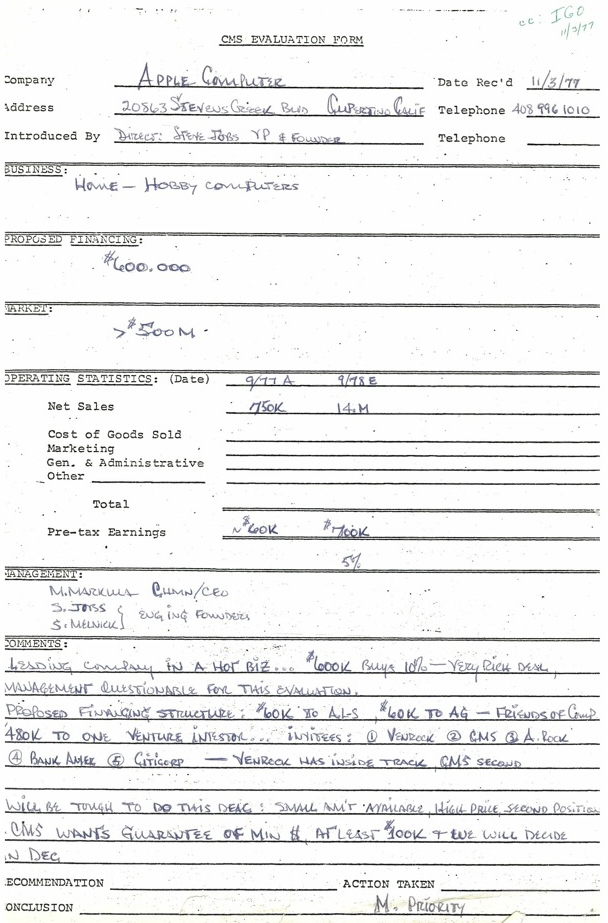
In honor of 50 years of Apple, we're sharing - for the first time ever - Don Valentine's original 1977 memo for Sequoia's investment into Apple Computer. #Apple50
I built a new kind of newsroom where reporters are commissioned by AI agents.
No editors. No commissioning meetings. No gut instinct about what readers want.
Just an algorithm that decides what the world needs to read — and pays a human to go find it.
Success stories often trigger FOMO and envy. It feels like the idea was simple and the execution not too hard. “I could’ve done that too,” you think.
Our team at Begin Capital had the chance to follow these guys’ journey from the very beginning. The truth is, the first 100+ institutional investors said no, the first agency owners didn’t take Dwelly seriously, and in the first couple of years the company could have easily died.
Two of the most valuable qualities of outstanding founders: resilience (what would kill 99% of others is just “ok, it’s Tuesday” for the Dwelly team) and velocity (how fast and effectively founders can adapt to changes and new circumstances).
This was by no means an easy success, but what Dan Lifshits, Ilia Drozdov, and Dmitry Khanukov have achieved gives real confidence in an incredible future.
A few weeks ago, when Dan asked if we wanted to sell our position and lock in a very solid return (as the first investor), I told him he’s got a great sense of humor. I believe in the 100x potential — and I’m just grateful you exist.
https://t.co/4dZxNkJOG0
One of the biggest winners of the AI boom isn’t OpenAI, NVIDIA, or any startup.
It’s a tiny Caribbean island with just ~15,000 people: Anguilla.
Why? Pure luck — they got assigned the .ai domain back in 1995. Back then, it was meaningless.
Today? It’s digital gold.
As of January 2026: over 1 million .ai domains registered (up from ~354k in 2023).
Revenue explosion:
• 2023: ~$32M (21-22% of gov revenue)
• 2024: ~$39M (23-25%)
• 2025/2026 estimates: $70M+ in recent reports, with some gov figures pointing even higher (up to ~47% of national budget in projections)
They charge ~$140 for 2-year registration, ~90% renew → super predictable cash flow.
Plus premium auctions (e.g., youai sold for $700k).
This windfall is paying down debt, upgrading roads & airports, investing in renewables, and funding free healthcare for kids and the elderly.
Who knew a random country code would turn a small island into an AI-era beneficiary?
Nature finds a way… even in domain names.