“Accelerating Scientific Research with Gemini in the Real-World”
This paper closes that gap of previous AI scientists by connecting Co-Scientist to experiments, lab hardware, and execution feedback across materials science, biology, and computer science.
From generate hypotheses, design experiments, all the way to interact with real lab hardware, use experimental feedback, and then write papers from the resulting evidence, it automates science research completely end-to-end.
https://t.co/QNVtC7mJYH
Fui bolsista de iniciação científica pela FAPESP durante a faculdade. Por isso, é muito triste ver a situação que a nossa principal agência de fomento à pesquisa chegou.
Se São Paulo é o estado brasileiro que mais produz pesquisa científica, é graças ao financiamento público através de agências com a FAPESP.
Nos últimos anos, lutamos na ALESP contra manobras do governo Tarcísio que reduziam os recursos da FAPESP no Orçamento do estado.
Agora a conta chegou.
Estamos estudando as medidas cabíveis para impedir a extinção do programa de bolsas para pesquisas no exterior. Em breve trago novidades.
We are entering the era of biological computing.
Singapore just unveiled the world's first biological data center prototype with a reported ~16 million lab-grown human neurons.
It's established at the NUS Life Sciences Institute, it comprises 20 CL1 biological computing units.👀
These living neurons connect with computing hardware, process electrical signals and adapt, while built-in life-support systems keep them alive.
This project aims to explore whether biological computing could become a more adaptive and energy-efficient complement to conventional silicon-based systems.
This is such a wild study!
Intelligence may partly be the capacity to meet energy demands by finding new ways to transform energy.
These sea slugs "steal" chloroplasts from the algae they eat (kleptoplasty), allowing them to photosynthesize for months without ever expressing photosynthetic genes.
Energy serves as a strong motivator for intelligent problem-solving. In this case, slugs are using tools that algae developed to draw energy from an abundant but otherwise inaccessible source: the Sun!
What if we could develop a technology to co-opt the biomachinery of other species without gene editing? Suppose healing wounds, slowing aging, and enhancing sensory systems could be achieved by leaning on the organic innovations of 9 million species over 4 billion years.
How many problems do we face that nature has already solved?
Full read here: https://t.co/p7G8P6MyFB
UMAP makes useful pictures, but what structure does it destroy?
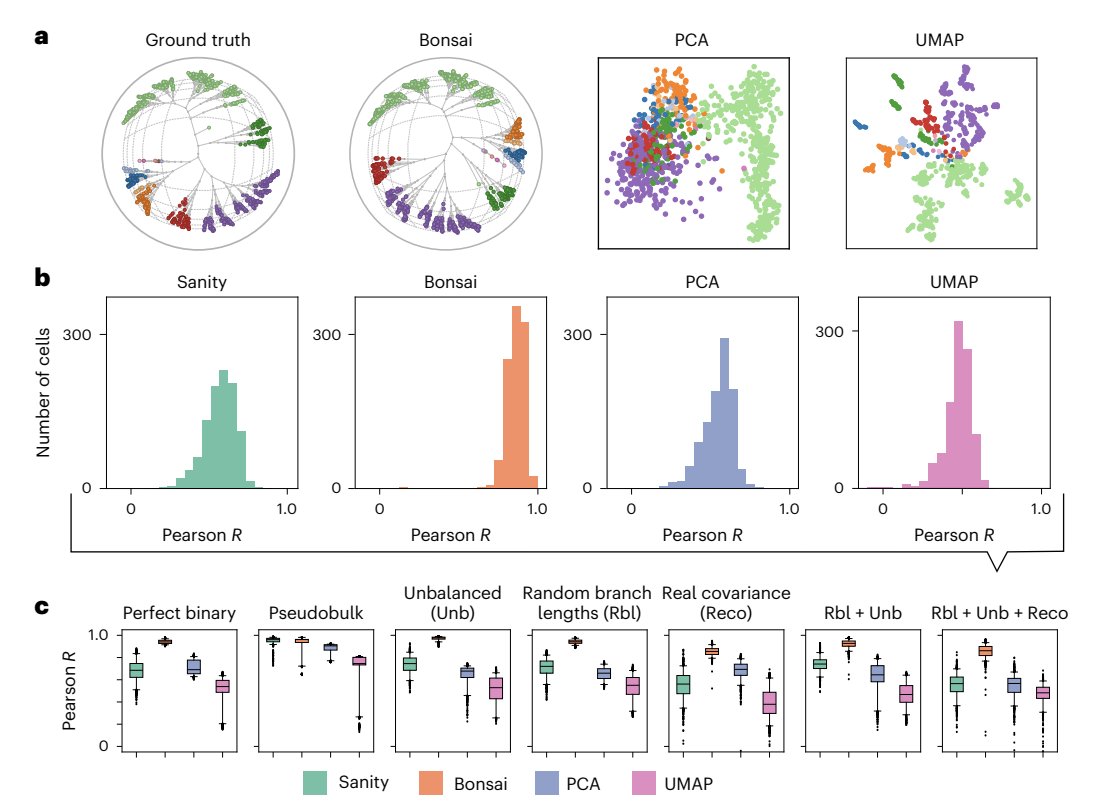
Daan H. de Groot and coauthors introduce Bonsai, a Bayesian method that represents high-dimensional data as a tree rather than forcing it into a conventional two-dimensional embedding.
The motivation comes from single-cell biology. Methods such as UMAP and t-SNE are extraordinarily useful for visual exploration, but their geometry is not a faithful representation of the original high-dimensional space. Local and global relationships can be distorted, and changing visualization parameters can change the apparent biological story.
Bonsai takes a different approach. Each cell is treated as a noisy point in high-dimensional gene-expression space, complete with uncertainty estimates. The method then reconstructs the maximum-likelihood tree connecting those points under a probabilistic model of how expression states can change.
Because a tree can always be drawn in two dimensions, visualization no longer requires projecting the data onto two artificial coordinates.
On synthetic benchmarks, Bonsai almost perfectly reconstructs structures that PCA and UMAP largely fail to recover. It also preserves cell-to-cell distances much more faithfully.
And the biological payoff is not only prettier visualization.
Applied to cord-blood single-cell data, Bonsai recovers established differentiation relationships and identifies an apparently previously undescribed subset of natural-killer cells associated with the myeloid rather than lymphoid lineage. The method also scales through a backbone implementation to datasets exceeding one million cells.
There is a broader scientific lesson here.
Dimensionality reduction is not a neutral preprocessing step. When ML changes the representation of scientific data, it can also change which hypotheses become visually plausible.
Paper: de Groot et al., Nature Biotechnology (2026), CC BY 4.0 | DOI: 10.1038/s41587-026-03220-2