https://t.co/NuuS1Vw0nn
Hi everyone, it has been awhile. I thought I should provide some updates since I first created the fundraiser.
I am now formally discerning with our vocations director, and can now say I am a pre-seminarian. As I am discerning with the Personal Ordinariate of the Chair of Saint Peter, a quirk of our vocations process is that prospective seminarians are asked to formally discern with the Ordinariate for at least a year, but the norm is to discern for more than a year. Therefore, it is unlikely that I could be admitted to seminary in 2026.
On the other hand, this affords me more time to get my finances and other affairs in order. On that topic, I still have no been able to find gainful employment in the time since I established the fundraiser, so continued donations would be appreciated. I would also appreciate prayers for my finances and for finding a job, in addition to prayers for my vocation!
Thank you once again for your help!
Fr. Cekada, who dies outside the Church, continues to decieve unsuspecting Catholics from beyond the grave.
As Cardinal Billot explains in the quote below, a "material heretic" is not a Catholic (i.e., one who submits to the Church's magisterium as the rule of faith) who errs in good faith; it is a public non-Catholic (e.g., a Protestant, Sedevacantist, etc.) who errs in good faith. A Catholic who errs in good faith can be in material heresy, but he is not a material heretic.
As Billot also explains below, "if by 'material heretic' you understand one who professes dependence upon the magisterium of the Church in matters of faith, but denies something defined by the Church because he is ignorant of the fact that it was defined, or holds an opinion contrary to Catholic teaching because he mistakenly thinks that it is taught by the Church, then it would be utterly absurd to put material heretics outside the body of the true Church; but this would also be to distort completely the true meaning of the word."
Both formal heretics and material heretics are outside of the Church, since both terms refer to public non-Catholics; that is, those who are separated from the body (or structure) of the Church.
Cardinal Billot, Tractus De Ecclesia Christi (1927):
"Formal and Material Heretics
"Now, heretics are divided into formal and material. Formal heretics are those to whom the authority of the Church is sufficiently known. Material heretics are those who, affected by invincible ignorance concerning the Church herself, choose in good faith another rule to determine what they are to believe. The heresy of material heretics is not imputed as a sin; on the contrary, it is possible for them to have even that supernatural faith which is the commencement and root of all justification; for, they might believe all the principal articles explicitly, and believe the others, not explicitly, but implicity, by the disposition of their minds, and the good intention they have of believing all truths whatsoever are sufficiently proposed to them as revealed by God. Consequently, they can still belong in desire to the body of the Church and meet the other conditions necessary for salvation.
"Nevertheless, because we are concerned with real incorporation into the visible Church of Christ, our thesis does not distinguish between formal and material heretics—understanding the latter according to the notion of a material heretic that we have just explained, which alone is the proper and genuine sense of the term. For, if by “material heretic” you understand one who professes dependence upon the magisterium of the Church in matters of faith, but denies something defined by the Church because he is ignorant of the fact that it was defined, or holds an opinion contrary to Catholic teaching because he mistakenly thinks that it is taught by the Church, then it would be utterly absurd to put material heretics outside the body of the true Church; but this would also be to distort completely the true meaning of the word. For, a sin is called “material” only when all the elements of that sin are present materially, but without advertence or deliberate choice. Now, heresy by its nature requires departure from the rule of the ecclesiastical magisterium. In the case cited, there is no departure; there is only an error of fact about what the rule dictates. Such an error cannot be heresy, even materially so.
"Since, in the present discussion, it makes no difference whether one be a formal or a material heretic, we will direct our attention to another division.
"Notorious and Occult Heretics
"Heretics are divided into occult and notorious. Occult heretics are, in the first place, those who by a purely internal act disbelieve dogmas of faith proposed by the Church. Those also are occult, who do indeed manifest their heresy by external signs, but not by a public [i.e., notorious] profession. You will easily understand that many men of our times fall into the latter category—those, namely, who either doubt or positively disbelieve matters of faith, and do not disguise the state of their mind in the private affairs of life, but who have never expressly renounced the faith of the Church, and, when they are asked categorically about their religion, declare of their own accord that they are Catholics."
The end of The Odyssey is literally about coming home to massacre all the strangers who have taken advantage of your hospitality and taking back what is rightfully yours, and the entire journey is also constantly just strange things showing up that often want to kill him and his men, typically by lulling them into false senses of security.
Even as warped and subverted Nolan’s version is from the original, his movie doesn’t at all communicate the need to be hospitable and kind to strangers. That doesn’t actually come through in his telling at all. I don’t even know how he thinks it does. The whole line is quite confusing given what he says and what’s actually shown on screen.
If someone criticizes their wife all day, you would be concerned for their marriage
Likewise, if the majority of someone’s content is critical of their own church people should be concerned for their spiritual health
The problems in the order were created by the destruction of their elaborate Formula of the Institute and Constitutions of the Society of Jesus and unlike the Dominicans I don't think there was a sufficient implicit patrimony for them to fall back into when things calmed down. They also outright adopted a recognizably modern left to center left mission and structure.
Konrad was shot in the back of the head by Jesuit operatives after posting this. It was a last ditch effort to appease the Society, hoping they’d remove the hit they’d placed on him for releasing the Pacelli Files.
Courage: "And so it must be said that preachers, catechists, and teachers have lost the courage to 'threaten with hell'." (John Paul II in his book "Crossing the Threshold of Hope")
Nick was clearly using the langauge commonly found in the Wisdom literature where "create" designates a perfect production on the side of the producer (as St. Thomas clearly explain).
"Wisdom was created before all other things." (Sir. 1:4) "The Lord created me as the beginning of his ways." (Prov. 8:22)
St. Thomas Aquinas: "The Son of God is said to be both created and begotten, in order that creation may exclude change in the begetter and birth exclude imperfection in the begotten, the two combining to give us one perfect idea." (QDePot.Q3.A18.Rep17)
Priest-friend got a call this week from an elderly parishioner asking if he had any need for the old high altar that's been sitting in his garage for the last 50+ years.
The idea of an entire generation of viejitas quietly saving these things for a future generation of priests is kind of wild.
It'll be reinstalled in the parish within the next six months.
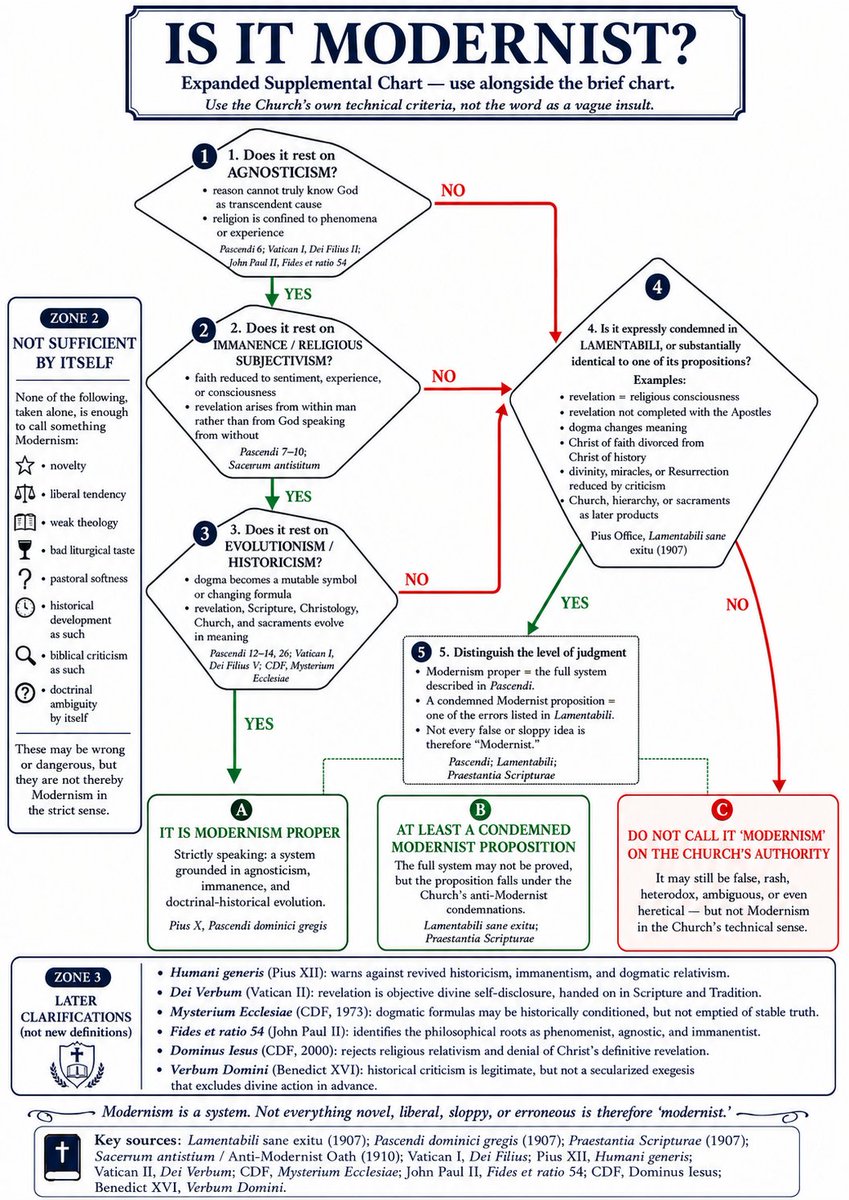
I have been autistically looking at every Roman Catholic-adjacent post on “modernism” for a week now, and it is plainly obvious that the overwhelming majority of you who use the term:
1. Understand it as meaning nothing more than anything you take to be vaguely opposed to so-called tradition.
2. Have not read the actual relevant documents of the Church.
3. Do not actually understand the teaching of the Church to which you are referring.
The liturgical reform, for example, is called modernist not because it actually aligns with anything condemned by St. Pius X or by any of the subsequent popes who made additional clarifications, but rather on the basis of nothing more than its being new, being disliked, and being subjected to insinuation founded on merely private and ambiguous interpretation. It goes on like this with every single thing frequently called modernist on this platform and on most others.
Needless to say, this has nothing actually to do with the teaching of the Church. And if your point was to avoid a private and evolving understanding of the Church’s teaching, based on a fundamentally agnostic approach to the divine reality of the instituted Church, then you have done exactly the opposite of what St. Pius X charged you to do.
Mother Miriam has done a complete 180 on the SSPX: "God has established His Church, his universe, everything on obedience, everything on obedience.
Children are to obey their parents, not if their parents are holy and right, in everything but sin. Wives are to submit to their husbands, not because they're holy, not because they're right, but because God has given them that position — again, in everything but sin. Religious are to obey their superiors, whether their superior is right or holier than them, or no matter what it is, they are to obey in everything.
And Christ's sheep, which is us, every one of us is to obey the successor of Peter, whether we know for sure he is, whether we agree with him, whether we can point out definite heresy. If he's the Pope, then we obey in everything but sin. We don't come against him. So that's where I left it yesterday, and my heart was completely converted."
https://t.co/Ca4kxb6VcQ
"Vatican 2 teaches religious relativism."
Meanwhile the actual teaching of Vatican II:
"The reason for missionary activity lies in the will of God... Everyone, therefore, ought to be converted to Christ, who is known through the preaching of the church, and they ought, by baptism, become incorporated into him and into the church. Christ himself explicitly asserted the necessity of faith and baptism... And so, today as always, missionary activity retains its full force and necessity." - Ad gentes 7
Because it's in the lectionary readings! Because the only Preacher deemed it important enough to warn people about it frequently in the Gospels. Because it is a dogma of the Church that is constantly undermined today and needs to be defended. Because psychologically, fallen human beings are often not effectively motivated to will the good by an exclusive focus on the positive (and this is why two of the four last things we are told to meditate on pertain to the possibility of being damned). Of course, it should always ultimately be contextualized by the positive because evil only exists with reference to good.
For the same reason that Scripture and tradition tell us to keep death in mind.
https://t.co/VA3BeHjxic
No Catholic apologist should be “searching for the truth”. There is no truth outside of the bosom of Holy Mother Church who embraces her children so tightly. A Protestant would be more likely to convince me that 2+2=5 than Rome erring on a single Dogma.
Saint Anthony Mary Claret was so overcome with the love of God, that when he heard the liberal bishops oppose Papal Infallibility at the First Vatican Council, he became indignant to the point of suffering a stroke he ultimately died from.
This is how we must love God.
Mental prayer has completely changed my life.
I have no idea how to explain it.
During prayer, it’s a fight to stay in contemplation. And truth be told, I don’t ‘get’ much from the prayer time itself in the moment, but I know that I must do it regardless.
However, outside of prayer, I notice that I have more interior peace, I’m less reactive and angry. It’s like I have developed this new kind of constancy seemingly out of nowhere.
Peace that is hard to explain. Less interiorly disturbed.
I’m not sure the mechanism at work here, but i can say with certainty that this change single handedly has to do with mental prayer every single day.
Moral of the story:
We all must do more mental prayer.
"Those who say that the Catholic Church employs violence against consciences in order to spread the faith of Christ truly slander her. Certainly violence existed and still exists, but the Church has suffered and continues to suffer it; she has not inflicted it."
At Southern Evangelical Seminary, a big nondenom seminary, the school experimented with having their students read Aquinas, to learn how to defend the existence of God using his arguments.
Over 20 seminarians left evangelicalism to become Catholic after this, and nine of them left their testimonies in “Evangelical Exodus”.
James White criticized the seminary for this, accusing the program of “being a gateway to Catholicism” because of its new curriculum.
This is just one example, but there’s a good reason evangelicals and Calvinists discourage their faithful from learning the history of Christianity.
A difference between Catholics and Orthodox I’ve seen, is that most Catholics hope and pray for reunification, whereas the average Orthodox gets sick at the idea of reunifying the church.
Catholics want to bring the entire Orthodox Church back into full communion, where the Orthodox think that every Catholic should convert to orthodoxy on an individual basis until unity is achieved.
The former *could* happen, the latter never will.
It goes back to the Council of Florence where the Orthodox hierarchy formally accepted the Pope and the Filioque, but were met with riots from the layman when they returned to Greece, where they eventually caved and reignited the schism.
Constantinople fell 14 years later and was the last of the 4 Orthodox sees to fall to the gates of hell.