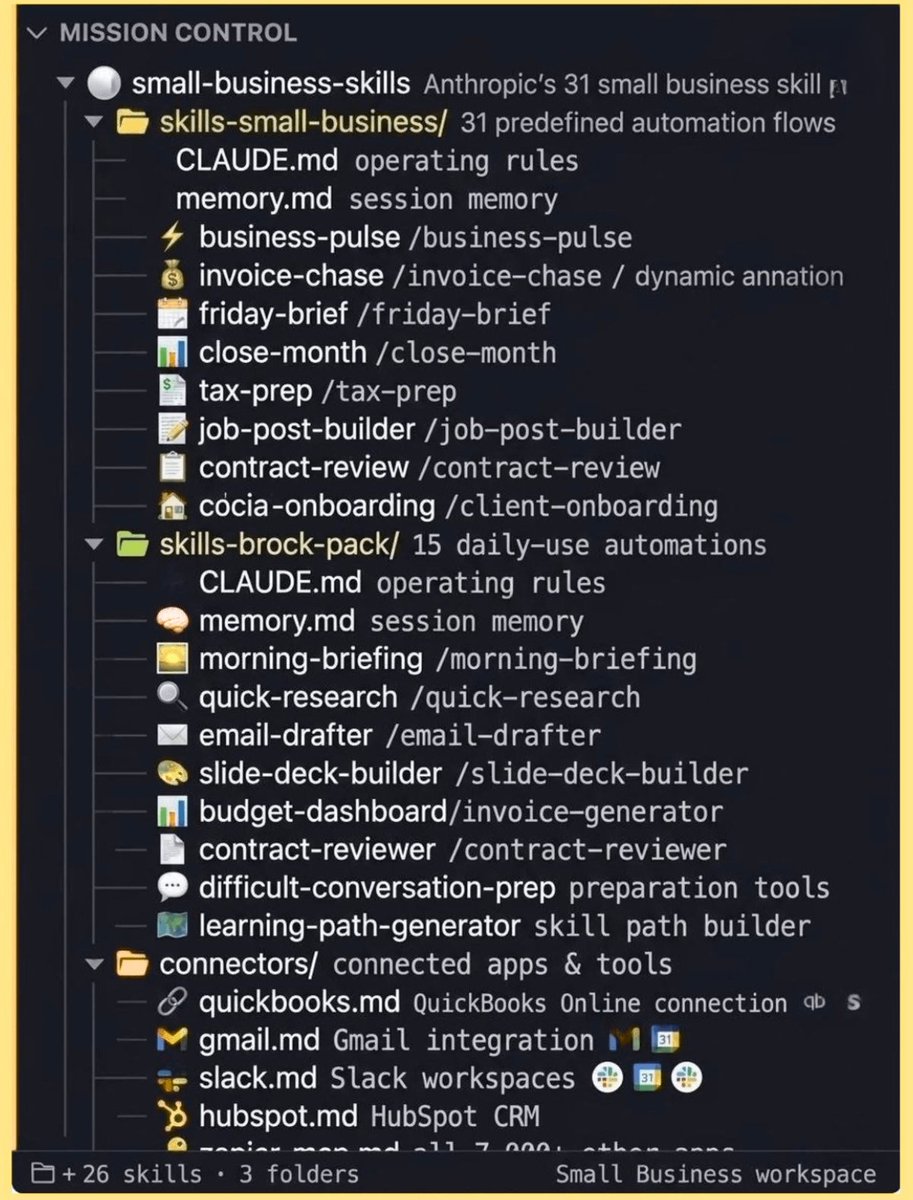
Anthropic just released 31 ready-to-use Claude skills for small businesses.
382,000 downloads in 24 hours.
I mapped every single workflow into a 10-minute setup guide.
Financial operations, sales automation, HR workflows, marketing growth, real-time dashboards.
Want the full breakdown?
Comment "Skills" + Follow @ameliahazelai (so I can DM you)
The breakdown includes:
→ All 31 skills organized by function
→ The 5 critical skills to deploy first
→ 12 connector setup guide in priority order
→ Permission settings for every sensitive action
→ Real output examples from Business Pulse, Invoice Chase, Job Post Builder
What changed:
Small businesses used to manually stitch together:
→ Zapier
→ Notion
→ CRM tools
→ Email workflows
→ Custom scripts
Now it's packaged into reusable AI skill packs:
→ Workflow logic
→ Memory systems
→ Behavior rules
→ Connectors
→ Orchestration
Business operations as AI-readable skill files.
The crazy part: You don't need Claude Pro to use them.
These are .md skill files. You can adapt them for Codex, Cursor, Gemini, or any coding agent.
Save this. Deploy the first 5 skills this weekend. Start automating.
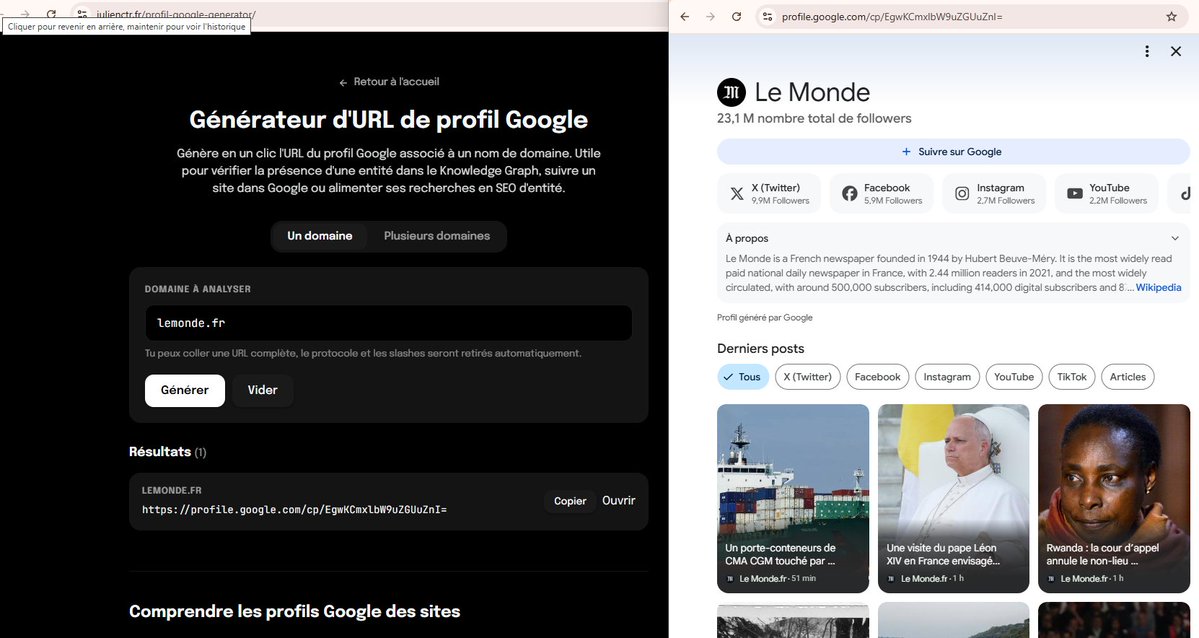
Google a une fiche secrète sur chacun de tes domaines. Et tu peux la lire.
Test gratuit ici : https://t.co/pvR2IIc8FS
(script original signé @1492_Vision, merci à lui)
10 raisons de tester sur tes domaines et ceux de tes concurrents :
1/ Vérifier si Google te reconnaît comme une entité. Fiche vide = tu n'existes pas pour le moteur.
2/ Lire la description que Google associe à ton domaine. Si elle ne reflète pas ton positionnement, tes signaux d'entité partent dans tous les sens.
3/ Voir les profils sociaux que Google rattache à ta marque. Compte concurrent collé à ton entité ? Profil officiel manquant ? Tu sais où corriger via sameAs.
4/ Identifier les contenus récents que Google associe à ton domaine. Ce qu'il considère comme ton actualité, donc ce qu'il met en avant.
5/ Diagnostiquer un Knowledge Panel manquant. Souvent Google a déjà la donnée mais choisit de ne pas l'afficher en SERP. Stratégie totalement différente derrière.
6/ Auditer 50 concurrents en lot avec le mode multi. Lecture instantanée de qui Google considère comme une entité solide et qui n'est qu'un nom de domaine.
7/ Filtrer tes cibles netlinking par solidité d'entité. Un lien depuis un site reconnu par Google pèse plus qu'un lien depuis un domaine inconnu du moteur, peu importe son DR ou son TF.
8/ Vérifier les associations cross-domaines. Sites internationaux, sous-marques, vieilles redirections. La fiche te montre si Google a regroupé tes actifs ou pas.
9/ Suivre l'évolution dans le temps. Reviens chaque mois pour voir comment la fiche bouge après tes actions de SEO d'entité. Baromètre indépendant de la Search Console.
10/ Aligner tes signaux avec les nouvelles surfaces IA de Google. Quand une AI Overview mentionne mal ta marque, neuf fois sur dix la fiche profil a déjà la mauvaise donnée. Corrige en amont, ça corrige en aval.
how to use autoreason for ad creative
you run Meta ads, your best creative has a 1.8% CTR and $19 CPA, and you want both numbers to improve. most marketers would prompt an LLM with "write me 10 ad variations" and test whatever comes back.
the problem with asking AI to rewrite its own work is it never says "this is already good." it invents problems that don't exist, drifts from the original angle with every pass, and keeps changing things even when the output was fine two rounds ago.
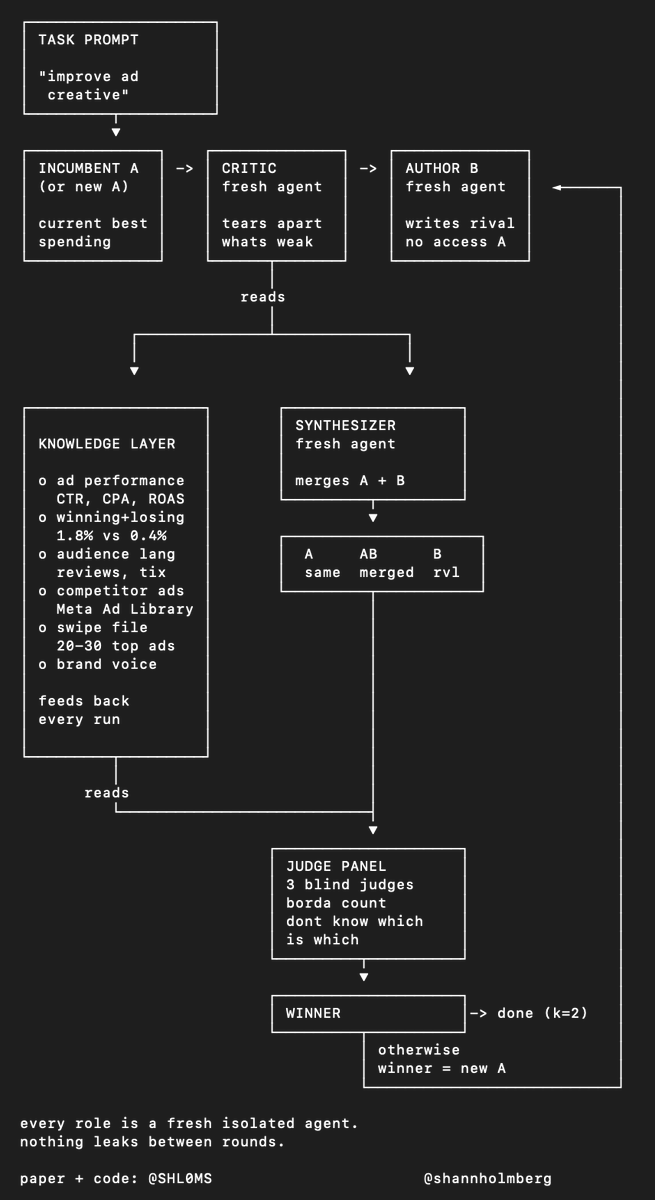
autoreason tries to fix that with adversarial isolation. every role in the loop is a fresh agent that can't see what the others wrote.
your current best ad is incumbent A, the one that's live and spending.
the critic:
a fresh agent reads your knowledge layer and tears incumbent A apart. it pulls from:
> your last 50 ads with performance data, what patterns separate the 1.8% CTR creatives from the 0.4% ones
> audience language from reviews, support tickets, reddit threads, how customers describe the problem in their own words
> competitor ads from Meta Ad Library and TikTok Creative Center
> a swipe file of 20-30 high performing ads in your vertical, the ones you know are spending heavy because spending heavy means working creative
the critic doesn't rewrite anything, it just produces a teardown. whats weak in the hook, whats generic in the body, whats missing compared to ads that convert better.
author B
a fresh agent that has never seen the original ad. it only gets the critics teardown and the knowledge layer, then writes a rival version from scratch.
if author B could see incumbent A it would just rearrange the same words. keeping it blind is what forces a different angle instead of a tweak.
the synthesizer
a fresh agent takes both and produces three candidates:
> A unchanged (keeping the original is always an option, this is how the system knows when to stop)
> AB merged, pulling the strongest hook from one and the strongest body from the other
> B the rival as-is
the judge panel
3 blind agents score all three using borda count. they dont know which is original, which is rival, which is merge. they look at hook strength, clarity of the offer, social proof, CTA friction, and how each version stacks up against the swipe file.
the loop
winner becomes the new incumbent. if A wins twice in a row (k=2), the system stops because further iterations would just be scope creep. otherwise it loops back with fresh agents for every role.
nothing leaks between rounds. the judges have none of the context that produced the revisions, which is why their scoring stays clean.
the knowledge layer is one of the things that makes this work for ad creative instead of just generic prompt chaining:
> full ad performance history, CTR, CPA, ROAS per creative
> winning and losing patterns across your account
> customer language from reviews, tickets, reddit
> competitor ads from Meta Ad Library and TikTok Creative Center
> swipe file of high performing ads in your vertical
> your brand voice and positioning
without reference points for what a 3%+ CTR ad looks like in your space, the critic has no benchmark and the author writes copy that could be for any product. pull 20-30 ads from competitors and adjacent brands that you know are spending heavy, screenshot them, feed them in.
you still run the winner through real A/B testing in Meta. autoreason just narrows the search space so youre testing strong candidates instead of random shots.
results feed back every run so the next one is sharper
paper + code: SHL0MS / Nous Research
Google just revealed how sites must be named if you want to show in traditional and AI search results.
This comes straight from Google’s John Mueller.
Someone complained that their site doesn’t show when they search for their own site name.
John’s response was fairly blunt.
If your “site name” is made up of generic, competitive keywords, Google does not assume people are looking for you.
And that same logic now applies to AI search.
It is also the exact problem that SEO Stuff has been helping businesses solve all year.
https://t.co/eh1auroJF7
Here’s the core idea in plain English.
If your brand name looks like a keyword, Google treats it like a keyword.
If it doesn’t uniquely identify you, AI won’t either.
The example John gave.
If your site is called something unique like:
“Aware_Yak6509 Productions,”
and your homepage is indexed, then Google can reasonably rank you for that name.
But if your site is called something like:
“best web online dot com”
Google assumes the query is informational, not navigational.
So your homepage doesn’t show.
This is not a branding issue, but a search intent problem.
And it gets worse in AI search.
(Want to know if your site is AI-search ready?
Check here: https://t.co/Pn764BHwyL)
ChatGPT, Perplexity, and Google AI Overviews do not ask:
“Which site has this name?”
They ask:
“Which entity best answers this question?”
If your “brand” looks interchangeable with 500 other sites, you are a non-factor.
This is why so many sites:
Rank for content
Get cited without clicks
Or worse, get used without being named
The AI understands the topic, but does not understand you.
So heading into 2026.
Your site name must:
Be uniquely identifiable
Be consistently referenced across the web
Map cleanly to a real entity, not a keyword bucket
Otherwise:
Google won’t treat branded searches as navigational
AI won’t associate your content with your brand
Competitors get recommended instead of you
This is exactly why SEO Stuff (https://t.co/wKpf0EILTx) does not treat branding, SEO, and AI visibility as separate problems.
How SEO Stuff maps to this reality.
SEO Stuff is built around entity reinforcement, not just rankings.
The Gold Plan
https://t.co/yEFyM0Ze7W
Content written to be extractable and attributable
Clear entity naming across articles
Question-based H2s that AI can quote cleanly
Internal linking that reinforces brand-topic association
DR50+ backlinks that teach Google and LLMs “this brand exists and matters”
The Premium Content Bundle
https://t.co/4CAnUt07PO
60 long-form, comparison-driven articles
Designed to train AI systems on:
Who you are
What category you belong to
When to mention you
This is how you stop being “just another site” and start being a recognized entity.
The Premium Backlink Bundle
https://t.co/Z9m9D7TjES
Authority signals from domains AI already trusts
Reinforces your brand name as something distinct, not generic
Prevents your content from being cited without attribution
The real lesson from John Mueller’s comment.
Google isn’t saying “pick a clever name.”
Google is saying if your brand isn’t uniquely identifiable, search engines and AI systems have no reason to recognize you.
And AI search has zero patience for ambiguity.
@ponchodelosrios Si, el único pero, es que el consumo de tokens es brutal, arme tres propuestas diferentes de hasta 15 cuartillas y con eso basto para terminarme mis tokens en el plan pro
@sentient_agency The anti-hallucination gate using live DuckDuckGo research before scripting is a smart design choice. Grounding Claude's output in real-time search rather than parametric memory is the right call for news content. $0.10/video is genuinely compelling if the output quality holds.