Lecturer in Social Policy @UoBrisSPS. PhD @LSESocialPolicy
Research on: comparative family policy, labour market inequalities, ideas, continuity and change.
Very pleased to see this published online today:
'Shifting worlds of father politics? Comparing path-departing change in paternity and parental leave policy in Germany and the UK'
https://t.co/s4HlPeDHzq
(1/4)
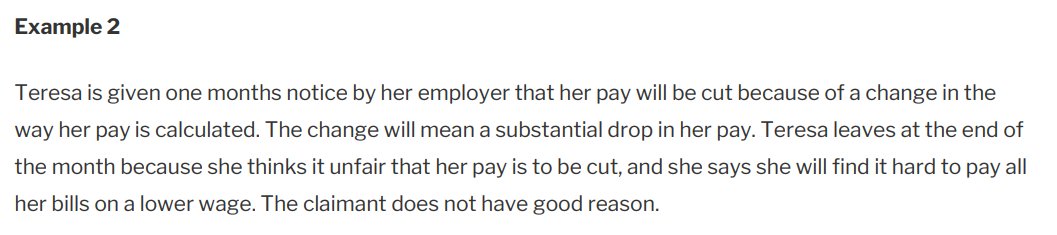
If you leave a job without "good reason" in the UK, you are sanctioned 100% of unemployment benefits for 90 days. Here are some examples of things that do not constitute a "good reason" to leave a job (from the official handbook for DWP decision-makers):
Graph showing benefit from the government's new childcare entitlements by income.
We're moving far away from early years provision being about both care and education, with the poorest children being locked out of most state funded provision - and little discussion about it.
My review in @spaajournal of the Research Handbook on Leave Policy, edited by @IvanaDobrotic, @_sonjablum and Alison Koslowski, is now online.
Available at: https://t.co/HKcqmAwFml
Looks like the shift in government thinking on the early years being largely childcare (rather than also importantly early education) is going to staff qualification levels too. They're consulting on several ways to water down qualification requirements -
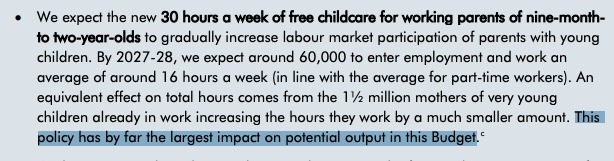
According to the OBR the childcare changes will have "by far" the largest impact on growth.
Yet the tax giveaway in the budget to the biggest companies costs twice as much as the new investment in childcare.
🤔
...and leave for fathers as separate from this policy goal, more associated with providing fathers with 'choice' rather than to do with behaviours at home. I explain this difference through different political contexts during the reforms and the impact of policy legacies.
(4/4)
Very pleased to see this published online today:
'Shifting worlds of father politics? Comparing path-departing change in paternity and parental leave policy in Germany and the UK'
https://t.co/s4HlPeDHzq
(1/4)
In Germany, fathers' leave was seen as crucial in improving work-family reconciliation for mothers: shifting the burden of unpaid care in the household was viewed as important. In the UK, work-family reconciliation was seen as primarily an employment issue for mothers...
(3/4)
This paper will be part of an exciting special issue of @spaajournal on education policies in knowledge economies alongside many excellent articles. The introduction is here: https://t.co/UlSAesEtx2
Very pleased that my new article with Timo Fleckenstein and Soohyun Christine Lee is published online in @spaajournal. It compares reforms to education and training policies in Germany and South Korea in the shift towards the knowledge economy.
https://t.co/iriMyqGGUI
Arguing that both countries have faced 'twin pressures' from firms' changing skills needs and ambitious parents, we find Germany has been more successful than Korea in mediating these pressures and the resulting inclusion/efficiency tensions.
New🙌 Studying education reforms in 🇩🇪 & 🇰🇷, Fleckenstein, Lee & @_SamMH_ analyse government capacity to reconcile efficiency & inclusion, in the context of twin pressures from firms (changing skills needs) & parents (high aspirations for their children).
https://t.co/BBwscpD1OU
I am beginning to wonder if Truss-o-monics is really just "We know we are on our way out so let's take the last of what's left on the way out the door!"