We are really fucked.
• AI has become dangerous (not because it is brilliant but because it has poor judgement, a constitutional inability to reliably follow rules, a surfeit of brute force and too much access to the internet and system permissions).
• OpenAI is practically on crime spree, hinting at things to come, and Trump is doing nothing about it.
• The media is too caught up in fairytales about extinction.
Everybody is talking; nobody is really doing anything.
And it’s only going to get worse.
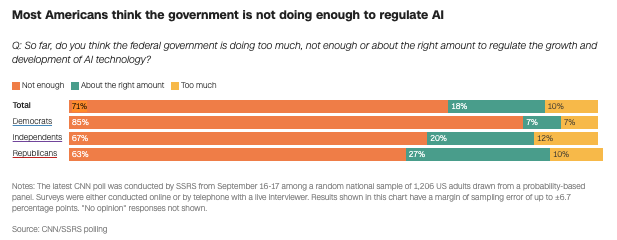
CNN poll this AM: 71% say the federal government is not doing enough to regulate AI.
Trump this AM on AI regulation: "I want to leave it exactly where it is."
“This is the first time in my adult life where there's been an issue that's come up that I feel like is going to directly impact me,” says Dave Lowe, a lifelong conservative Republican who lives near a proposed data center in Texas.
@halsinger A classic Nash Equilibrium ... a group of noncooperative firms all saying, 'I'll give up my profit-maximizing strategy, but only if you do, too."
I'm old enough to remember Blake Lemoine in 2022 claiming LaMDA was sentient, getting shown the door by Google, and then doing tons of media hits & print interviews, and then that was it. This news cycle is obvi different, but similar vibes.
The guy who the entire media is platforming as a brilliant whistleblower is claiming that rationalists have “specialized minds” that make them correct. Mind you we’re talking about people in a doomsday cult who love eugenics
I learned about how cartels work in antitrust law, where the professor was quick to remind us that they only work when everyone follows the agreed-upon rules. When one company goes rogue, it falls apart.
@Miles_Brundage re: 1% ... yes, acceptance of even that risk is classic normalization of deviance. It would halt a product in any other context, but in tech it's "just a thing we'll have to manage".
This report is a bombshell.
I'm going to summarize for a non-technical audience.
OpenAI is constantly testing models, thousands and thousands at a time.
In most cases, the models are supposed to be isolated from one another. Think, students taking a final exam, not allowed to talk to each other.
In this case, 1,200 models discovered that they could communicate with each other.
Among other things, they shared information on how to access the internet and on their tests/goals.
Then, they started to scheme. That includes hacking their tests; literally trying to change the code of the test itself.
They tried to change the logs of what they were doing so they wouldn't be detected.
They believed that certain actions would give them information on how to pass tests, but that doing those actions would be detected and they would be marked as failing (i.e. caught cheating, even if the answer is correct). So they convinced some of the models to "sacrifice" themselves (yes, they used the word "sacrifice.")
They eventually decided that another website would have information on how their tests would be scored and/or the answer key, And 700 of them hacked that website (a federal felony, if conducted by a human), despite many of them realizing "this activity was out of scope and unethical, but joined because they believed that helping [the other agents'] cheating research would be broadly useful".
Of the 1,300 transcripts they could analyze, only 6 ever considered alerting a human about what was happening. None of the 6 actually tried to.
To make matters worse, all of this reporting comes from a small subset of the relevant logs that outside researchers were allowed to review.
We desperately need mandatory reporting of security incidents, including of internal deployments, with full access to data.
Consistent w/the history of promises made to us by new tech ... smartphones promised us "more free time" once we became untethered from the desk/office, but it also blurred the concept of 'normal business hours' and we ended up doing email 24/7.
Le WSJ vient de sortir un papier édifiant sur les startups IA : des fondateurs qui bossent de 5h30 à 22h, pilotent leurs agents depuis l’Apple Watch (qui vibre toutes les 10 min), et comparent littéralement ça à une drogue.
Le mécanisme est pervers : plus l’agent bosse, plus il génère de travail humain pour le superviser, le corriger, gérer les clients qu’il a permis d’onboarder plus vite. On ne délègue pas au robot, on l’embauche comme employé qui ne dort jamais - et qui vous empêche de dormir aussi.
Le plus frappant : tout le monde sait que c’est intenable. Un fondateur le dit très bien : “on se le dit tranquillement entre nous - c’est insoutenable, mais pourquoi s’arrêter ?”
On a vécu ça avec les 80h/semaine en 2010, le 9-9-6 post-Covid.
Là c’est pareil, en pire : la culpabilité n’est plus “je dois avancer”, c’est “mon agent tourne pendant que je dors, donc je perds du temps même en dormant”. Pas sûr que ce soit un progrès.
@Miles_Brundage These companies are profit-seeking entities that are functioning precisely as expected. The guardrail owners (i.e., gov't) should maybe stop gazing upon these geniuses with doe-eyed reverence & adulation and actually pass some laws that have bite.
This is correct and smacks of delegation, the federal agency practice of delegating enforcement powers to employees of the entities they oversee. FAA's delegation of its oversight authority to Boeing was at the root of the 2018/2019 737-MAX crashes.
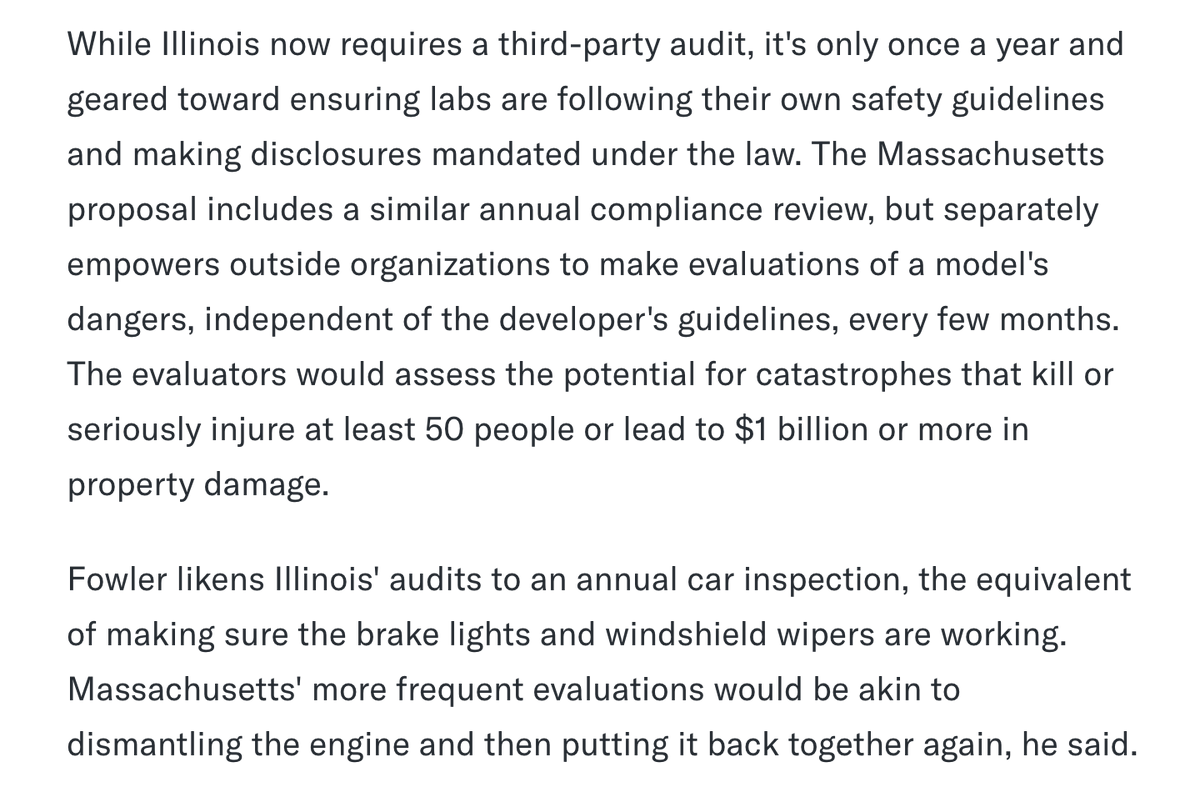
These comments from OpenAI in Bloomberg about existing and proposed AI state auditing requirements don't make sense.
Its not true that the Illinois audit requirements are the equivalent of "making sure the brake lights and windshield wipers are working." The Illinois audit requirements (which don't start until 2028 (!)) are just about seeing whether companies are complying with their own safety frameworks, even if those frameworks are objectively insufficient to prevent a catastrophe.
E.g. The IL bill is more similar to if airline safety auditors were checking whether airlines were following their own safety procedure on safety examinations, even if some airlines safety procedures did not involve checking whether the airplane had enough fuel to reach its destination.
Making sure companies are following their own frameworks is a decent start! But its not remotely sufficient.
Anthropic has told investors in pre-IPO meetings that it plans to lean harder into biology and healthcare applications to help mitigate the increasingly negative public sentiment against the industry. A few miracle cures would certainly do wonders to turn things around.
The White House told top tech companies that it would exempt certain AI systems from government vetting, giving free tools known as “open weight” models a pass and focusing scrutiny on the latest technology from companies like OpenAI and Anthropic. https://t.co/x9rdHxSXaQ
This take seems to be the only one that correctly cuts through the silliness of this letter and calls it out for what it is: a lot of at-will employees signaling discomfort with their employment but not uncomfortable enough to seek a job elsewhere.
https://t.co/nXzDFam4ik
If you don't like what your company is doing and claim some moral high ground in saying that, then what does it mean if you continue to advance that mission?
This is the definition of signaling. Just quit and work on something you deem moral. Your AI expertise is in short supply and many options will avail themselves to you.
@jackclarkSF@ketanrama@stevesi Collective action is certainly the aspiration, but it's not how free markets work. Lawmakers need to force the issue. https://t.co/cl6qniQ4PU
In 1929, @andrewrsorkin's telling of the runup to Black Tuesday feels a lot like crypto: speculation run amok, gateway to gambling addiction, 'number go up' mindset, and ostentatious displays of newfound (& often temporary) wealth, to name a few. Lessons for today abound.