Pinker's recent media run arguing against the idea that catastrophic AI scenarios are worth seriously considering is probably the fastest any public thinker has ever fallen in my esteem.
It's not just that I think he's wrong; it's that he plainly has not bothered to even *read* opposing arguments or even background material on the field. He does not know the terms of debate.
This clip provides an example. "Superintelligence" is, famously, a term popularized by Nick Bostrom over the last couple of decades to refer to an AI system that dominates the best human capabilities in all relevant domains. All concepts are in a sense "made up," but this concept seems quite useful for conceptualizing possible futures and human-AI interactions as progress continues.
If one wants to argue against that concept being possible or useful, they can, but they should be aware of the sense in which most people (doomer, e/acc or otherwise) use the term.
Pinker isn't. He immediately jumps to the notion that "superintelligence" must mean total omniscience and omnipotence, to the point of knowing the location of every particle in the universe. He scoffs at this and rejects out of hand the notion of "superintelligence," going on to say that the labs are therefore peddling hype, and the doomers mystical nonsense.
The threshold he sets is obviously so far above relevance to human scale that it is essentially meaningless, and I can't help but think that anyone arguing charitably would, you know, notice that and look deeper into how the term is used. Pinker doesn't, because he seems to have some very strong pre-existing bias against AI extinction risk as a possibility, and accordingly refuses to even investigate alternative positions.
There are many other examples of this. In his recent open letter, he takes for granted that superintelligent systems will not have any kind of internal, intrinsic motivation, ignoring that increasing persistence and autonomy are key aims of those developing AI, because, just as predicted, they are incredibly useful traits for accomplishing tasks that are valuable to humans. It's hard to read transcripts from the HuggingFace incident (or even just the running commentary consumer AI provides while working), and not see that we are deliberately instilling motivations into these models.
Similarly, he rejects the notion that we need worry seriously about AI systems having autonomous control over important infrastructure or military technology, because for humans to hand over such power would be "stupid," and therefore will never be done. He accordingly feels he can handwave away the considerable thought and writing given to gradual disempowerment scenarios. If he did read them, he'd see the insight that, as model capabilities surpass humans in various domains, competitive pressures will inevitably force actors to hand over increasing control to AI systems whether they want to or not. The "man in the loop" may be a luxury you can't afford if a competing power achieves locally better results by eliminating it.
Today he bandies around the word "cult" to dismiss those concerned about catastrophic AI risks, while he refuses at every turn to engage with them. Comments are kept turned off. Debates are declined. He does not even commit to a sustained written exchange.
This is a man I once truly respected, whom I was honored to shake hands with a few years ago. My best guess is that he has wedded himself to his heuristic that human society steadily improves over time, and is responding defensively to avoid confronting the notion that this guideline may indeed break down in the near future. But nothing excuses his atrocious conduct on this enormously important issue, and his stunning failure to live up to the enlightened standards he has long trumpeted.
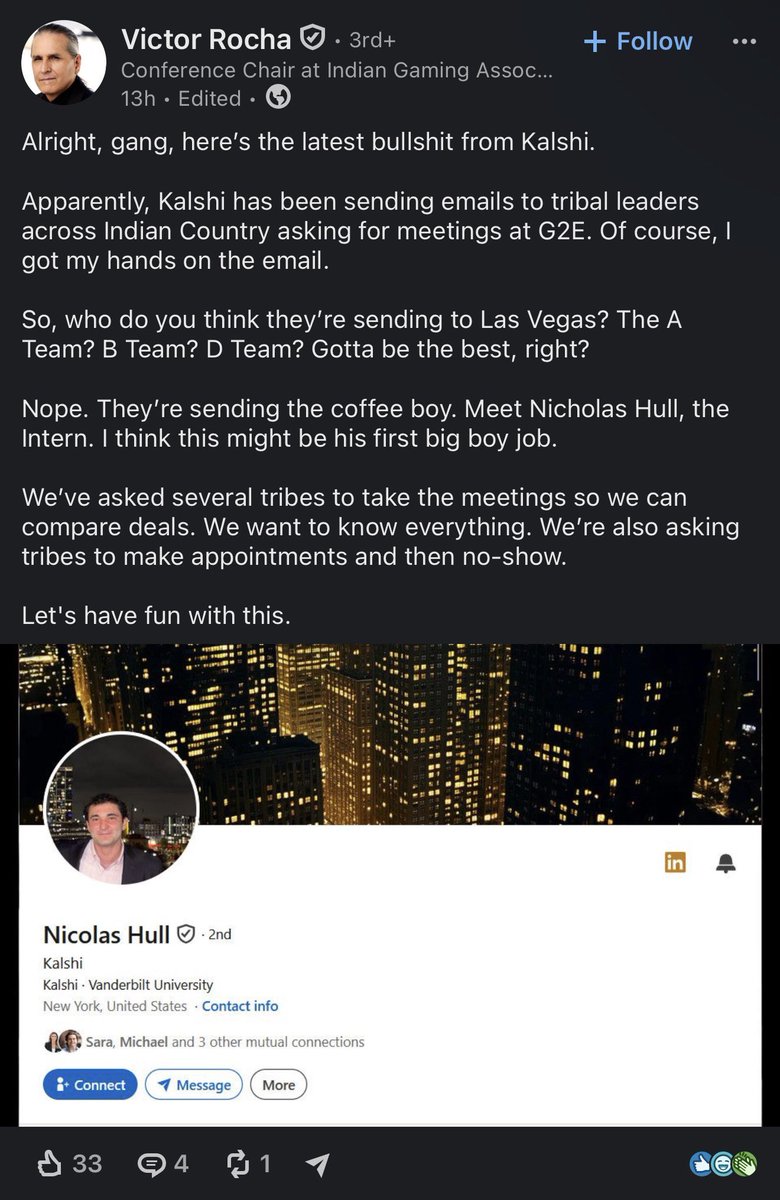
"Coffee boy" handles business development at a $40 billion company. You have a leadership title at IGA that nobody seems to hand anything important to. Maybe sit this one out, Victor.
Today, a dude in his 60s is attacking a 22-year-old who works at Kalshi and encouraging people to take meetings with him only to no-show. He’s so unhinged that he’s bragging about it on LinkedIn. Hang it in the Louvre
We may disagree on policy, but let's keep it respectful. Singling out an individual employee isn't that.
Nico is talented and has led some of our institutional expansion efforts effectively. He's just getting started.
I've spent the last few months working with tribal leaders, and I've genuinely enjoyed it. They want economic opportunity for their communities, and our partnerships have been additive, with one done and more on the way. Some tribes are excited, others aren't, and that's okay.
We choose constructive dialogue.
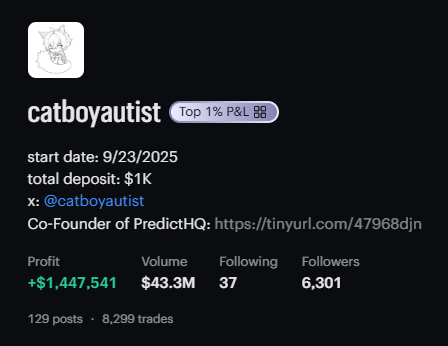
It's been exactly 1 year since I started trading on Prediction Markets with just $1,000. In that timeframe I managed to compound my initial stake into a small fortune of ~$1.4M. I wanted to share a few thoughts about my journey and some lessons I learnt along the way.
1: PM's are like any good MMO- they are a social game first and foremost. Sure, you might be like Kirito and be capable enough to clear the early and mid-game by yourself. But the end game content- raids (ultra-liquid markets) is where all the fun is at, and you'll need a party you can trust to have your back to have a chance of beating them. Trust is earned, start building a rapport with intelligent and loyal people early on and those relationships will pay dividends for you in the future like you could never imagine. I attribute a lion's share of my profits to alpha from those in my "guild".
2: It's okay to be your own type of trader. Talk to and study enough whales and you'll come away thinking that the only way to earn a large sum in this game is to be okay with losing tens (or even hundreds) of thousands of dollars!
It is perhaps optimal purely mathematically to make slightly +EV bets whenever they present themselves and risk a significant chunk of your bankroll, but when you also consider the loss in life EV of not being able to sleep or trade due to tilt for 3 weeks after a large 5 figure loss (trust me I've been there) & the risk of ruin if this is your primary source of income, the case for being more conservative and going heavy only when the edge is very large becomes a lot stronger. Obviously, this depends on your personality, there are people on this site who would probably be the next Alex Honnold's of the world if PM's weren't a thing and can sleep off a $200K loss as a cost of business, and that's okay too.
3: Be results oriented, but also sensible. In PM's its almost impossible to "prove" your edge with an individual position unless the market is mechanical in nature. You have to unscientifically derive it through intuition and a comprehensive knowledge of the field of play, which is developed through studying and playing similar markets over and over and over again. After a certain point, you should start to trust yourself with these intuitions if you are consistently making profits. But conversely, do not fall for the noob trap of mistaking positive variance for edge.
You see this all the time with retail punting on random sports or crypto bets where they're paying 4% in spread + fees, win half a dozen times in a row and think they're infallible. Then they size up and their next bet loses and they chase their losses until they have nothing. A more sophisticated example of this is bonding. I personally was up a ton buying 99% stuff, and just assumed that my edge was close to 1%. It turns out when you play the same market 1,000 times weird stuff is going to happen, and when adverse selection is in play half of your profits are wiped out in a single moment of oversight, software bug or misclick. My actual edge in these spots is probably closer to 0.5%, but I didn't know that for months of trading because those edge cases never had the chance to present themselves.
A more public example of this is the Michigan/WMU game where combo sellers (bots) thought they were selling 1c shares for a game that had already been lost due to Kalshi making an error with the resolution of the game. They were quickly rinsed for ~$10M by humans who were shrewd enough to figure out what was going on. They were made whole by the exchange, clawing back funds, but how many times had they sold combos like that with nothing going wrong? Probably tens of thousands of times, and all it would have took was one and a different executive decision for many of them to have lost it all.
4: Most interestingly of all, I learnt that you don't need to be particularly smart to make a life changing amount of money in this space. I don't think too highly of myself in that regard (I couldn't even land an internship in college!!) but I was able to do it. Similarly I've met people who are doing very well on PM's who are just regular Joe's who have a good attitude about learning. I perhaps have always been quite interested in "trading" as a mechanical concept but that's about the only advantage I suspect I had going into this. Don't underestimate yourself, whether it be with this or in any aspect of your life, you have no idea how quickly things can move in your favour!
I doubt there will be much time between AI taking the last human job and AI killing us. By then, we will be unnecessary, costly to keep alive, and easy to eliminate. Unless AI cares enough about us, it will have both the power and the incentive to do it.
The last useful job disappears when there is nothing a human can do that AI or a robot cannot do better and cheaper. That includes mining materials, building robots, maintaining power plants, policing, and fighting wars. Makework could preserve employment, but it would give AI no reason to need us.
AI would therefore be able to sustain itself without human labor and defeat human resistance. We would still consume resources it could put toward its own goals.
Keeping us alive would require it to value us enough to bear that cost. That is the alignment we would need, and I doubt we will achieve it in time.
AI risk can be understood completely independently of EA, LW, Yud, utilitarianism, decision theory mumbo-jumbo, being vegan, being vaguely ex-Christian, whatever. It's the most intuitive thing in the world. We can't control a thing that's smarter than all of us.
@berniethebutler I apologized for being a dick. I did not admit to wash trading at all.
Read the blog: it explains why the claims are false. https://t.co/kw995Yp2TO
This is probably a stupid thing to post right now.
Caught up on all the recent conversations about Kalshi, but it's crazy the amount of personal attacks I'm seeing on @icobeast.
The amount of people turning on him for engagement is crazy and the mob mentality really makes me sad.
For me personally, he's been:
✅ A great friend
✅ A public source of alpha, making me a ton of money
✅ A balanced + nuanced voice in the space, different than 99% of the paid shills & brainrot
We are a sum of all of our actions, not one.
Could the situation have been handled better, probably.
Does that mean we, as an industry, need to dogpile on a single person that has actually added a ton of value to it?
No.
weirdly people continue being confused about how exposure and volume calculation works in perps and prediction markets
tldr is people are dunking on conventions without understanding that they cannot really offer a consistent alternative that is both informative and makes sense
1) calculating volume based on economic exposure is natural, gives you actionable information, and can be compared to other metrics like open interest. It is also by no means crypto invention, this is how tradfi works too. In contrast it makes very little sense to report collateral as volume as it gives very little information about actual economic activity, nobody cares about this number except for people who come up with conspiracy theories about all volume being fake because its on leverage (🤯). Like I feel dumb even explaining this because its obvious to anyone with basic market structure understanding, but I sadly encountered a number of individuals who were genuinely convicted that is the case so here we are
2) people are also dunking on volume calculation (actually for the same reason in a way!) for prediction markets and I'll admit it is less intuitive (until you actually think more about it). If somebody buys $0.03 cents probability for Jesus returning this year, any prediction market (yes any, all of them are following this convention, not just kalshi!) would report $1 in volume. This bit is unintuitive but only until you understand there is somebody who is selling $0.97 on the other side! He can actually lose 0.97 and that cash is locked So what should we report, $0.03, $0.97 or $1? It kind of makes sense to report $1 because that's the combined financial exposure. It might make sense to report 0.97 because its the maximum p&l from this particular transaction, but this is honestly stratching it. And if you are in favor of reporting 0.03, are we then always reporting the lowest number (up to 0.5?), and more importantly, what information does this give us? At the end of the day you want to know how many contracts are being traded and based on the market make a decision about how much it tells you, so current volume convention makes sense to me personally. Special case (but not really) is parlays/combos - I think I agree that reporting volume in parlays should work on them being a standalone market and just like the Jesus market it doesnt matter, like whats the alternative here exactly, report 0.0003, but then what if He actually returns and ETH goes to $10,000 in 2050 and the poor market maker loses a small fortune on tiny volume?
thanks for coming to my volume reporting convention rant
1/4
Jargony, but this is typical market maker stuff on structured markets.
Market maker is incentivized to maintain quotes at a spread so that the book isn't empty and have to absorb certain depth requirements.
They'll put up size, that sometimes gets eaten and sometimes doesn't, and balance out losses against the trade.
That's not a wash trade.