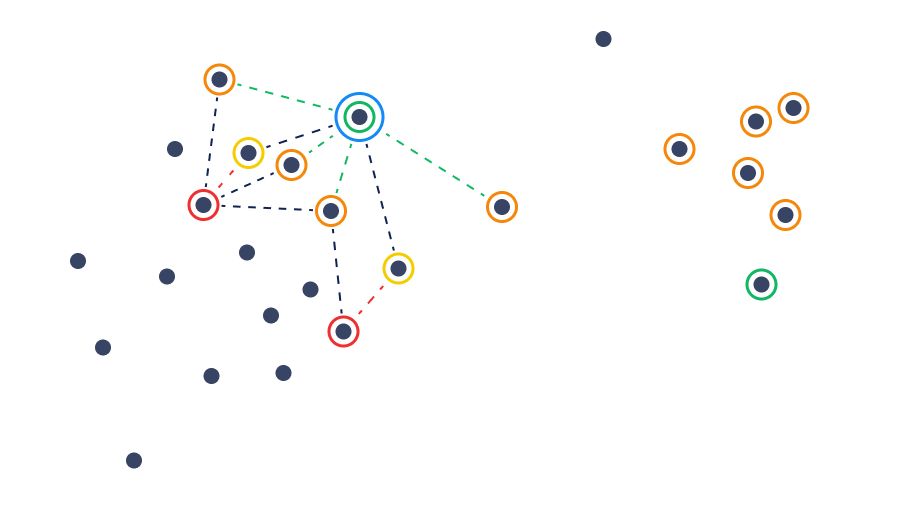
Relevance feedback allows retrieval systems to iteratively improve search results in the direction of relevance. It’s been studied for over 60 years — yet remains absent in modern production-level neural search.
We looked into the research field to understand why — and along the way, gathered this summary of methods proposed over the years.
⬇️
For 40 years, BM25 has been the standard for search engines. However, it falls short for modern RAG applications.
Say hello to BM42: The combination of semantic and keyword search
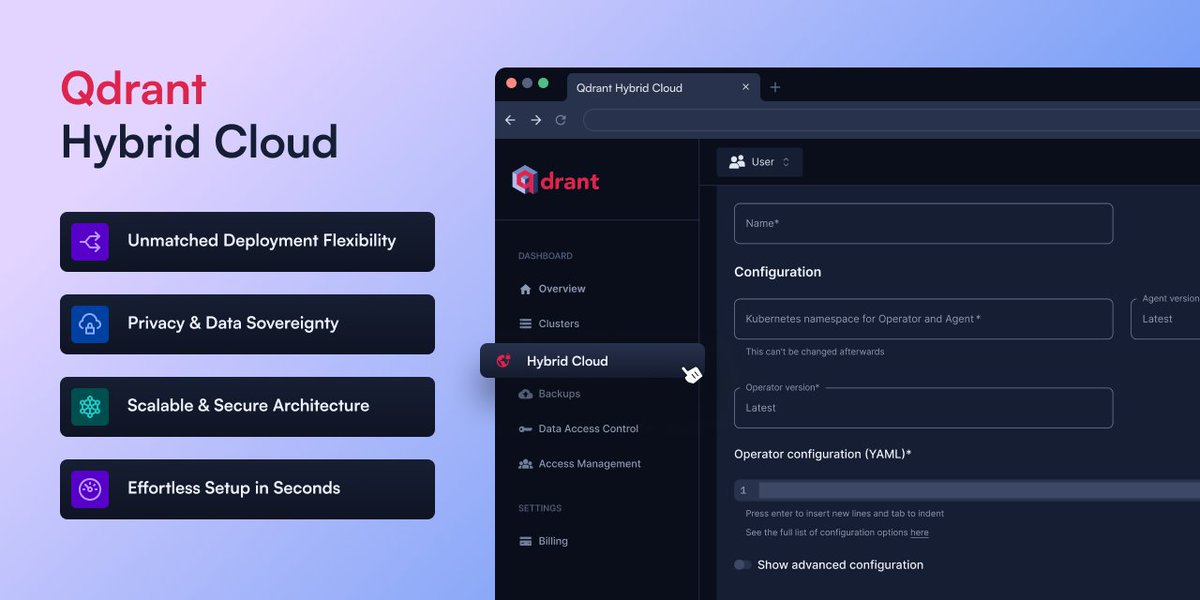
We’re excited to announce the launch of Qdrant Hybrid Cloud, the first-ever managed vector database you can deploy anywhere—cloud, on-premise, or edge— designed for true deployment flexibility, data sovereignty, privacy, and control.
Why is this big? 🚀
Deployment flexibility and data sovereignty are critical as the industry moves from prototyping to deploying production-ready AI applications.
Easy integration with existing systems complements these advantages, streamlining development and operations.
Key benefits of the Hybrid Cloud:
✔️ Deploy Anywhere: Deploy Qdrant in any environment of choice with our Kubernetes-native design.
✔️ Full Data Sovereignty: Enjoy privacy control with decoupled data and control planes with complete database isolation.
✔️ Fully Managed: Enjoy the benefits of a managed vector database within your own environment.
✔️ Effortless Setup: One-line installation by simply adding your environment to your Qdrant Cloud account.
Thank you to our trusted launch partners for their collaboration:
@OracleCloud, @RedHat, @Vultr, @OVHcloud, @Scaleway, @DigitalOcean, STACKIT, @llama_index, @langchain, @AirbyteHQ, @CivoCloud, @JinaAI_, @Aleph__Alpha, @Haystack_AI by @deepset_ai.
woop wooooop, this is some seriously cutting edge stuff I got to build for this release.
Currently baking an article which will make it easier to understand, stay tuned 💥
2/ 🔍 Discovery API: This new API enables you to navigate the vector space with different kinds of control and influence, complimenting search and recommend API behaviors.
🧭 Context Search: Explore without a target point, steering through preferred zones for diversity.
Biggest challenge here was to create a new scoring engine and refactor internal communications.
Happy news is that it set the stage for enabling other kinds of search too, and we have some pretty interesting ones in the pipeline ⚙️🚀
Proudly sharing this, from what I’ve been working on the last few weeks:
https://t.co/mUlsm98LVJ
tldr; having a metric of similarity between vectors can be far more powerful than just using it as a replacement for a search bar
We were definitely considering implementing something similar, and I must say, Vespa did a great job here.
However, we eventually decided to pursue a slightly different approach first. And here's why: 👇🧵
Please welcome Qdrant 1.2, packed with a bunch of new features and improvements! A lot of exciting novelties, such as grouping requests, Product Quantization, and optional named vectors, but also many, many more!
https://t.co/LnPLxxNuPW
For our @full_stack_dl project, we developed https://t.co/2mvfv1NcuD, a @nextjs app to measure the diameter of fibers in electron microscopy images 🔍📏. We run inference in the browser by using a smart combination of @pyodide and @onnxruntime@Yael_su@__coszio @aledelunap