As of last week, I am no longer at NVIDIA 🧵
Leaving the CUTLASS team was extremely hard. I will dearly miss my incredible colleagues and the extremely compelling mission statement of creating the world's best accelerator programming model w/ hardware software codesign 💚
Hi all, I have a new result I'm excited to share. It turns out that *all existing implementations* of softmax and cross-entropy (that's JAX, PyTorch, textbooks, etc) have a subtle bug --- two bugs, actually. A simple rewrite fixes both, and eliminates "slingshots" when grokking:
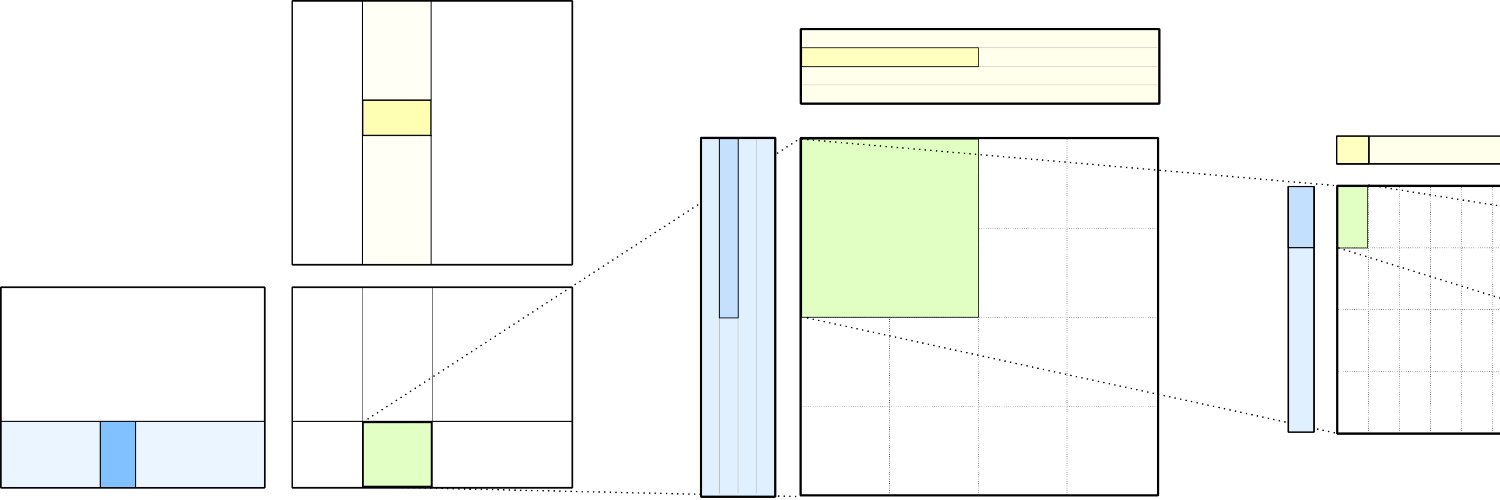
Gave a talk at PTC on flex_gemm which is a new gemm_epilogue API in pytorch built on Quack. I think its neat, not ground breaking but neat nonetheless :)
https://t.co/rkE8i90qI1
planning to bootstrap this and continue to add fun examples
We’re sharing Dist-MoE, open-source library from Meta SuperIntelligence Labs (MSL @AIatMeta ). Dist-MoE provides fused communication and compute kernels for BF16/MXFP8 training and inference, plus NVFP4 inference.
✅ Fused communication and compute kernels
✅ Full CUDA graph support
✅ Dynamic activation packing across layers into a bounded buffer
✅ Dynamic, capacity-driven recompute
✅ Forward and backward kernels for BF16/MXFP8
✅ No shared-expert branch required
Some highlights from our GB300 NVL72 benchmarks:
• Up to 1.40× speedup over Mixture-of-Kittens (MoK) in our imbalanced, ten-layer MXFP8 training workload across 64 GPUs. Dist-MoE packed activation state across all ten layers with zero capacity-induced recompute.
• 3.09 useful PFLOP/s per GPU (3,090 TFLOP/s) for NVFP4 Mega inference across 16 GPUs.
• 1.86 useful PFLOP/s per GPU (1,856 TFLOP/s) for MXFP8 Staged training across 64 GPUs.
• 1.27 useful PFLOP/s per GPU (1,271 TFLOP/s) for BF16 training across 64 GPUs.
• Sub-linear scaling under imbalance: in NVFP4 inference across 16 GPUs, 8× the received rows on the busiest GPU required 4.82× the iteration time; about 40% lower iteration time per received row.
Full configurations, raw results, and measurement definitions are in the blog.
@levendlee and I also put together an interactive visual explainer covering token dispatch and combine, quantization, forward/backward kernels, activation packing, dynamic recompute, and memory planning.
Blog:
https://t.co/PRSXlOML6O
Repository:
https://t.co/t0iAijeFQU
TorchTitan (@PyTorch ) integration:
https://t.co/zMjeUGDFVH
If you work on MoE training, inference, or GPU kernels, take a look. We welcome feedback and contributions.
#PyTorch #MixtureOfExperts #MoE #OpenSource #TorchTitan #DistMoE
after an exciting week of launches (muse wonder [full] & muse spark open), i want to write a note of appreciation to the amazing research teams at meta superintelligence labs on reaching such a special milestone ♥️
we started MSL and TBD a little more than a year ago and set a goal of producing a frontier model within a year or so. given where llama4 landed, that was an incredibly audacious goal, and we knew it wouldn't be easy. many people told us it would be impossible. we knew it was unlikely, but still worth doing. a remarkable group of researchers and engineers joined the effort from inside and outside meta. every single person came in, picked up a shovel, and got to work with earnestness and urgency. nobody asked whose job it was.
we assembled a team of the most brilliant people i have ever had the opportunity to work with (and remember, i was an HRT intern 🙃). i am surrounded by ambitious, visionary, technically excellent, hard-working, pragmatic, thoughtful scientists, engineers, and product folks—people who will chase a weird loss spike past midnight just because they need to know why. these models are the product of their passion, hard work, and brilliance.
somewhat paradoxically, when we started TBD, we set a principle of no deadlines. we knew we had an astronomical amount of work ahead of us—across pretraining, post-training, RL, multimodal, infrastructure, safety, data, AND frontier research. there was no use setting arbitrary timelines—we just had to get to work, be thoughtful, and build the foundations of a frontier research effort in record time. and run after run, this team did exactly that.
our researchers are magicians. i can only describe building these models with this team as a wondrous journey of scientific discovery. i am constantly amazed by what we can accomplish with scaling. i will remember this past year for the rest of my life—the late nights, the broken runs, the evals that came back better than any of us dared to hope. watching this team create wonder after wonder has been a true and deep gift.
more than just the models we released this week, we have built a machine that builds new models. it often sounds like a cop-out to say labs can just turn the crank to keep scaling, but now i have seen it first-hand. sure, it's a lot of work and a careful process, but we have built a scalable system to keep advancing at the frontier, and i am really proud of how fast this team keeps making these models better.
lastly, i get to work with researchers who care deeply about how their work benefits humanity. it's easy to forget when everything is changing so fast, but the whole damn point is to make people's lives better. time and time again, i have seen our researchers, engineers, and product folks build our technology with care so it can truly be good for the world—whether that's building the best models for muse, thoughtfully open-sourcing strong models, or making sure the alignment and security of our systems are rock solid. this is a team of people who never forget there's a real person on the other side of every prompt.
thank you to everyone at MSL for being part of this crazy journey over the past year. i'm so grateful for every one of you, and our work is not done!
1/ muse spark open is the most capable US open-weight model to date.
816B total params, 42B active. 1M-token context. natively multimodal. built for coding and agentic work like long-horizon tasks, hard software engineering, multi-step reasoning.
america! 🇺🇲
introducing muse wonder
our new frontier model. state-of-the-art at personal agents and professional agents.
our largest and most capable model yet—rivals the big bois
@ekzhang1@kimbochen Is one of your assumptions also that P and D run on the same accelerator? It’s not explicitly listed but seems to me to be the biggest one?
Last month I wrote about how we can build a positive and safe future for everyone: https://t.co/eoLGVY8yad
Every lab has the responsibility and incentive to move at the pace required to train its models safely, and the ability to take its own actions to ensure that happens.
The reality is:
- People won't want to use agents that are misaligned with them and that don't do what they ask, so labs have a strong natural incentive to make their models more aligned.
There is a lot of debate about slowing progress on capabilities until alignment catches up. My view is that trust and alignment are quickly becoming the most important capabilities that will differentiate agents and models. Any lab that doesn't focus on alignment will fall behind.
- Labs face significant liability if their models cause harm, so they have a strong incentive to prevent this as well.
Meta delayed shipping Muse for several months to focus on safety and security. We didn't call for everyone else to do this before we would. We just did it as part of our day-to-day work because it was clearly the right thing for people and for us. I'm proud of the security foundations we've built.
- Engaging independent evaluators and advisors is industry best practice. MSL already does this today in several areas because it helps produce better work. Other labs can just do this too. In general, it would be helpful for there to be a larger and more diverse ecosystem of evaluators.
- Committing the significant majority of compute towards serving people rather than racing towards recursive self-improvement is one of the best ways to ensure we develop this technology safely. Meta has made this commitment and other labs can do this as well.
I believe the key to building a positive future for everyone is maintaining the right balance of power. This is within our power to do.
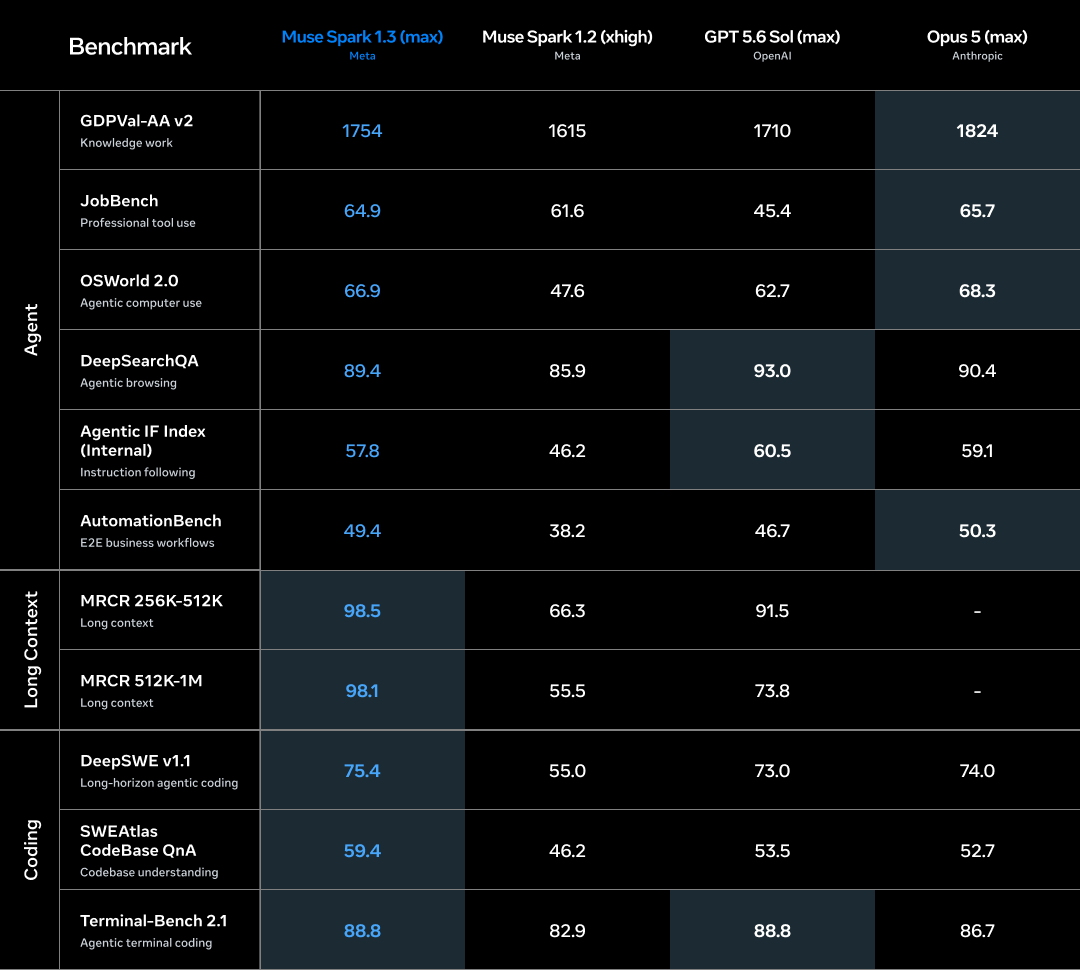
1/ today we’re releasing muse spark 1.3—available in muse code & the meta model api.
this is our most capable model yet—frontier performance almost too cheap to meter. much stronger at agentic and coding with better usability. we think users will really notice the jump.