Previously we proposed SMT, a new algo to pretrain nonlinear RNNs. Here are some new results:
SMT→DMT trains RNNs to have LLE≈0, likely indicating edge of chaos dynamics!
Meanwhile, BPTT trains RNNs with predictable dynamics (vanishing gradients, poor memory).
1/ Today we're launching @EmpiricalLayer, an open-source data science harness for the AI agent you already use.
Informally: "Lean for data science." 🧵
https://t.co/tXzYvPmE2a
Some of you thought that Inkling 2 Small was too big at 594B parameters. We heard you: Inkling 2 Mini is a looped transformer with just 26B parameters, small enough to run on your laptop, powerful enough for agentic work with a score of 20.1 on AA Index.
https://t.co/9HzaUMwghb
Harnesses used to be a crutch for weak LLMs. In 2026 and onward, with stronger models, harnesses now offer a mechanism for composing an LLM’s existing and new capabilities to generalize well beyond their training environments.
In our new paper, LM Harnesses are Compositional Generalizers, we explore how various harness abstractions enable LM systems to generalize over task length, task strategies, recursive task depth, and more through composing existing LLM capabilities. These abstractions provide a means for more data-efficient training, especially over long tasks, by keeping trajectories locally in-distribution (LID) — i.e., shaping all individual LLM calls to be in-distribution.
For tasks that take a very long time to roll out, this implies that we can even perform surrogate harness training, meaning we train an individual LLM call instead of doing the very long harness rollout, using purely synthetic tasks, with fake tool calls + sub-agents!
A common idea floating around is that LLMs will absorb harnesses and make them obsolete. We disagree, and argue that we haven’t sufficiently explored what harnesses can provide.
The full paper, logs, codebase, and data are available: https://t.co/AXBjdoqmiz
w/ @SOURADIPCHAKR18@lateinteraction
Imagine giving an agent a computer and asking it to improve itself at games. There are no installed games; it must write its own games to practice.
What does it do?
Strong models compose their own self-improvement loops. We give some initial measurements of this capability
1/n
@Xinyu2ML@skywong265979 When I first saw the title, it reminded me of our conversation a while back, I just realized this is indeed that project. Congrats on finally putting it out :)
Language models process each token through a single residual stream (blue arrows): reading / writing memory and applying MLPs at each layer, and finally decoding the next token.
Can we scale up this single stream computation?
Introducing Latent Lattice Language Models (LLLMs): augmenting this vertical stream with a horizontal axis of computation—the Lattice of Latents (orange arrows).
RNN 🤝 Transformers 🧵
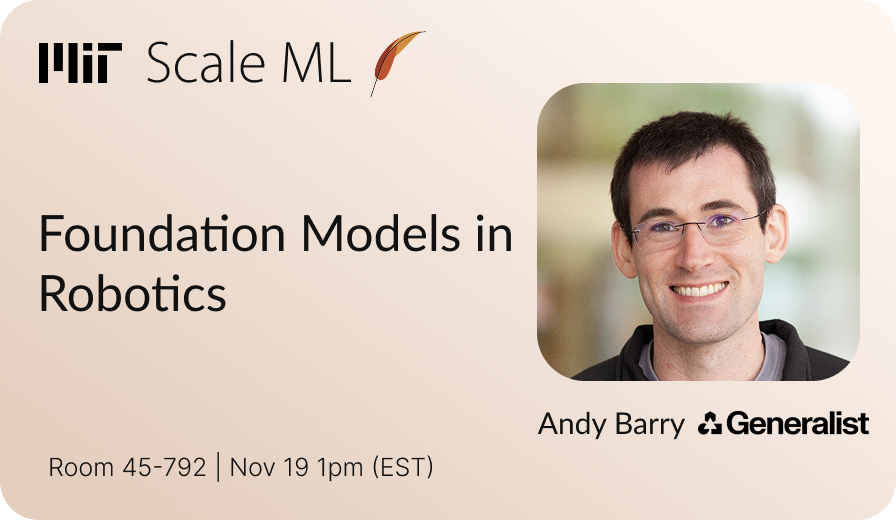
This week we will be having Andy Barry from @GeneralistAI present on Foundation Models in Robotics!
Date: Thursday, Nov 19, 1pm ET
Location: MIT 45-792
Join the mailing list on our website for zoom link.
Lean Verified Precision (w/ @Robertljg)
Recently, "A Fix for Softmax" demonstrated a surprising bug in the textbook softmax implementation. How do we avoid having subtle bugs in the world's most expensive software? 🧵
Big reasoning speedups are here. 1,000× faster training and 280× less compute than any looped model. All done using a fully trainable energy from the 80s
Keep reading to hear how energy is the right paradigm for reasoning
With @HughBlayney@jcrwhittington@prefrontal_ai
🧵/10
Inkling 2 Small is our first model trained partly in NVFP4, with a mixed-precision recipe that enables a great tradeoff between speed and accuracy. Check out our new post to see how we did it, and the lessons we learned along the way!
Meet Inkling 2 Small! We’ve tweaked the architecture a bit since the last generation, adding attention residuals (with a q/k/v split), gated attention, dynamic attention sink, dynamic shortconv, value norm and more. Don’t ask me “linear attention wen"
Excited to share our latest edition of world model PAN 2 built on a Generative Latent Prediction (#GLP) architecture. A world model needs to operate in an "Aristotelian world" instead of a "Platonic world" where physical intelligence translates to 6 dimensions of capability: obeying the laws of physics, coherence over history, persistence beyond sight, conformity to constraints, invariance to viewpoints, adherence to objective dynamism; and furthermore provides 3 advanced functions: acting as a world simulator that is steerable with actions and plans (long sequence of sections), thereby enabling stimulative reasoning or thought-experiments, and therefore supporting agent to solve complex tasks, and doing so in a fully auditable fashion (hence Aristotelian). A full paper will be posted soon to explain in details how we achieve this.
Congratulation to the @IFM_AI PAN team.
Introducing FlashState ⚡: an inference system that flexibly manages the prefix cache of hybrid LLMs, designed for agentic workloads.
On GLM 5.3 Flash, FlashState more than doubles vLLM's throughput and provider profit, while cutting latency by 3.7× and user cost by 2.5×.
Distilling most of our expertise in kernel and inference engine optimization into an agent loop that powers our production. A 2-year project that we're finally able to share