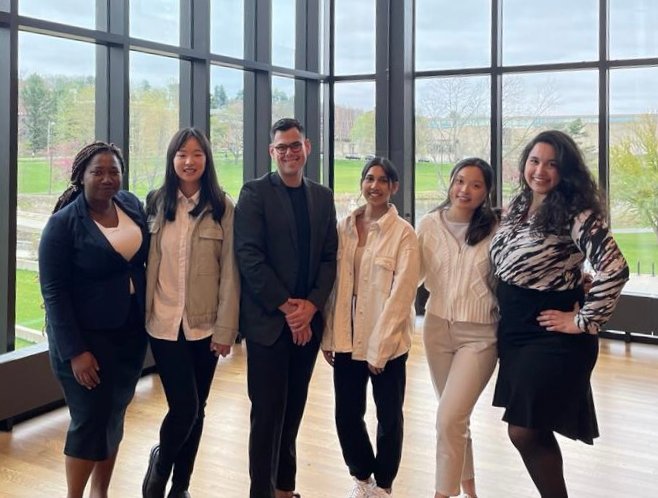
Here's your chance to become a successful freelancer by acquiring digital skills in seven emerging fields!
With the support from Sindh Education Foundation, Government of Sindh, UNDP and CyberVision are providing digital skills training to young individuals from #Sindh.
Global carbon dioxide emissions from burning fossil fuels are set to hit a record high this year, exacerbating climate change and fueling more destructive extreme weather, scientists said https://t.co/uXurx3F5h2
Great Opportunity!
Dr. @ChenghaoW at Sustainable URban Futures (SURF) Lab is seeking PhD students in the following areas:
1- Urban Air Pollution Modeling
2- Building Energy Modeling
3- Urban Climate Modeling and Analytics
Deadline: 25th November 2023
https://t.co/44pNfhOmkC
This is how I advise my #PhD students to write research manuscripts (in case someone finds it helpful).
General points:
1. Research questions addressed by your manuscript are key and should guide you.
2. Don’t view your manuscript as an article. See it as a STORY.
3. Pick the writing style that is easily understood by a broader community. Make reading easy.
4. Most of data should get into the paper. If some doesn’t support the hypothesis, it still must be in the Suppl. Information. It must show the reproducibility limits.
5. Make the paper shorter, not longer. Cut out things that may sound like ‘bluff’ or ‘decoration’ of the story. Use well-defined terminology, don’t invent it unless clearly necessary.
6. Focus on reporting & explaining the numbers. Minimize discussions of qualitative outcomes and your imagination.
▫️
Specific steps:
1️⃣ First, formulate and polish the key questions that your study addresses. It may take hours or even days (even though you've been doing research in this area for years). A single study should address no more than 1-3 key questions. It’s your perfect start for writing.
2️⃣ Write down the structure of your STORY first: Sections and Subsections that will answer those questions. Into each subsection, put 1-2 sentences that formulate the message(s) from this subsection. It will hugely help you navigate the manuscript later and save a lot of time.
3️⃣ Write approximate messages in the conclusion section. Usually, no more than 1-4 sentences.
▫️
At this point, SHARE your [structure+questions+messages] document with your advisor for feedback. Toss it back and forth until you both converge. You can also include major collaborators if needed.
▫️
4️⃣ Write the introduction part. Put down the paragraphs that introduce a reader into the key question(s) of the manuscript and the background of your story.
5️⃣ Write the main text for each section, smoothly and firmly. Each paragraph should add a separate value and end with a message-like sentence. Follow the “First… Second… Third…” structure for paragraphs when possible, it gives rigor and readability to your story.
6️⃣ Write the conclusions. Add a broader perspective that is justified and not generic.
7️⃣ Write the abstract. It must have simple terminology and clearly explain what readers can find inside the paper. It also should contain the key conclusions.
8️⃣ Write up 4-5 different titles and spend >30 mins with your team discussing which title sounds best.
Finally, iterate on the resulting draft within your team.
The number of drafts can easily exceed 20.
▫️
❗In addition, I always emphasize that a high quality of your research paper:
- sharpen your writing and analytical skills.
- shapes your reputation.
- shows who you are as a researcher and communicator.
▫️
p.s. Everyone has a different style of advising and writing. You can adopt only some specific steps if you find them helpful.
p.p.s. Another way that we sometimes use is by starting with figures ('story in figures' style).
#AcademicTwitter #AcademicChatter
I have two open PhD positions 🎓 in my lab @TUChemnitz starting from October 2023! One will be focusing on spectroscopy/microscopy & the other one on synthesis of perovskites and related compounds. More info here: https://t.co/4ygse8tSLl Please retweet!