What does prediction of attitudes, values, and other latent social constructs, mean for social science research and policy? We explore this question and identify gaps and opportunities for academics and practitioners. https://t.co/G5sNERiN9k
Breaking my twitter hiatus today to promote a paper @bsigrin, @TomeEmma and I wrote. We predict referrals and lost leads for low income solar using CRM data from @GRID. We find proxies for spatial peer effects are most predictive. Details of the webinar below.
Can referrals and lost leads be predicted? What data is needed? What can we learn from existing solar programs to inform scale-up in new markets?
To learn more join our webinar from 9:30 - 10:30 a.m. MT on Wed. December 22: https://t.co/XubQAFATn1. No registration required.
(2/)
Can referrals and lost leads be predicted? What data is needed? What can we learn from existing solar programs to inform scale-up in new markets?
To learn more join our webinar from 9:30 - 10:30 a.m. MT on Wed. December 22: https://t.co/XubQAFATn1. No registration required.
(2/)
What activities will people give up to spend more time in their car? Or do activities shift into car? Time-use data can provide an answer. We attempted to study time use and CAV here: https://t.co/JFpEMAXVhI. More work needed!
Most work on the topic of rebounds from connected and autonomous vehicles suggest a increase in vehicle miles traveled. This study suggests an average of ~20% increase in VMT.
A great new paper by my colleague @MortezaTaiebat looking at potential energy rebound effects from connected and autonomous vehicles. One important finding: higher income quintiles are likely to increase travel more & have increased net energy consumption
https://t.co/GRHbUkeOgp
my perspective on India's job guarantee has changed as I've learned from a decade of work with @Prof_Karthik_M and @sandipz. we discuss here
https://t.co/eAkFBbPmvQ
@E_Buechler @ElephantEating@Ericdwilliams0 we haven't done this it would be great to get the empirical values to compare both. can you share this paper? Thanks!
We (@_ashok7, @Ericdwilliams0) have a new article about heterogeneity in carbon mitigation from efficient appliances in Energy Policy. I want to talk about a few interesting things from the paper, which you can download (free for now), right here: https://t.co/7cWRbiAOKX
Differences in behavior dramatically affects energy and $ savings for efficient appliances. New journal article in @ElsevierEnergy with @_ashok7, @ElephantEating, and @rbchen: https://t.co/Z5fEU0hwf7
@srujana_goteti I was thinking about this today. I use a small trash can and I believe that makes me reduce waste because I don't want to walk every day to throw the trash.
A quote from: Van Rijnsoever, Frank J., Allard Van Mossel, and Kevin PF Broecks. 2015. “Public Acceptance of Energy Technologies: The Effects of Labeling, Time, and Heterogeneity in a Discrete Choice Experiment.” Renewable and Sustainable Energy Reviews 45: 817–829.
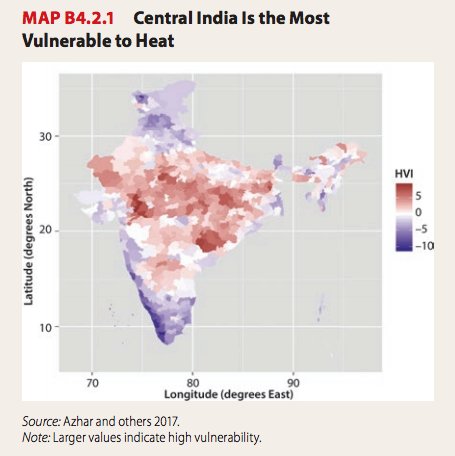
In the top 10 states in India, vulnerable to climate change, annual consumer expenditure (shown as living standards) is expected to increase by 10%. The most affected are the central states at the district level most from Maharastra. Source: @WorldBank