Four years ago I started working in the USA at Mayo clinic as an undergraduate student. This week I am happy to share my major work has just been published! #Mitophagy#PD#PINK1#PRKN https://t.co/PiSVbalSIB
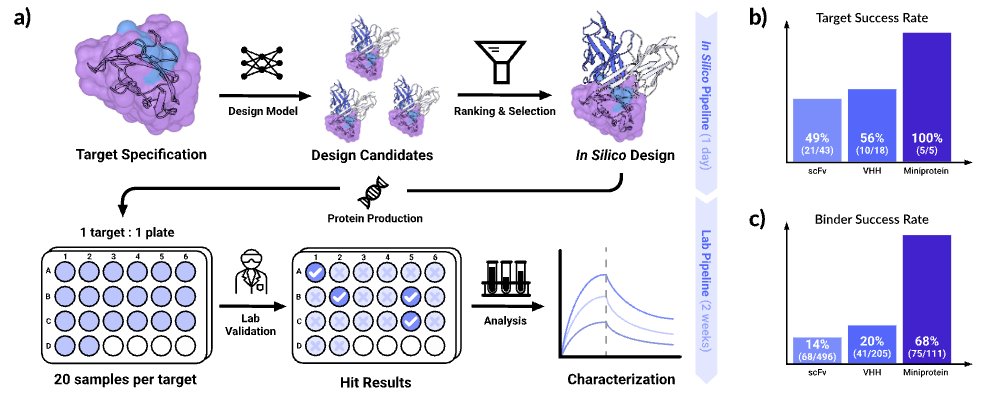
16 % hit rate for fully de‑novo antibodies😎
Chai‑2 makes ≤20 designs per target and still nails binders on 26/52 antigens in a single 24‑well plate🧬🧪
Two weeks from epitope prompt to picomolar hits 👀
Today, FutureHouse is launching the FutureHouse Platform, bringing the first-ever superintelligent scientific AI agents to scientists everywhere via a web interface and API. The Platform is launching with four agents, each with their own specialization:
Extremely clever new NGS tech from Roche 🧬
If it's hard to discriminate between nucleic acids accurately with a nanopore, why not synthesize a new polymer off a DNA template that is easier to sequence?
It's an intuitively simple idea, but took *a ton* of creative nucleic acid chemistry + enzyme engineering to design modified NTPs and create polymers of them.
It's been very interesting to see Roche move into the NGS market, and time will tell how this stacks up with the growing set of totally orthogonal approaches people are cooking up for sequencing tech.
It feels like we are entering another renaissance for biological measurement infrastructure—which is super important.
“Progress depends on the interplay of techniques, discoveries, and ideas, probably in that order." - Sydney Brenner
(These animations of sequencing tech will never get old to me. What a time to be a biologist!)
Super excited to preprint our work on developing a Biomolecular Emulator (BioEmu): Scalable emulation of protein equilibrium ensembles with generative deep learning from @MSFTResearch AI for Science.
#ML#AI#NeuralNetworks#Biology#AI4Science
https://t.co/yzOy6tAoPv
Rapid in silico directed evolution by a protein language model with EVOLVEpro @ScienceMagazine
• A breakthrough in protein engineering, EVOLVEpro combines protein language models (PLMs) with active learning to deliver up to 100-fold improvements in protein properties with minimal experimental data.
• EVOLVEpro surpasses conventional methods by using a few-shot learning framework, requiring only small mutant libraries to optimize diverse proteins, including CRISPR nucleases, antibodies, and RNA polymerases.
• The model efficiently navigates rugged fitness landscapes, avoiding local optima that plague traditional directed evolution approaches. It achieves this by integrating a PLM with a regression layer that learns protein activity landscapes.
• In antibody engineering, EVOLVEpro demonstrated multi-objective optimization, enhancing binding affinity and expression levels simultaneously—showcasing its potential in therapeutic antibody design.
• A highlight is the evolution of PsaCas12f, a compact CRISPR nuclease, achieving 50% editing efficiency at mammalian genomic loci, outperforming state-of-the-art miniature nucleases.
• EVOLVEpro-enabled engineering of T7 RNA polymerase (RNAP) yielded mutants that increased RNA production fidelity and reduced immunogenic byproducts, advancing RNA therapeutic applications.
• Structural analysis of mutations proposed by EVOLVEpro reveals novel insights, guiding future protein engineering strategies and demonstrating the power of combining computational predictions with experimental validation.
• The study benchmarks EVOLVEpro across 12 datasets, validating its broad applicability and modular design, ready to integrate next-gen PLMs for even better performance.
@idmjky@mat10_d@ssgriz@hnisimasu@lukas_villiger@alisankayabolen@omarabudayyeh@jgooten@MITdeptofBE
💻Code: https://t.co/6IhTie7WcC
📜Paper: https://t.co/hRDkU09haE
#AI #ProteinEngineering #Bioinformatics #EVOLVEpro #DirectedEvolution #Therapeutics #CRISPR #RNA
I had a fantastic time contributing to this review on the emerging parallels between tankyrase and PARP1/2! Congrats to all the authors and if you are interested in enzyme regulation, then please check out the manuscript! @SGuettlerLab@matthewrjessop Katy Miller
Our review on tankyrase and PARP1/2 is out in @Biochem_Journal! We review recent structure-function work and find intriguing parallels which we hope will inform future drug discovery efforts. Had a great time working on this with @SGuettlerLab@ICR_London! https://t.co/OxqtWQcBDN
Excited to share that UK regulators have cleared the clinical trial application for BEAM-302 as a potential treatment for alpha-1 antitrypsin deficiency! We are on track to initiate the trial in the first half of 2024.
https://t.co/TZQdPgt76e
In a major milestone for science, for medicine, and for patients, the world’s first CRISPR drug has been approved in the UK.
“A new treatment for sickle-cell disease and transfusion-dependent β-thalassemia has been authorised by the Medicines and Healthcare products Regulatory Agency (MHRA) for patients aged 12 and over after a rigorous assessment of its safety, quality and effectiveness.”
Congratulations to the many scientists, doctors, patients, and industry leaders who made this development possible.🍻
https://t.co/pUL956YsG3
BREAKING NEWS:
OH SHIT! HISTORY HAS BEEN MADE!
Vertex and CRISPR Therapeutics Announce Authorization of the First CRISPR/Cas9 Gene-Edited Therapy, CASGEVY™ (exagamglogene autotemcel), by the United Kingdom MHRA
$CRSP $VRTX #CRISPR
https://t.co/fYC6FKTg7U
Nnaopores can discriminate the 20 proteinogenic amino acids!
That is good progress!
A next step is extending this discrimination to complex mixtures containing other small molecules, e.g., metabolites.
Excited to share our work introducing BEAN🫘, a pipeline that greatly improves the power of CRISPR base editing screens🚀!
BEAN utilizes surrogate per-gRNA editing outcomes, identifying coding & noncoding variants impacting LDL cholesterol uptake.
📰https://t.co/i0YC4lTADp (1/)