WOW the response to our upcoming #AISTATS paper has been incredible. Here is a compilation of just a few of the paper reaction videos: https://t.co/QFdHRWNnn6
If AI papers were pharmaceuticals: Do you suffer from high-dimensional Bayesian optimization? Watch this commercial to understand how our #NeurIPS2020 paper can help you get back to living your life! https://t.co/s1hkn3bCxx
I extracted repeated phrases from Biden and Trump speeches to create a bingo card generator. To be used in 2 days! #DebateBingo https://t.co/Kq1O92zDKa
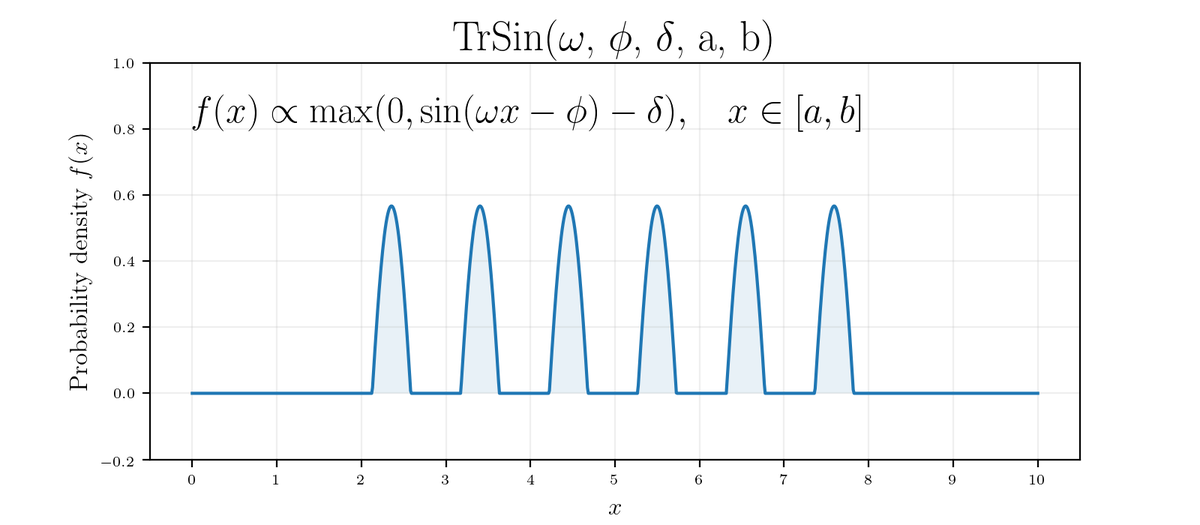
Introducing the Truncated Sine distribution, denoted TrSin. The main application is modeling the probability of a smoke detector starting "low battery" beeping, which is 0 during the day and peaks from 12a-4a.
One interesting aspect of the current pandemic is that the peak of flu season was already past before significant mitigation began in the US. What would the flu season have been like? Flu death trend was similar to those of last year and 2016-17, which had 34k and 38k deaths.
Just learned some fun, apropos history: the classic method for estimating excess flu mortality and detecting epidemics is called Serfling regression. It's a linear regression with Fourier terms to model flu seasonality. (Prophet does the same). https://t.co/mfnnqN3Hs3
At Mozilla, we’ve noticed a recent increase in desktop usage of @Firefox.
Because this data may have some value to researchers investigating #SocialDistancing measures, we're releasing a dataset to support this collaborative effort.
https://t.co/HJ9oydXoyM
Of all the things that shocked me in grad school, I still find it really shocking that no one is doing code reviews in science. It was the clearest sign that people were fundamentally uninterested in how the sausage got made — but so much of what’s important was in those details.
Thinking more about this, walking around the room searching for better cell signal is more like a Bayes opt problem where "can you hear me now" is the expensive function evaluation.
Adjusting rabbit ears was a great example of humans using stochastic gradient descent in everyday life. I wonder what it's modern equivalent is - walking around the room for better cell signal?
🎉Prophet v0.6 is now out for Python and R.🎉
Props to @_bletham_ who did the majority of the work and to Chris Suchanek who did the cmdstanpy integration.
Github: https://t.co/7EZJA82SkW
CRAN: https://t.co/EVjJT8Ec2d
PyPI: https://t.co/R8VDuU6b5h
Docs: https://t.co/x1BFZSPqP9
@eytan@RCalandra For the code for this paper (https://t.co/vw9litoaLO) we tried something new and organized it by figures in the paper. E.g. executing https://t.co/Pmkk9EVmrP runs the simulation for Fig. 4 and generates the pdf figure in the paper. Interested to see if people find that useful!
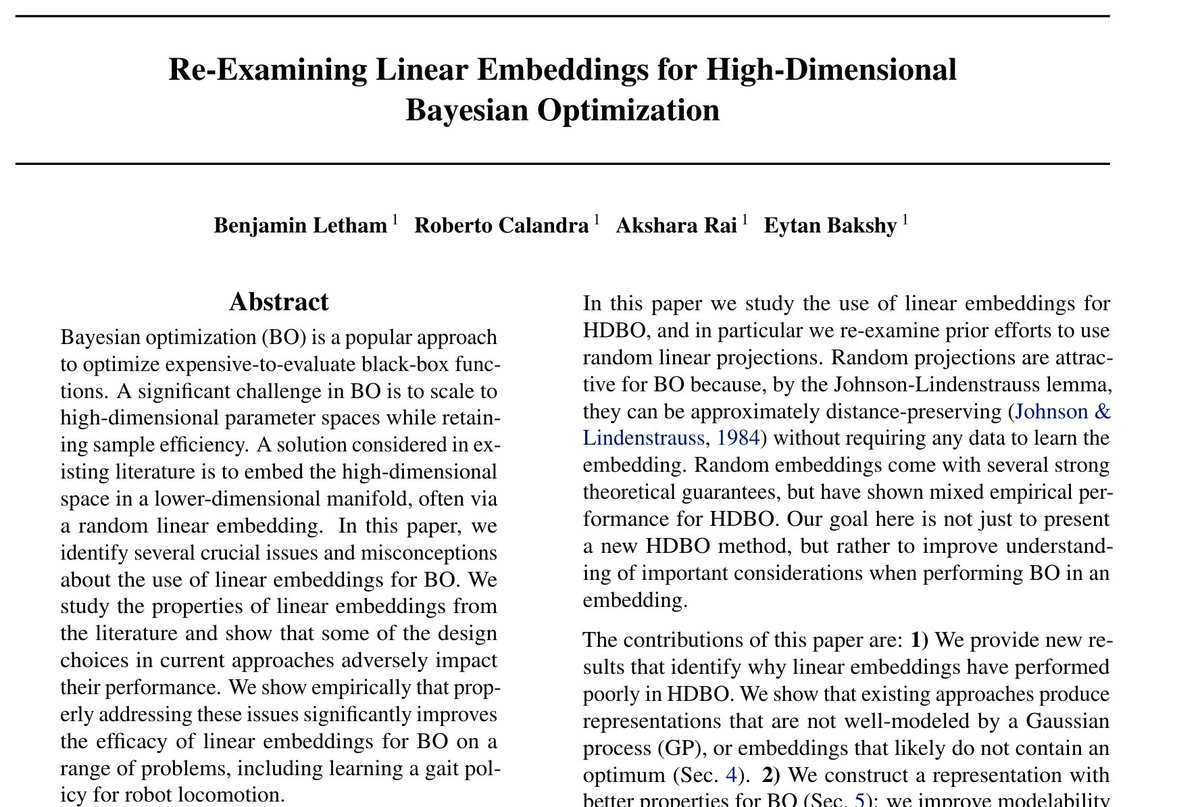
We investigated why random embeddings can perform poorly for high-dim Bayes Opt even on problems with low-d linear structure. A big factor is model fit, which can be surprisingly poor even in a linear embedding. https://t.co/Oyn5uCeivA . @eytan@RCalandra
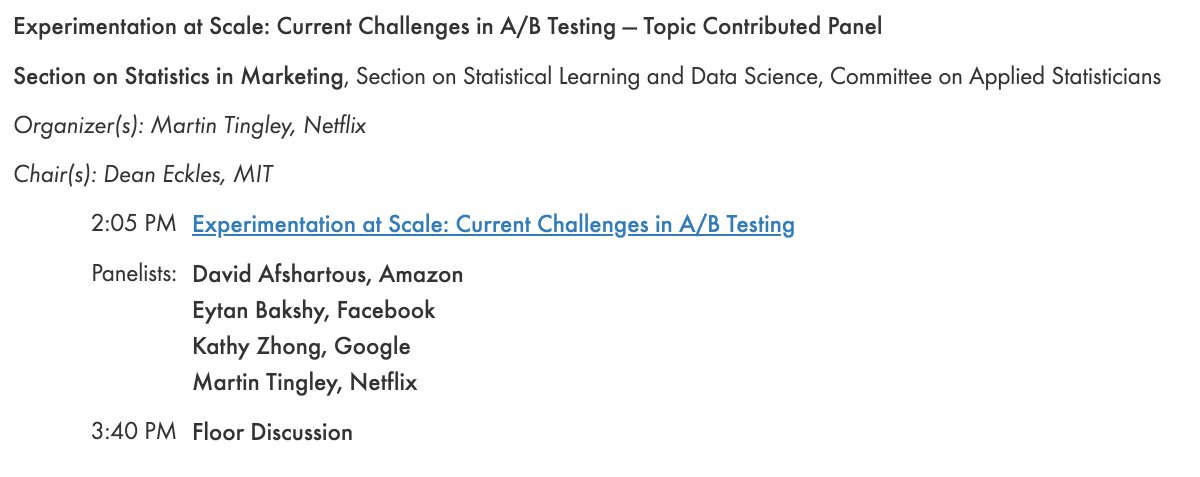
Interested in large-scale, rapid experimentation in the Internet industry? There are multiple sessions tomorrow at #jsm2019 on the topic. I'm moderating this panel with experts from FANG in CC-703. Will dig into statistical, computational, and practical issues.
Usually at conferences with parallel tracks I go to the session that seems most relevant. But in the spirit of explore-exploit, for #JSM2019 I'm trying out epsilon-greedy, epsilon = 1 session. My epsilon session is: Causal Inference in Sports Statistics.