The Bitcoin price has been edging higher in recent weeks, after recovering the 200-week moving average around $63k. The market did experience a weekly close below the 200WMA towards the end of of June, but has since held above it for four consecutive weeks.
Bitcoin bear markets tend to reshape the investor base.
Coins move from weak hands to strong hands, supply becomes increasingly concentrated amongst long-term holders, and eventually the market begins to stabilise from the ground up.
Strategy just sold Bitcoin for only the second time in its history.
The sale was small - just 32 BTC out of a treasury of 843,706 coins - but it raises a much bigger question:
What does this sale tell us about how Strategy intends to manage its balance sheet going forward?
Every red candle feels like impending doom.
Every green candle brings back just enough hope to make recovery feel possible.
Then the next red candle arrives, and the bear market feels like it will last forever.
At the Feb-2026 low, over 80% of all capital invested in Bitcoin was underwater.
Historically, bear markets only end after enough of those underwater coins transfer to stronger hands at lower prices.
This is the “capital rotation” process that slowly transforms a top-heavy.
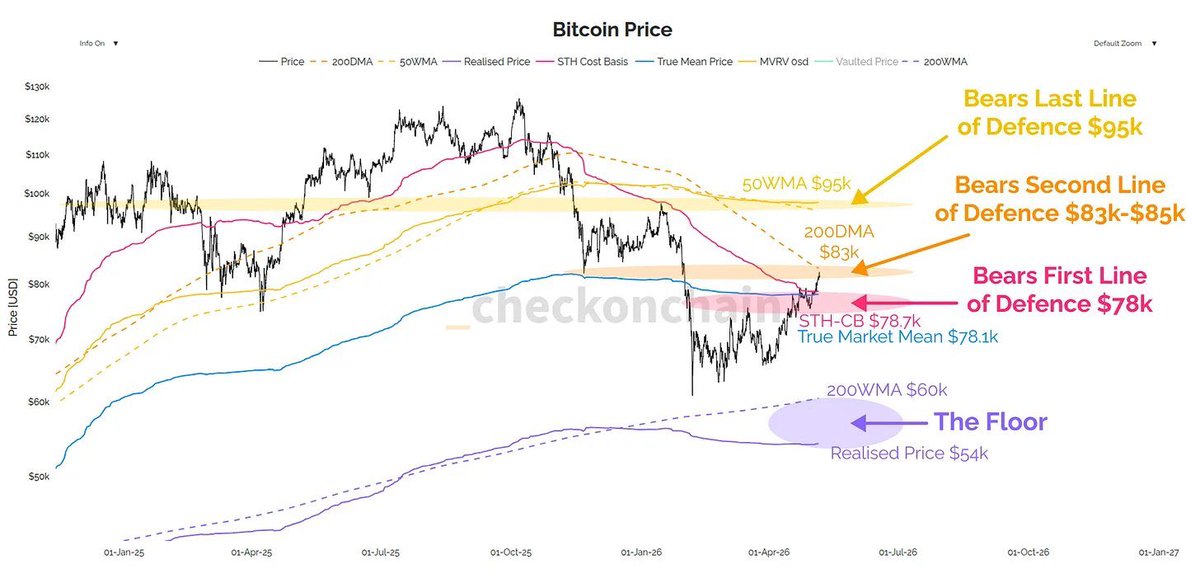
Bitcoin has recently reclaimed the bears first line of defence at $78k, a level aligned with the True Market Mean and Short-Term Holder cost basis. Historically, sustained moves above this region tend to coincide with a meaningful improvement in investor sentiment.
A major feature of the 2025-26 Bitcoin bear market was the scale of long-dormant supply returning to circulation.
Across 2024 and 2025, more than 1.3M BTC held for 5+ years were revived onchain, representing over $110B in rotated capital.
Bitcoin’s rally into the mid $80ks has many bears questioning their thesis, especially as several key recovery signals are now starting to flip constructive. However, the road higher is unlikely to be smooth, and multiple major resistance zones still remain overhead.
Everyone blamed derivatives, ETFs, market manipulation, or “suppression” for the 2025-26 Bitcoin bear market.
But the data points somewhere much simpler:
Old holders sold enormous amounts of spot BTC into strength.
Realised profits routinely reached $40B-$100B per month.
The Checkonchain team is proud to launch the 2nd edition of The Bitcoin Checkpoint report, in partnership with our friends at @unchained.
In this 30+ page report, @_Checkmatey_ provides a data-driven breakdown of Bitcoin’s 2025–26 bear market, using a wide range of data-sets across spot, onchain, ETF, and derivatives markets.
Get the full report here👉 https://t.co/PDKhop6D2I.
In the report, we assess:
- How the 2025 bull market topped, and the role of spot sell-side pressure.
- The mechanics of the drawdown, and what drove the move to $60k.
- The two major capitulation events that have shaped this bear.
- How over 2.0M BTC has rotated into a new cost basis range.
- Why models like the True Market Mean are increasingly relevant.
- Our base case thesis for where we believe this bear market bottoms out.
Check out the full report 👉 https://t.co/PDKhop6D2I.
Strategy's preferred stock Stretch (STRC) has taken a nose-dive, which rightfully has many questioning whether this is the market sending a more damning signal.
In our latest newsletter piece, @_Checkmatey_ examines the breakdown in Strategy's preferred stock complex, what it reveals about investor sentiment, and why Bitcoin bear markets have a habit of exposing leverage hidden beneath the surface → https://t.co/rjBnaD504f
Some insights explored in the article:
- Only STRF investors remain above their original $100 par value on a total return basis
- STRK and STRD investors are underwater, even after accounting for dividends received
- STRC has traded below its intended $100 par value since mid-May
- Strategy now carries more than $21B in debt and preferred stock obligations
Bitcoin bear markets tend to reshape the investor base.
Coins move from weak hands to strong hands, supply becomes increasingly concentrated amongst long-term holders, and eventually the market begins to stabilise from the ground up.
In our latest newsletter piece, @_Checkmatey_ examines why the 200-week moving average remains one of Bitcoin's most important accumulation zones, how this bear has reshaped the ownership structure, and what the earliest signs of improving momentum look like →
https://t.co/UBLKo12Ybp
Watch now: Bear Market Update with @PeterBTCAdviser.
In this discussion with Pete, @_Checkmatey_ breaks down the key on-chain signals, investor behaviour, and market mechanics that are shaping the current Bitcoin bear market.
We explore what capitulation really looks like, how to identify opportunity during periods of maximum pessimism, and the frameworks we use to navigate volatile markets.
Watch now ↓
https://t.co/SNNMPt3gB9
Bear market bottoms are a process, not an event.
First, price-sensitive investors capitulate. Then comes the harder phase: months of sideways action that slowly wear down the conviction of those who remain.
In our latest newsletter piece, @_Checkmatey_ examines the evidence suggesting Bitcoin may be experiencing a time-pain capitulation event, and what investor behaviour looks like during this phase of the cycle → https://t.co/DakgPAdzpg
Chart explainer:
The 200WMA Quantile measures where Bitcoin is trading relative to its 200-week moving average. Current readings sit in the bottom ~10% of all historical observations, a region only visited during the deepest stages of prior bear markets.
Resilience is about how quickly you can rebound from a shock event, and begin thinking clearly about your next decision.
In our latest newsletter piece, @_Checkmatey_ examines one of the most common investor dilemmas: should you wait and try to lump-sum the bear market bottom, or is a structured DCA strategy actually the better approach? Learn about it here → https://t.co/wxRrs8EMrX
Resilience as an investor is all about how quickly you can rebound from the shock value of a market move, and adjust to the cards that lay on the table.
In our latest newsletter piece, @_Checkmatey_ examines Bitcoin's latest sell-off, how investors are responding beneath the surface, and what the probabilities suggest about prices at 66k.
Get it here: https://t.co/Gu1xKqd46w
Strategy just sold Bitcoin for only the second time in its history.
The sale was small - just 32 BTC out of a treasury of 843,706 coins - but it raises a much bigger question:
What does this sale tell us about how Strategy intends to manage its balance sheet going forward?
In our latest newsletter piece, @_Checkmatey_ examines the sale, the firm's evolving capital structure, and the risks investors should understand when analysing the world's largest corporate Bitcoin treasury → https://t.co/NAeqsUxgwb