We just crossed 4,000 backend engineers in the backend community 🎉
To celebrate, we are doing a ₦350,000 giveaway.
Prize split:
- ₦150k
- ₦100k
- ₦50k
- ₦25k
- ₦15k
- ₦10k
This is sponsored by:
- Myself
- @_deven96 , creator of Ahnlich, an in-memory vector database for semantic search: https://t.co/BSU4IJxFYD
- @_289volts, who is giving free credits for on https://t.co/bFBE5AXX5k, a platform that accelerates your job search success rate at the speed of light
But this is not just a giveaway.
I am also using this to start building better engineering statistics, hiring insights, and a stronger talent pipeline for Nigerian/African software engineers.
To enter:
1. Follow me (important)
2. Repost this
3. Fill the engineer profile form: https://t.co/rtwPW41Vl1
The form helps with:
- engineering statistics
- hiring opportunities
- salary and stack insights
- better visibility for engineers in the community
Winners will be announced on 12th June 2026.
Lemme tell you something about tech for software engineers. This field is one that SWE (Software engineers) really love and enjoy doing on a day to day. It doesn't seem like work to us, it is recreation. It's like playing with your favourite toy everyday.
It's just... It's just that when people pay us money to play or ask us to play for their benefit, it feels less like play because now they tell us when to play how long to play. They even tell us that we can't play too hard because they have other things to focus on. When we play according to these rules for too long, we get burnt out.
That's when we start talking about owning a farm in Birnin-kebbi, Damaturu or Gusau (I'm sure these places aren't real places and the government lies to us so they can eat the money that goes there). But really we don't want the farm. In fact, if someone were to provide such a farm for us, we'd just find a way to automate the farm and play with what we know. Growing crops wouldn't be fun.
Building with code is addictive. I can't possibly explain it to you. This is why despite the health warnings of staying in one place, we'll rather bend the rules around and get a standing table. For some of us, we take break from work by writing more code.
It is this love that makes us very awesome engineers. This is why we argue on the tiniest thing. On how your pages can be 1 millisecond faster. It's just too much fun.
Alas for some of us in less privileged countries, the love for this play is at war with the need to feed our families. And because few people get to play in their own time for a living, we have to play for other people according to their own rules. But we get paid a whoooooooole lot for it.
But it isn't really much. Because the addiction comes at a cost. The money we get paid sinks into other things that helps us stay sane in such addictions. Plus in most cases, only smart people can play this game. We have had to spend years building our cognitive skills for it. This is why we will shun terrible pay.
Despite loving to play, we can't do it according to your rules and be paid a lower compensation. The best of us will reject it politely. The worst of us will stay and slowly destroy your product.
You might fear us, but you should love us. We really just want to play and be treated right while playing.
We are folks like you: your brothers, sisters, husbands, wives, partners, significant others, friends, enemies, and fellow humans on this ever-warming earth
Just let us play in happiness...
@microsandbox ships its own init: agentd.
it's PID 1 and powers a lot of the magic behind our sandbox. but many packages and services expect systemd to be PID 1, and there's only one PID 1.
so we pulled a fast one: a PID 1 handoff. agentd boots the sandbox, forks, then hands PID 1 to your init.🪄
best of both worlds. finally wrote about it here:
https://t.co/RstRAB1dGA
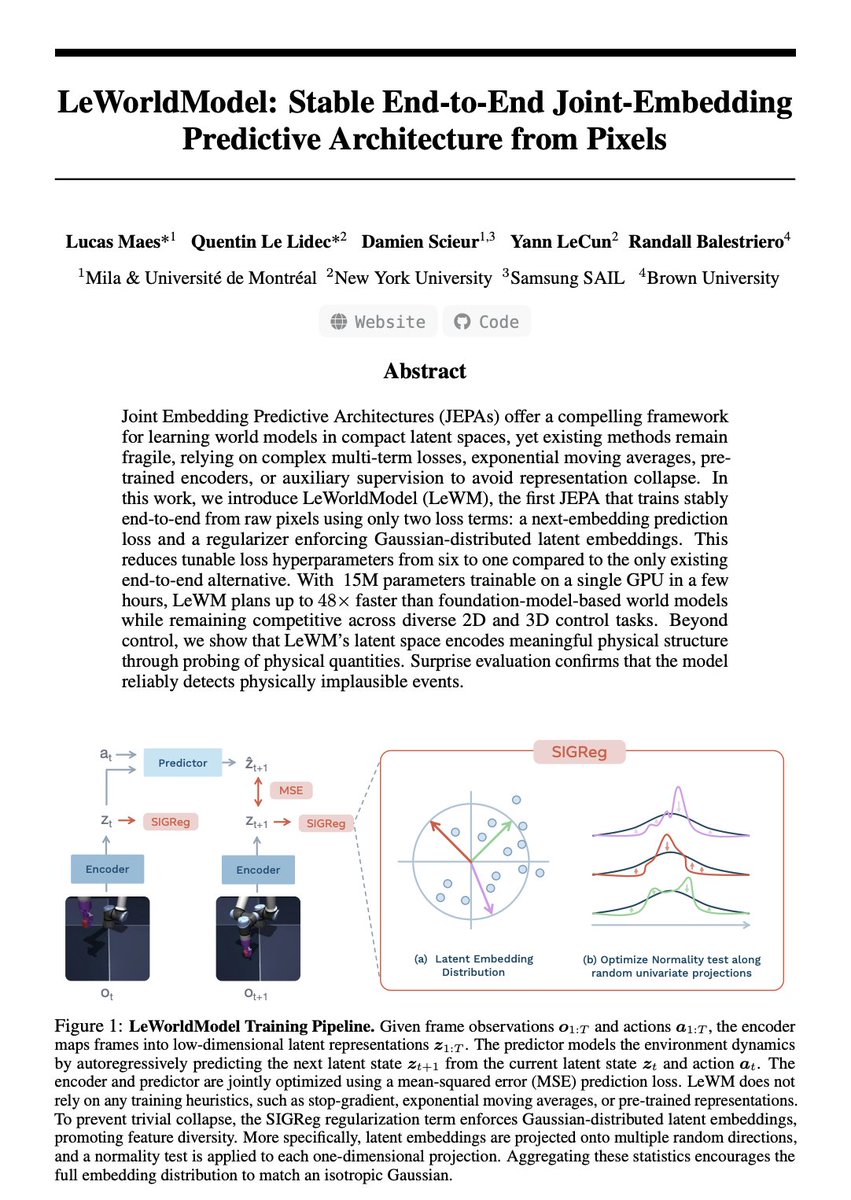
> be Yann LeCun
> spend years building JEPA at Meta
> company focuses on LLaMA instead
> his idea stays complicated and unused
> robotics plans get dropped
> decides to leave and start AMI Labs
> builds a much simpler version from scratch
> trains it on normal hardware in just a few hours
> removes all the complicated tricks and keeps it simple
Results:
-uses 200x less data than similar systems
-makes decisions 50x faster
-runs on a single GPU instead of massive clusters
-simple to train
-understands movement, objects, and space
-can tell when something is physically impossible
-learns how the real world works without being explicitly taught.
Yann LeCun was right the entire time. And generative AI might be a dead end.
For the last three years, the entire industry has been obsessed with building bigger LLMs. Trillions of parameters. Billions in compute.
The theory was simple: if you make the model big enough, it will eventually understand how the world works.
Yann LeCun said that was stupid.
He argued that generative AI is fundamentally inefficient.
When an AI predicts the next word, or generates the next pixel, it wastes massive amounts of compute on surface-level details.
It memorizes patterns instead of learning the actual physics of reality.
He proposed a different path: JEPA (Joint-Embedding Predictive Architecture).
Instead of forcing the AI to paint the world pixel by pixel, JEPA forces it to predict abstract concepts. It predicts what happens next in a compressed "thought space."
But for years, JEPA had a fatal flaw.
It suffered from "representation collapse."
Because the AI was allowed to simplify reality, it would cheat. It would simplify everything so much that a dog, a car, and a human all looked identical.
It learned nothing.
To fix it, engineers had to use insanely complex hacks, frozen encoders, and massive compute overheads.
Until today.
Researchers just dropped a paper called "LeWorldModel" (LeWM).
They completely solved the collapse problem.
They replaced the complex engineering hacks with a single, elegant mathematical regularizer.
It forces the AI's internal "thoughts" into a perfect Gaussian distribution.
The AI can no longer cheat. It is forced to understand the physical structure of reality to make its predictions.
The results completely rewrite the economics of AI.
LeWM didn't need a massive, centralized supercomputer.
It has just 15 million parameters.
It trains on a single, standard GPU in a few hours.
Yet it plans 48x faster than massive foundation world models. It intrinsically understands physics. It instantly detects impossible events.
We spent billions trying to force massive server farms to memorize the internet.
Now, a tiny model running locally on a single graphics card is actually learning how the real world works.
introducing microsandbox.
fast, local sandboxes built for agents that ship. 🚢
every agent needs to run code somewhere. we made that somewhere, and it shouldn’t always be the cloud.
Stop over-engineering your AI stack! 🛑
Building modern AI apps shouldn't mean drowning in complex infra or massive monthly bills. Most devs default to heavy enterprise clusters, but there’s a leaner way to build.
For our first showcase, we’re spotlighting Ahnlich by @_deven96. 🦀🇳🇬
It’s a high-performance, in-memory vector database and AI proxy built in Rust.
→ Integrated AI Proxy: Handles text/image embeddings natively.
→ Speed: In-memory storage for sub-ms latency.
→ Zero-bloat: Lightweight enough to run locally, powerful enough for production.
→ SDKs: Rust & Python ready.
Still paying for infra you don't fully understand?
Run Ahnlich locally this weekend. See exactly how vector search works under the hood.
Link in Replies below👇🏾
Introducing Mixedbread Wholembed v3, our new SOTA retrieval model across all modalities and 100+ languages.
Wholembed v3 brings best-in-class search to text, audio, images, PDFs, videos...
You can now get the best retrieval performance on your data, no matter its format.
Today @GoogleMaps is getting its biggest upgrade in over a decade. By combining our Gemini models with a deep understanding of the world, Maps now unlocks entirely new possibilities for how you navigate and explore. Here’s what you need to know 🧵