I’m listening to an interview with a Russian Su-34 pilot who has been taking part in the war against Ukraine since the very first days.
🔴 He claims to have 1,400 combat sorties.
The interview is more than 3 hours long. Some interesting points:
🔴 The Su-34 does not have secure, encrypted radio communications; according to him, this only appeared on the Su-34M.
🔴 On a standard Su-34, he mostly carried out missions using unguided munitions, while Su-34M aircraft, with secure communications, were used for missions involving the suppression of Ukrainian air defenses.
🔴 I don’t know how accurate this is, but according to him, on the very first night of the war he was sent to fly at 6,000 meters over Kyiv without a specific mission, then ordered to return. On the way back, he saw missiles heading toward Kyiv. He says he was used as bait to provoke Ukrainian air defenses and then strike them with missiles afterward. Knowing Russian command practices, this sounds plausible. According to him, older Su-34s were used in this way more than once.
🔴 He praises Ukrainian air defense, saying it is very well organized and decentralized.
🔴 The Buk-M1 was, in his view, the most effective Ukrainian air defense system in the early phase of the war. He does not give exact figures, but it becomes clear that Russian Air Force losses were much higher than what is commonly reported online, and a major share of that was due to the Buk system.
🔴 Ukrainian Buk units quickly changed positions and mounted their systems on semi-trucks, which significantly improved their mobility and speed of redeployment.
🔴 He also describes Ukrainian air defense tactics in an interesting way. According to him, Ukrainians realized they did not need to shoot down every enemy aircraft; instead, their goal was to down a few aircraft each time, and over time this created a cumulative effect. As a result, his combat group reportedly lost half of its aircraft during the battles for Kyiv (though he does not specify the unit size—whether a squadron or a regiment).
👍I’ll continue listening and taking notes throughout the day when I have time.
Russia was able to use one of its last remaining A-50U airborne to provide aerial surveillance.
Its radar unobstructed by the curvature of the Earth was able to detect Ukrainian FP-5 Flamingo cruise missiles from far away and defeat them.
This employment is likely exploitable.
Ukraine spent significant effort over the past few years to destroy A-50 aircraft for this very reason. These are officially called "Airborne Early Warning and Control" AEW&C for a reason. There powerful radars can see far and their onboard crew is able to direct aircraft and other assets.
While the exact number operating is unknown, it is reportedly in the low single digits. You need 4 to keep one up 24/7 and with 7 you can almost keep 2 up 24/7.
Given Russia is now being tracked as using these, Ukraine can plan operations around them where before they had to take the risk the sircraft were in the air.
Now that Russia is using them, Ukraine's drone strikes will be less effective due to early warning, but Ukraine can also plan around it. It may be a wash in terms of air defense.
Yesterday, Putin issued a threat against Ukraine’s European allies, calling for an "analysis" of each country’s involvement in every Ukrainian operation "in order to possibly make responsible decisions in the future, if necessary."
Judging by the latest news, Moscow is no longer merely waging a hybrid war against the West. It can be assumed that it is preparing the operational environment for a possible direct conflict with NATO, staying below the threshold that would trigger a collective military response.
My conclusion is based on three groups of reports that have appeared in the public domain over the past ten days.
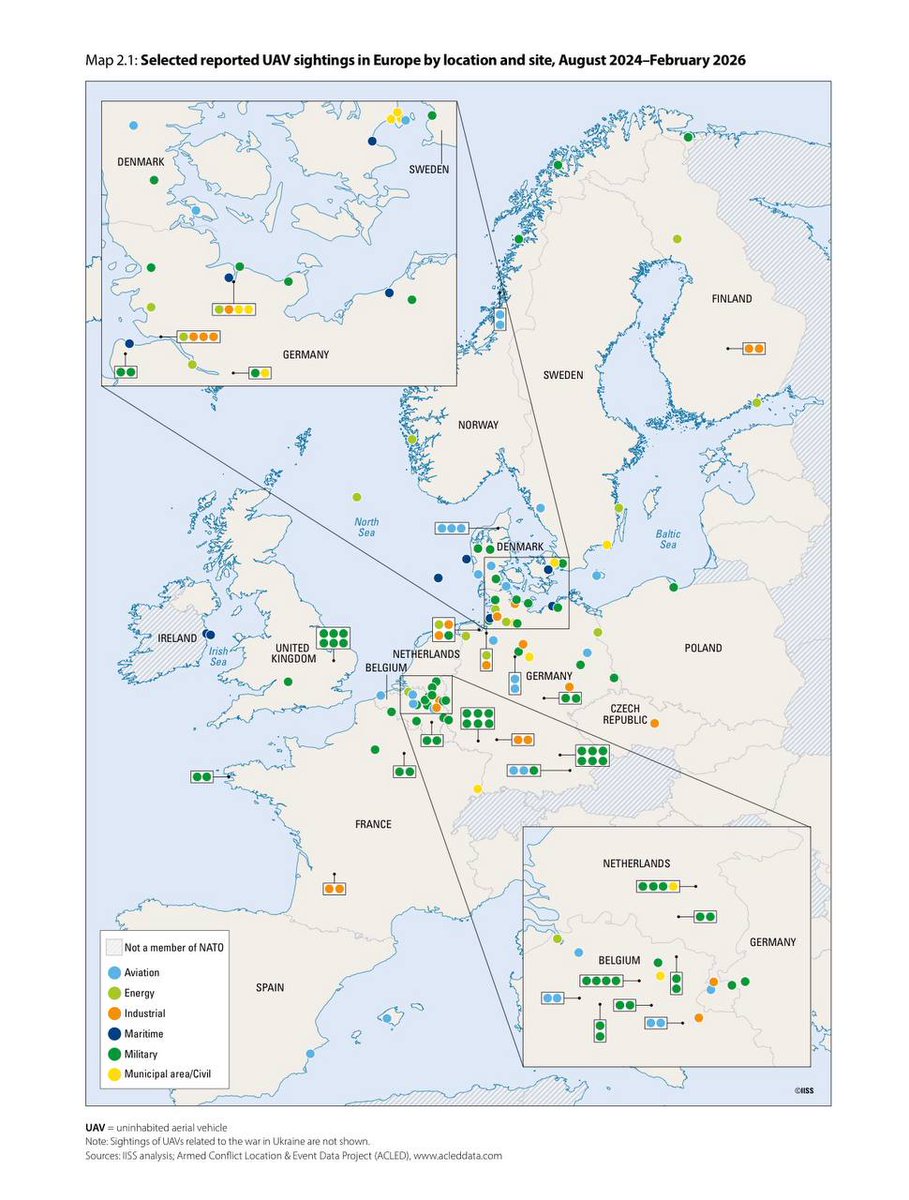
The first is the IISS report published on July 2. It says that between August 2024 and February 2026, 144 drone incidents took place in 13 countries, each time with tankers from Russia’s shadow fleet nearby.
The targets of these drones were NATO nuclear infrastructure sites: RAF Lakenheath, the Île Longue submarine base, and nuclear-sharing air bases in Belgium and the Netherlands. That is, Russia is effectively preparing the theater for future military operations - mapping air defenses and measuring response times.
The second group of news involves intelligence warnings. On June 22, Latvian intelligence reported signs of preparations for military provocations against the Baltic states or Poland.
On June 26, The Guardian confirmed these assessments, citing two countries on NATO’s eastern flank. A source in one of the countries said Putin may try to test U.S. guarantees toward the alliance’s smallest members.
On July 3, The Telegraph reported that the United States has been systematically informing Warsaw about Russian plans. The scenarios range from drone strikes on critical infrastructure and a simulated massive air attack to a limited incursion by Russian or Belarusian troops from Kaliningrad or Belarus, disguised as a navigation error or a rescue operation.
According to Polish sources, Moscow’s calculation is that, instead of opening fire, Poland would be forced under U.S. pressure to enter negotiations, and Russia’s central demand for "withdrawing troops" would be an end to Western support for Ukraine.
The third group of news concerns legitimization. On June 23, Putin spoke of "retaliation" against countries from whose territory drones are allegedly launched against Russia.
At the same time, Russia accused Latvia of providing territory for preparing attacks, while Ukraine’s Security Service exposed a network of 11 people paid by Moscow to carry out anti-Ukrainian actions in Poland.
We can see that Moscow is preparing the environment for a direct conflict - building the necessary infrastructure: intelligence, sabotage, and narrative.
It is important to pay attention to the method itself. Small provocations and incidents without a collective response show where the alliance’s threshold lies - and move it.
Charlie Edwards, co-author of the IISS report, summed it up this way: Russia has publicly demonstrated its ability to penetrate NATO airspace without triggering a collective response, and the gap between the alliance’s capabilities and its political will has become a strategic vulnerability.
Thus, at some point Moscow may feel that a limited operation - against Poland or one of the Baltic states - could bring a high return: for example, forcing NATO to negotiate a halt to aid for Ukraine.
Signs that the Kremlin is developing escalation decisions would include narratives about "Ukrainian sabotage from NATO territory," the transfer of forces to Kaliningrad and Belarus, the concentration of the shadow fleet near critical infrastructure, and tankers being escorted by warships.
What if the model is the router?
I think people underestimate the ability of frontier models now, but especially in the near future, to delegate work on their own as needed to dumber, cheaper models. The future might be start with a smart AI planner, let it delegate on its own.
pxpipe is interesting because it turns dense text context into images to cut Claude Code costs.
But the idea is not entirely new: DeepSeek explored something very similar with "optical context compression" end of 2025 (if you remember); rendering text as images so models can process long context more efficiently.
DeepSeek treated it as a model/architecture problem.
pxpipe treats it as an infrastructure hack: a local proxy that exploits the fact that frontier models can already read images well enough.
That makes pxpipe less elegant, more lossy, and probably risky for exact strings, hashes, IDs, or code details.
But still a cool idea and i really like the approach.
🧵Since the December 2025 border conflict, both Cambodia and Thailand have been fortifying the border regions, especially since March 2026. I will go through these developments, from the northeast to the southwest.
(all imagery via @SoarAtlas)
@Nrg8000@FaytuksNetwork
Regarding all the news about Russia and Poland I'll point out a few things. One stands out:
The rhetoric has escalated fast in just the past weeks from Tusk to Latvian intelligence. That's (They know something.)
Second: the first real provocation already happened. Last September, 20+ Russian drones entered Polish airspace
Third: the cost-benefit math favors Moscow right now. Polish intel chief said it directly cost of these provocations is low, NATO's response is mostly political, and that low cost invites more escalation.
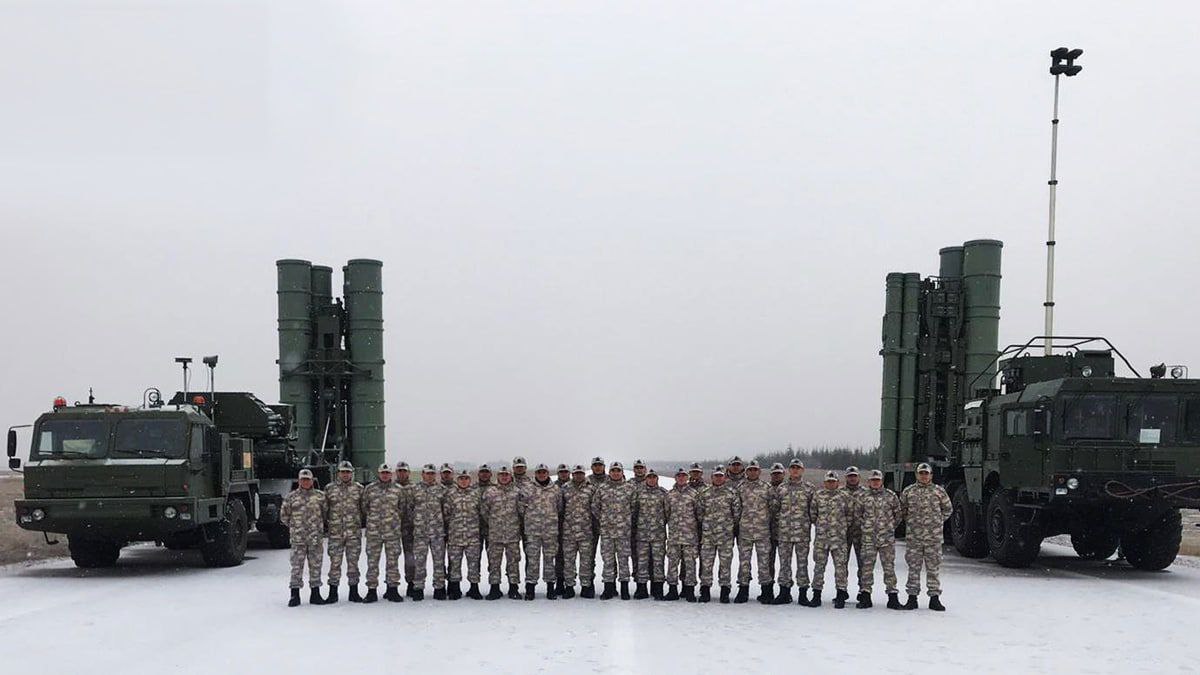
Turkish S-400 🆚 Ukrainian ballistic missile
Yesterday, during his livestream, Mark Feygin shared an interesting piece of news. According to him, Ukrainian ballistic missiles were allegedly tested in Turkey against Turkish S-400 air defense systems.
🚨 BREAKING: U.S. warns Poland that Russia is preparing an armed provocation. Belarusian troops could be involved
According to The Telegraph, citing its sources, one of the most extreme scenarios involves a ground incursion by Russian and Belarusian troops. The attack could be launched either from Russia’s Kaliningrad region or from Belarus.
Polish Foreign Minister Radosław Sikorski previously warned that Russia could stage an attack on its own territory to create a casus belli—a pretext for aggression against a NATO member.
Curious.
This appears to be Russian wargaming in scenario of Ukrainian landings on the Crimean Peninsula.
Have we seen this before? The map looks legit, symbols consistent with the ones used by the Russian military.
BREAKING:
More and more indications of Ukraine having launched its first ballistic missile at Moscow.
Something big came down in Yudanovka, a village around 50 kn from the Red Square in Moscow. Russia reports it shot down a long-range SRBM launched by Ukraine.
Witnesses have taken pictures of attempted S-300/S-400 interceptions taking place far up in the sky, at altitudes much higher than drone or cruise missile interceptions take place.
Ukraine said a few days ago that the new FP-9 ballistic missiles is almost ready and will be fired as possible as soon as possible, potentially even before the end of June.
It has a range of at least 855 km and a warhead of 800 kg, nearly double that of what Russia’s Iskander ballistic missiles carry.
It also has an incoming speed of Mach 7, reaching Moscow within 3 minutes of launch in Ukraine, making it very hard to intercept. A CEP of 20 meters means it’s very accurate (more than 50% of fired missiles land within a 20-meter radius of the exact target coordinates).
The Russians living in Moscow won’t be happy at all once it’s mass-produced and launched frequently in large quantities against Moscow.
Excellent work @DenShtilierman
My one serious piece of advice having used Fable a bunch before release is that, unless you are careful it develops its own internal bizarre cadence & dialogue over long tasks. If you aren't asking it report in plain language, this starts to creep into everything, including menus