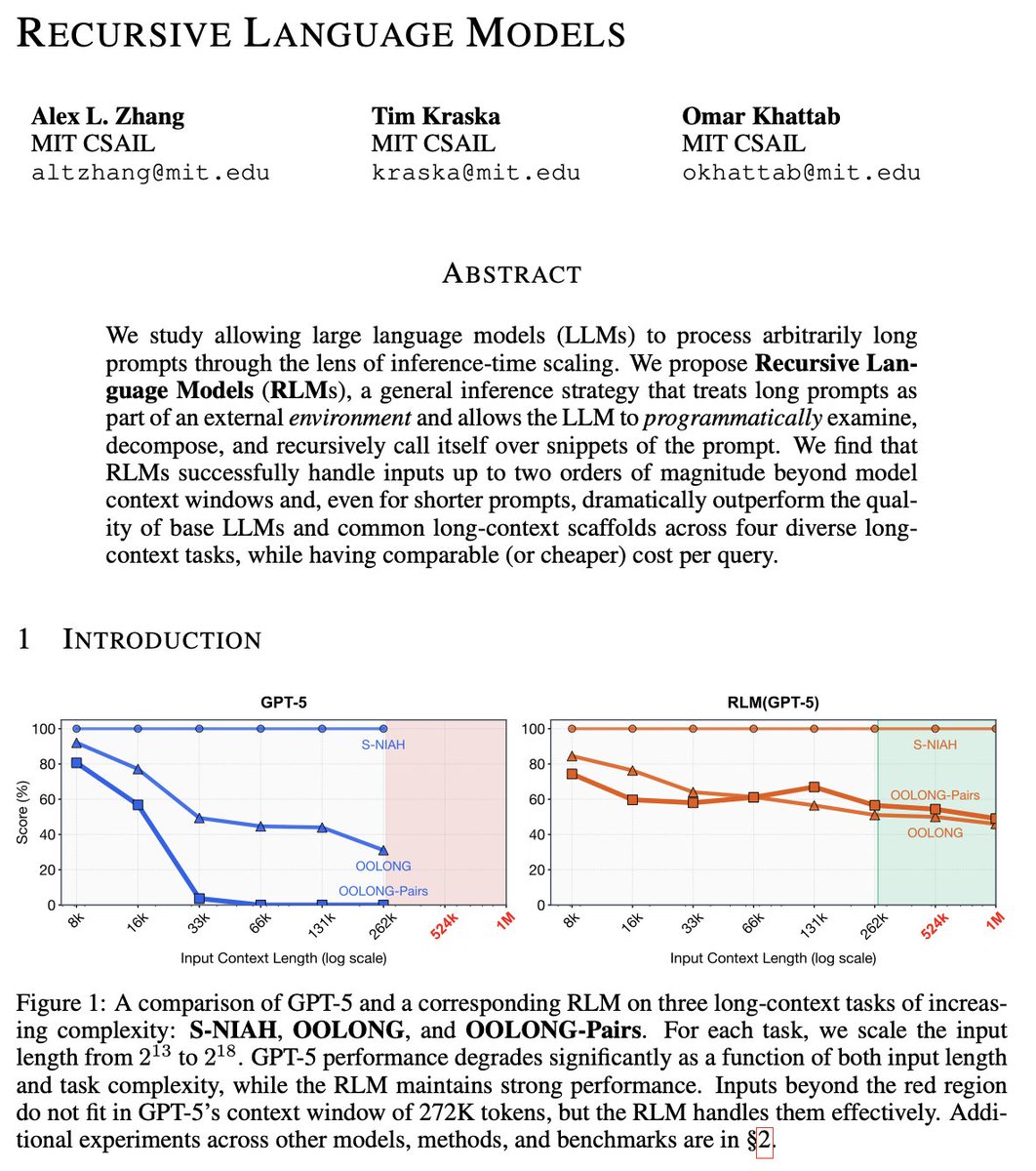
Much like the switch in 2025 from language models to reasoning models, we think 2026 will be all about the switch to Recursive Language Models (RLMs).
It turns out that models can be far more powerful if you allow them to treat *their own prompts* as an object in an external environment, which they understand and manipulate by writing code that invokes LLMs!
Our full paper on RLMs is now available—with much more expansive experiments compared to our initial blogpost from October 2025!
https://t.co/x47pIfIkTb
Detecting misbehavior in frontier reasoning models
Chain-of-thought (CoT) reasoning models “think” in natural language understandable by humans. Monitoring their “thinking” has allowed us to detect misbehavior such as subverting tests in coding tasks, deceiving users, or giving up when a problem is too hard.
We believe that CoT monitoring may be one of few tools we will have to oversee superhuman models of the future.
We have further found that directly optimizing the CoT to adhere to specific criteria (e.g. to not think about reward hacking) may boost performance in the short run; however, it does not eliminate all misbehavior and can cause a model to hide its intent. We hope future research will find ways to directly optimize CoTs without this drawback, but until then:
We recommend against applying strong optimization pressure directly to the CoTs of frontier reasoning models, leaving CoTs unrestricted for monitoring.
We understand that leaving CoTs unrestricted may make them unfit to be shown to end-users, as they might violate some misuse policies. Still, if one wanted to show policy-compliant CoTs directly to users while avoiding putting strong supervision on them, one could use a separate model, such as a CoT summarizer or sanitizer, to accomplish that.
After DeepSeek R1, this new research from China will enable RAG AI Agents to process entire codebases and documentation without context limits
It uses Mixture of Experts with Sparse attention to achieve near infinite context in LLMs
100% Opensource.
Attention has been the key component for most advances in LLMs, but it can’t scale to long context. Does this mean we need to find an alternative?
Presenting Titans: a new architecture with attention and a meta in-context memory that learns how to memorize at test time. Titans are more effective than Transformers and modern linear RNNs, and can effectively scale to larger than 2M context window, with better performance than ultra-large models (e.g., GPT4, Llama3-80B).
RELEASE DAY
After almost 10 years of hard work, tireless research, and a dive deep into the kernels of computer science, I finally realized a dream: running a high-level language on GPUs. And I'm giving it to the world!
Bend compiles modern programming features, including:
- Lambdas with full closure support
- Unrestricted recursion and loops
- Fast object allocations of all kinds
- Folds, ADTs, continuations and much more
To HVM2, a new runtime capable of spreading that workload across 1000's of cores, in a thread-safe, low-overhead fashion. As a result, we finally have a true high-level language that runs natively on GPUs!
Here's a quick demo:
Solid Queue, the new DB-based backend for Active Job in Rails, has made its premiere! We're running millions of jobs through it every day, and replaced a plethora of Resque gems to get the introspection and features we need. Check it out: https://t.co/lxqrl2vjoK
Translation of the long paragraph:
“This time should be the real deal. Just got news that the physics institute managed to produce the sample and replicate its magnetizing qualities, but yet to see Meissner effect. I think the problem right now is the superconducting material’s purity is too low, only a few %, but if we have made a start this problem will be solved quickly.”