When UPI came, it disrupted the likes of Visa and Mastercard, prevented a duopoly and created a fairer market with open, interoperable systems.
ONDC, launched by DPIIT, came with a similar promise of doing to e-commerce what UPI did to payments.
With Rs 220 cr freshly raised from Zoho, Paytm, Uber, etc, ONDC under Jain is like 14 startups rolled into one.
One of those 14 bets is DigiDukaan, hoping to create an open network of FMCGs, distributors and kirana stores.
Insightful longread by @mattsclancy
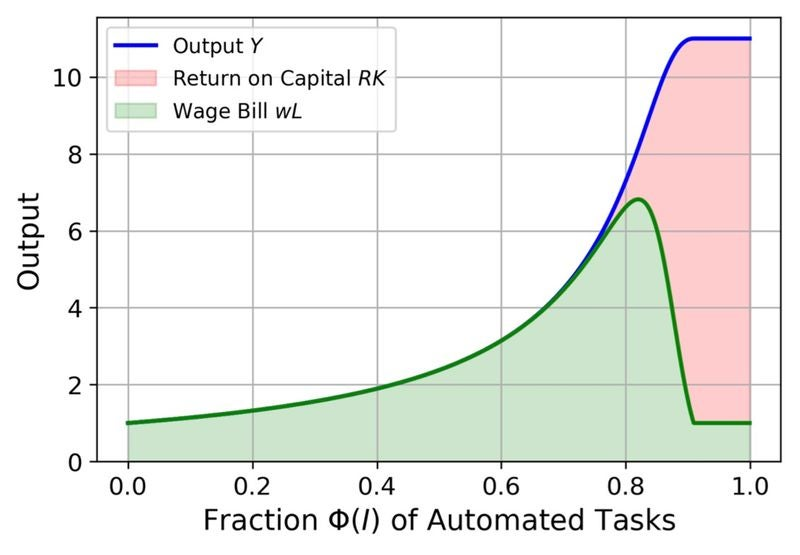
The oft repeated argument when it comes to AI taking over jobs is how society has always created new tasks. Clancy asks what happens when AI can perform any task, and "we’ll no longer be able to invent new tasks..."
https://t.co/bzfyRaQn34
The question of independence is a persistent one in Delhi’s policy circles and it hangs heavy over Chintan.
This is from the story @_inderpalsingh wrote two weeks ago, 'Adani’s think tank flexes its muscles in Delhi'.
https://t.co/WnfDUynZDW
All readers have a superpower- they carry a secret trapdoor that whisks them into a parallel world whenever they choose.
Flight delayed? No problem.
Meeting pushed back? No problem.
What frustrates others is a joyful invitation for us to open that trapdoor.
That’s a superpower!
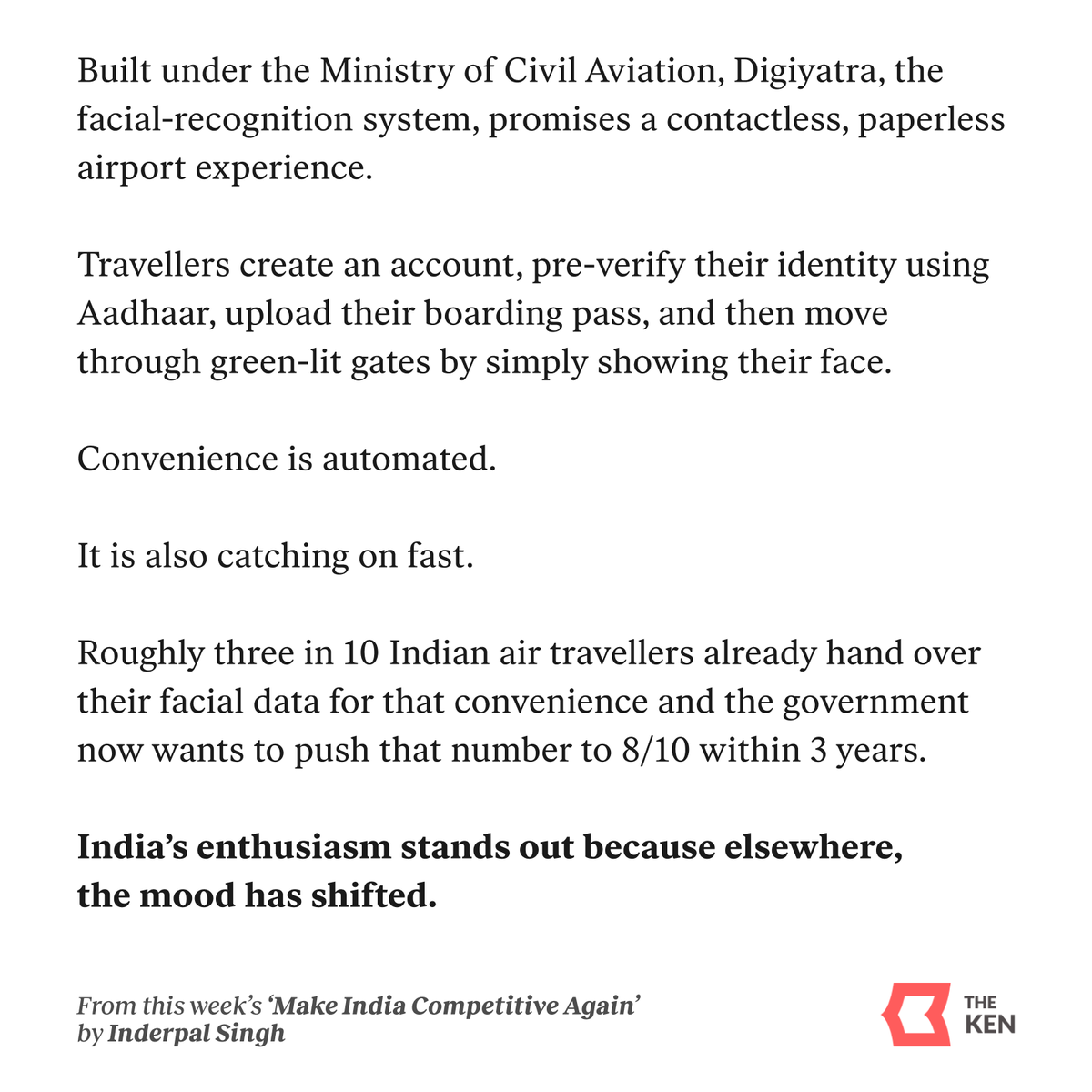
As the new privacy laws kick in, the designed-to-forget architecture that Digiyatra claims offers a rare glimpse of what privacy-by-design could look like at scale.
Read this week's 'Make India Competitive Again' by @_inderpalsingh: https://t.co/TSh10I8IIF
“Compliance is becoming more like finance,” said Raghuveer Kancherla, co-founder of Sprinto.
Shashank Karincheti, co-founder of Redacto, says privacy & data-protection services is at least a Rs 2,000-crore market in India.
But it isn’t an easy market to crack for startups ⬇️
Un moment de recul. A pause. A moment of stepping back. A surprisingly apt French phrase for an industry now staring at its most consequential shift in decades—and doing so most dramatically in India.
"The cloud giveth, and the cloud taketh away"
In my piece for @TheKenWeb, I examine the market for AI companies in India and what are the new antitrust issues that AI brings to digital markets.
90% of Indian AI firms don’t have reliable access to data.
The plug, the power, the brain—it all belongs to Big AI: large language models (LLMs) built by OpenAI, Anthropic, Google, and Meta.
It’s the kind of dependency that’s making India’s antitrust watchdog nervous.
"Every cloud has a server lining!"
In my latest piece for The Ken, I talk about data centres. When we say our data is up there in the cloud, it's actually down here on the ground in physical form in a data centre.
https://t.co/4yEXyo2d2F
Reliance and OpenAI are stepping up their data-centre bets in India. And NTT Data is in talks with Oracle for a partnership in the country.
While investments continue to flow in, the sector remains shrouded in approval delays, state-to-state competition, and market risks.
After decades of increasing complexity, the Indian government is promising simplicity in income tax laws.
The new bill is 600-odd pages long. It's just over half the length of the current Act, down to three lakh words.
Will this radically simplify India’s creaky old tax code?
A day of two Parliaments learning from each other, as @Nus_Ghani, 🇬🇧 Deputy Speaker @HouseofCommons meets @KirenRijiju, MPs and colleagues across 🇮🇳 Parliament.
Important lesson for young people: After childhood, there's no one to protect you from your own decisions. No one will stop you from getting yourself into a bad marriage, a job you hate, a mountain of debt, trouble with the law. You are the sole architect of your life path.
Gukesh rearranges all the pieces back on the chessboard, and then does Pranam to the board, gestures gratitude before rising to celebrate his win.
Well done mate. Congratulations.
"Harvard Alum," read the candidate's CV I was interviewing. There were no other details about his educational background. When I asked what he studied at Harvard, he replied, "A Course on Entrepreneurship." When I inquired about the duration of the course, he said it was four weeks. I couldn't help but form the impression that he's prone to exaggeration and questionable in terms of trust.
This wasn't the first time I had encountered such a situation or felt this sense of disappointment. Being an alum of a premier institute implies undergoing a rigorous selection process and spending a considerable amount of time with individuals who have undergone a similar process. A paid short term course is a good addition to the CV but it doesn't quite qualify you as a Harvard Alum.
Having completed an executive education course at Kellogg myself, I used to make it very clear that it was a short-term course and by no means would I dare call myself a Kellogg alum. Once, someone mistook me for a Kellogg alum during an interview. After that, I removed it entirely from my CV.
Employers value honesty above all else. By attempting to take a shortcut like this, you risk coming across as duplicitous. It's simply not worth it. Integrity is far more valuable than any Ivy League degree.
What am I composed of? Cells, neurons, quarks? Maybe. But I like to believe that I am ultimately composed of the stories I have to narrate before I go to sleep every night.