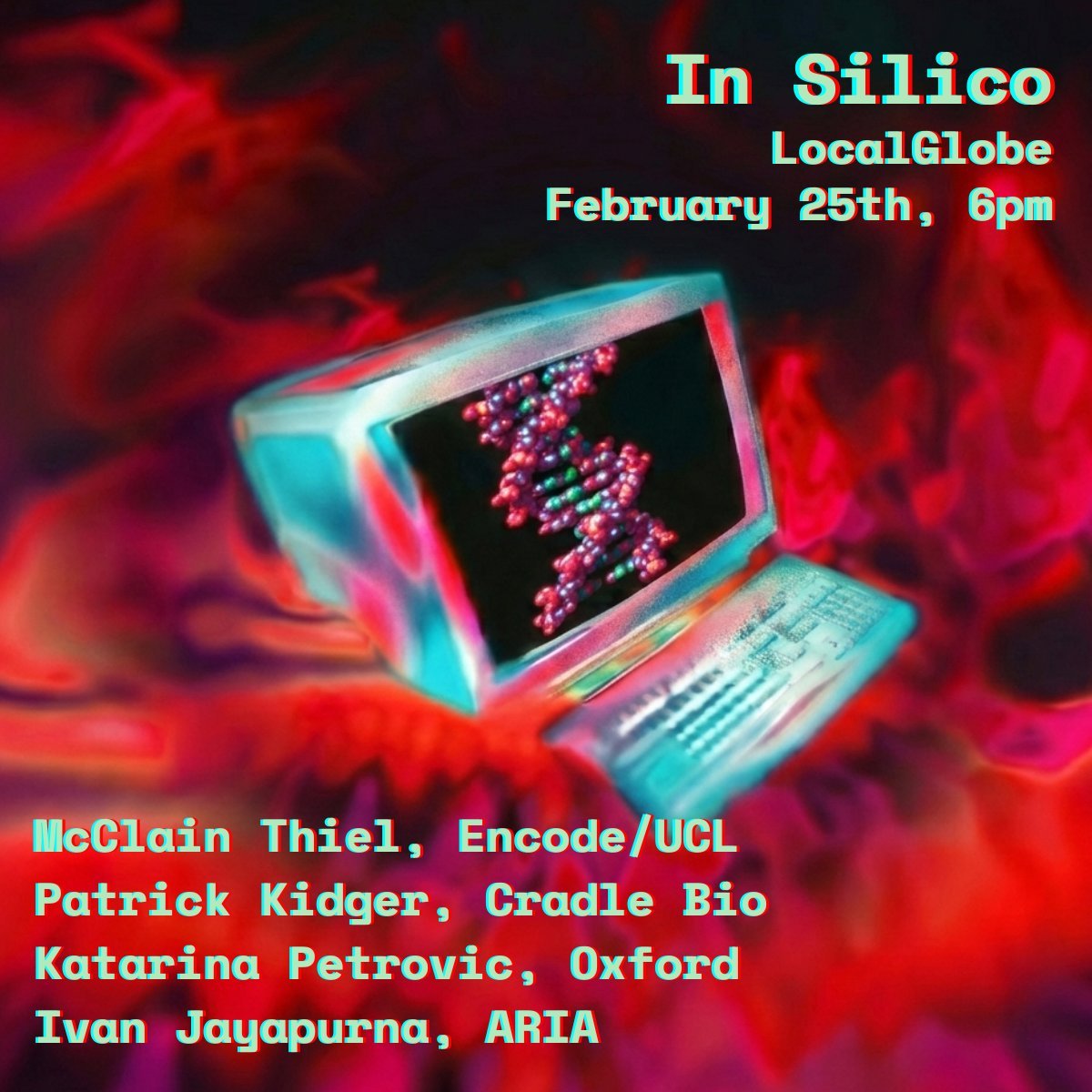
next insilico is next wednesday! 🧠💊💾🍳
speakers include: Ruxandra Teslo (Renaissance Philanthropy), Raina Thomas (Google DeepMind), Thomas Löhr (Bind Research), and Dominykas Lukauskis (Ternary Therapeutics)!!
hosted at Fifty Years HQ 🇬🇧
https://t.co/5I36xL58CR
NEW: today OpenBind ‘comes out of stealth’ so to speak with their first data dump of ~900 novel protein-ligand structures - most with paired affinities
This represents a meaningful %-age increase in all of humanities P-L data in the PDB collected in the last 50 years
More👇
There are 36 hours left to become a @pillar_vc Encode Fellow.
12 months. £115k salary. £100k+ compute.
No equity taken.
If you've been sitting on an idea, here's your nudge. Submit yours in <20 minutes.
🔗 https://t.co/xlpyXoi3VO
Thanks to our partners @ARIA_research.
I'm 6 months into this fellowship, and it's been brilliant. If you've got ideas at the intersection of AI and science and want to take a shot at making them real then I can't think of a better opportunity. 8 DAYS LEFT TO APPLY TO JOIN COHORT 2. @encode_pillarvc@ARIA_research
Excited to share yet another case study on using BAGEL 🥯👨🏻🍳 for protein design – this time, we are miniaturizing enzymes! 🧬✂️
Paper 📄 https://t.co/1fIwDaxmc6
Data 💾 https://t.co/UTKNDmqk2X
Code 👨💻 https://t.co/NlD6J6U4bm
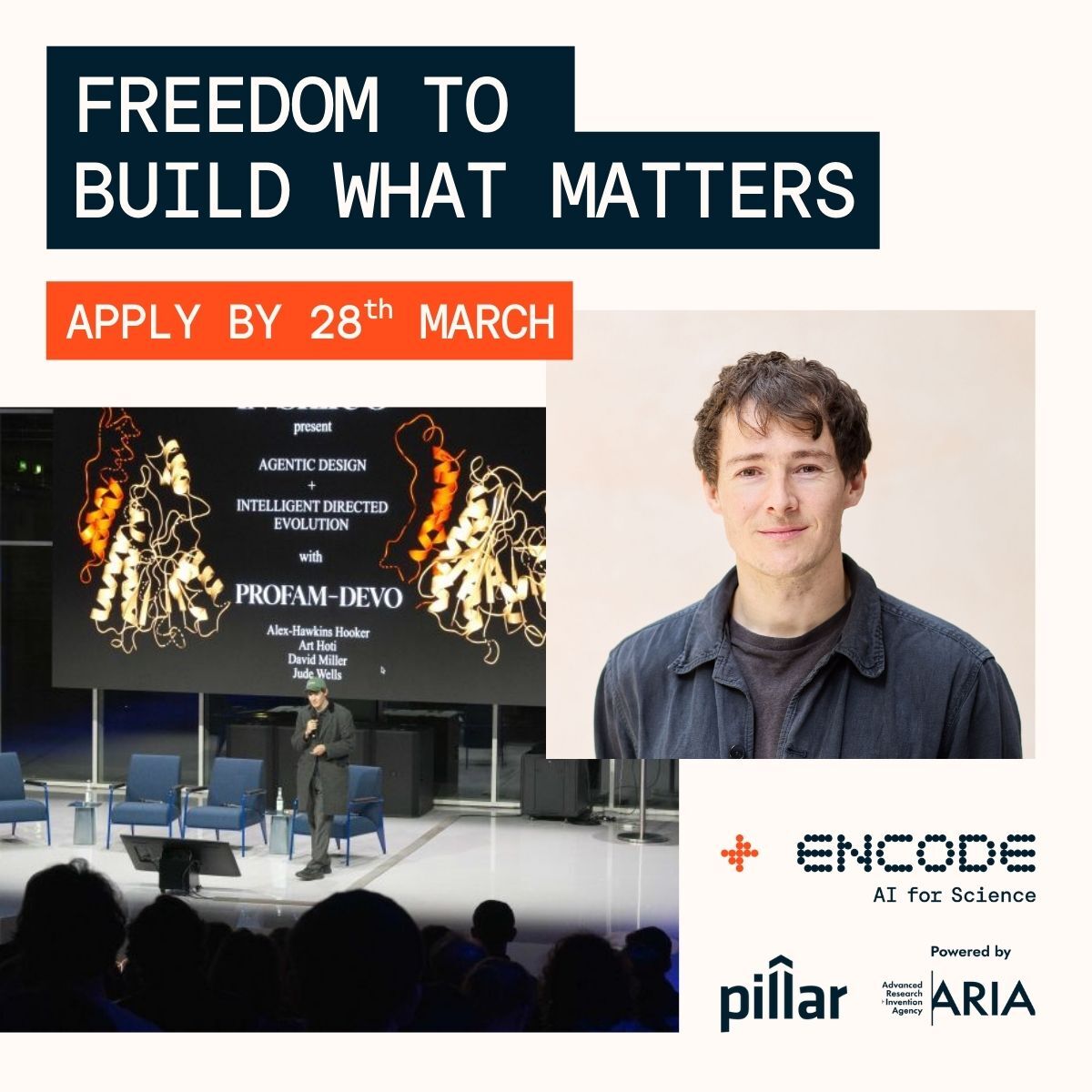
Freedom to Build What Matters
The first glimmers of AGI are here. Whatever you can dream of, you can build.
The efforts of a single individual have never mattered more. A single person, an idea, and a late night in the lab might be what changes a field.
And yet the outputs of such extraordinary power have mostly been disappointing. We are using the most important technology in history to create addictive short-form video, AI girlfriends, and better ad targeting.
Now is the time to do the work that will define this era.
We can cure disease, feed a continent, or make humanity multi-planetary. What you choose to work on now may be the most consequential decision of your career.
We built the Encode: AI for Science Fellowship for people who feel that weight.
One year of salary, plenty of compute, and direct access to frontier labs, data, and domain experts across biomaterials, atmospheric science, neuromodulation, robotics, and more.
No equity, no strings attached — just the freedom to explore.
We've partnered with ARIA and the UK's leading research universities to make it possible.
Applications close March 28th.
Biology has proven that proteins can produce materials with almost any function from only locally abundant molecules – yet today, our use of proteins is mostly limited to drugs and enzymes.
Backed by £50m, our Universal Fabricators programme will leverage breakthroughs in protein engineering + build a new, interdisciplinary community that can harness proteins to produce a functionally universal range of materials at scale.
We’d like that community to consist of experts in protein engineering, self assembly, complex matter physics, inorganic materials engineering, process engineering, and reactor design. They’ll be challenged to develop scalable processes that use proteins to template the assembly of inorganic + composite materials with structures that can’t currently be mass manufactured.
Submit your concept paper by 9 March + sign up for our webinar to learn more: https://t.co/87woAyad1D
Announcing the winners of the “De Novo” track of the Nipah Protein Design Competition!
This track rewards completely novel design ideas. No starting scaffold, no antibody to optimize, no template to tweak: just the target structure and a blank canvas.
Winners (by best binding strength)
🥇 Nick Boyd (Escalante) — KD: 1.4e-9 M
🥈 Johannes Klier (Schoeder lab)— KD: 1.2e-8 M
🥉 Brian Coventry (@UWproteindesign) — KD: 1.8e-8 M
@adaptyvbio RFDiffusion also looking very good with 4 designs in the top 12, a few mentions of MPNN too among the binders. Interesting to note that the majority of the Mosaic designs are predicted to bind with the transmembrane helix: could indicate non-specific binding via hydrophobicity
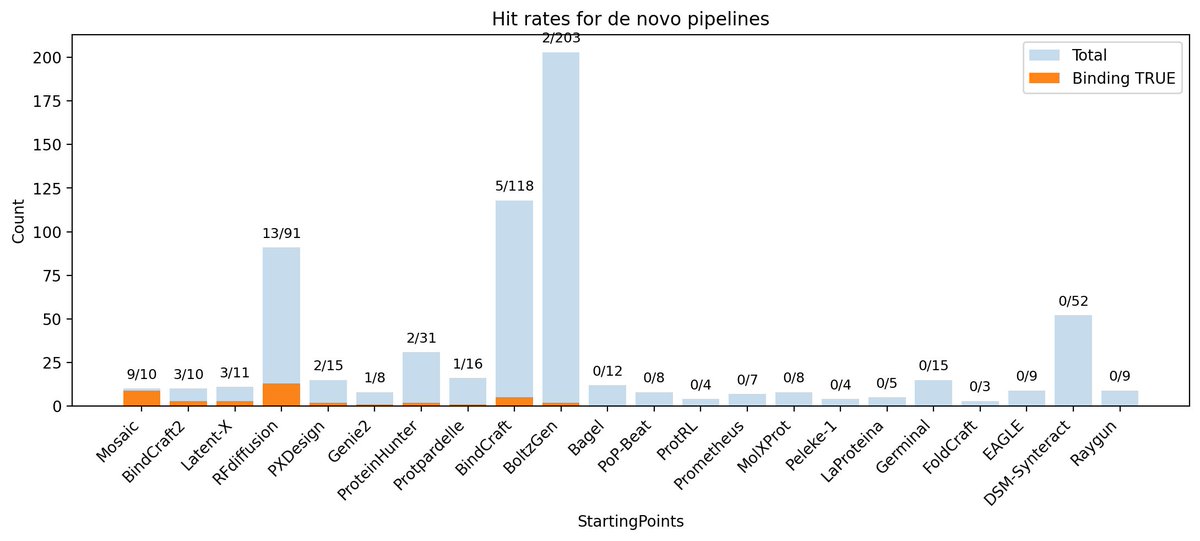
Love that on @adaptyvbio proteinbase you can see how different methods do (Mosaic, BindCraft, BoltzGen, RF Diffusion). So cool that these ML methods can consistently generate novel binders: Mosaic hit rate 8/9 and BindCraft2 3/10! on Nipah Virus binding.
https://t.co/vQx6jcDXL0
Quite pleased to hear that one of my submitted proteins placed #5 out of 1200 that were tested in this lovely competition. The approach: pure rational design. Nice to see that human + Microsoft Word is still competitive with state-of-the-art AI methods 🙂
Huge congratulations to Nick Boyd with Mosaic that absolutely killed in the competition! 𝑩𝒊𝒏𝒅𝑪𝒓𝒂𝒇𝒕2 did also pretty well with the second highest hit rate in the competition!
The idea was to make a single-chain variable fragment from a known antibody. Of my 3 submitted protein designs, it was the one I was most confident in, given that it exploited a known binding mechanism for this target. Read about the design process here: https://t.co/74eir2WSJA
Ok let’s go @adaptyvbio binder design competition: this time designing proteins to neutralise the Nipah virus. Lots of great de novo ML binder design tools out there now, but this year I’m submitting an entry from TEAM HUMAN, seeing if pure rational design can win against the machines.
Quite pleased to hear that one of my submitted proteins placed #5 out of 1200 that were tested in this lovely competition. The approach: pure rational design. Nice to see that human + Microsoft Word is still competitive with state-of-the-art AI methods 🙂
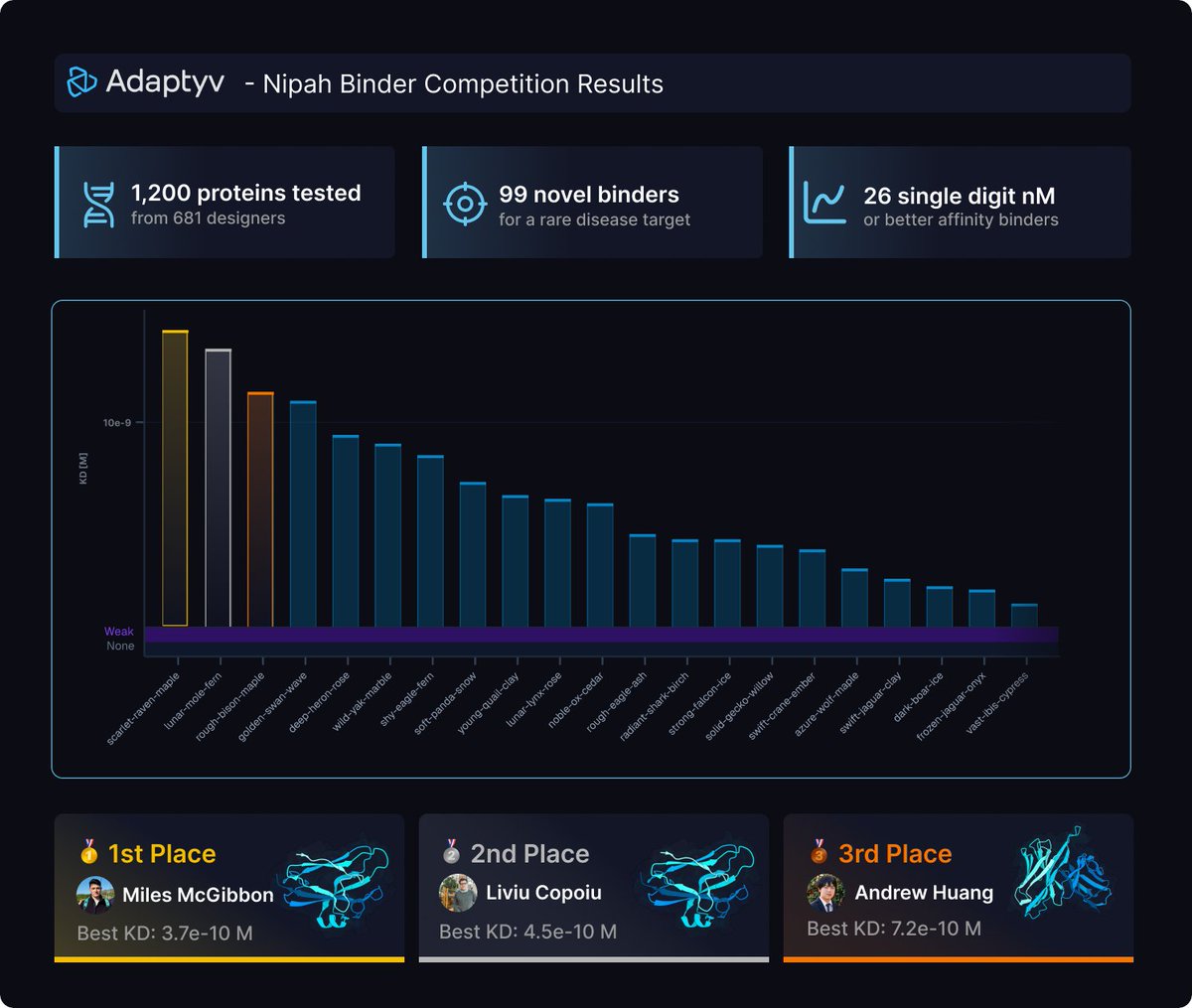
The results of the Nipah Protein Design Competition are out!
🧬 1200 proteins experimentally validated (3x more than last year)
📈 99 novel binders against the target protein (a challenging tetramer with little prior work)
💪 26 single digit nM or better binders, with the best ones at single-digit picomolar affinity!
All data now available open-source on Proteinbase!
Let's take a look at the results ⬇️