This is the story of Hyperliquid, the most profitable startup per employee on earth, told from a guarded office in Singapore.
Last year, its team of 11 generated $900 million in profit. It's 3 years old, has never taken a dollar of venture capital, and is beginning to change how century-old markets work.
Its founder, Jeffrey Yan (@chameleon_jeff), had never taken a physics class when he picked up a textbook at 16. Two years later, he won gold at the International Physics Olympiad. In 2019, he started trading with $10,000 from a living room in Puerto Rico—working off a television because he didn't own a monitor.
Within 3 years, he was running one of the largest anonymous crypto trading firms.
Then he shut it down. Yan was rich and free, but he had spent years inside crypto, watching it betray itself. Bitcoin's central premise was decentralization. Yet the biggest exchanges were centralized. Crypto kept reintroducing the dependence on trust it was built to eliminate. He set out to create what should have existed.
Hyperliquid is a blockchain with a trading exchange on top, and anyone can build on it. Yan's vision is to house all of finance. In 3 years, it has done over $4 trillion in volume. And in the past few months, it has begun to outgrow crypto.
Markets for oil, silver, and the S&P 500 now trade on Hyperliquid around the clock, weekends included, and are growing roughly 40% week on week. When the US and Israel bombed Iran on a Saturday in February, Hyperliquid was the venue traders turned to.
Hyperliquid's success has cost Yan his freedom. He works out of a secret office in Singapore and cannot travel without two bodyguards. Even the team's housekeeper doesn't know what they do.
In January, @domcooke spent a week at their office. Read his profile on Yan and @HyperliquidX below.
AI agents need three things to scale:
- deep liquidity
- cheap execution
- reliable infrastructure
The Arbitrum platform delivers all three.
Excited to see @SaildotMoney sailing toward the next $100M in autonomous volume. ⛵
3 months of sailing on @arbitrum ⛵️
→ +$100,000,000 in autonomous volume
→ 22 yield sources unlocked
→ $USDC + $USDT fully agent-optimized
Thank you for sailing with us.
The next wave is already forming.
Venezuela: The $60B+ Bitcoin "Shadow Reserve"
Markets focus on the $17T+ in Oil that Venezuela owns.
But what they don't know is that Venezuela one of the largest active $BTC holders in the world.
Similar in scale to both $MSTR and Blackrock.
Here's how this impacts markets and prices:
Intelligence reports indicate that the Venezuelan regime accumulated a "shadow reserve" of Bitcoin (BTC) and Tether (USDT) estimated at more than $60 billion. (HUMINT)
his hoard was built through "gold swaps" and the requirement that oil exports be settled in USDT to evade sanctions.
Intelligence cited by Whale Hunting (authored by Bradley Hope and Clara Preve) indicates that the accumulation began in 2018, coinciding with the aggressive liquidation of the Orinoco Mining Arc’s gold reserves.
- The regime likely converted ~$2B of gold proceeds into Bitcoin at an average price of $5K, which would have been around 400,000 BTC. At Jan 2026 price of ~$90K, that specific tranche alone would be worth $36B.
As the "Petro" experiment failed, the regime pivoted to using Tether (USDT) as a proxy for the petrodollar during cruide oil sales. However, Venezuela began to "Wash" that into Bitcoin, recognizing that USDT retains the ability to freeze addresses.
Given market intelligence, we can estimate that Venezuela has roughly:
Gold Swaps: 2018–2020, Gold Bars, Value Now: ~$45B - $50B
Petro-Crypto: 2023–2025, Crude Oil, Value Now: ~$10B - $15B
Mining Seizures: 2023–2024, ~$500M
Giving a grand total between 2018–2026: ~$56B - $67B in Bitcoin, implied at 660K+ Bitcoin, with a floor at 600K in Bitcoin.
That does not mean US has full control of the Bitcoin yet. The days following today will be defined by a high-stakes interrogation to secure the Bitcoin.
The U.S. will likely offer plea deals, reduced sentencing, or protection for family members in exchange for the surrender of seed phrases. Given the severity of the narco-terrorism charges, the leverage is there.
So now the revelation of the $60 billion hoard fundamentally alters the supply/demand dynamics of the Bitcoin market for 2026, as the Venezuelan reserve is estimated at: 600,000+ BTC.
This is 12 times larger than the German sale and 2 times larger than the U.S. government’s entire pre-raid stockpile.
In 2024, the German state of Saxony liquidated ~50,000 BTC ($3 billion). This 50K BTC sale caused a 15-20% market correction and weeks of bearish sentiment.
Now compare that to 600,000.
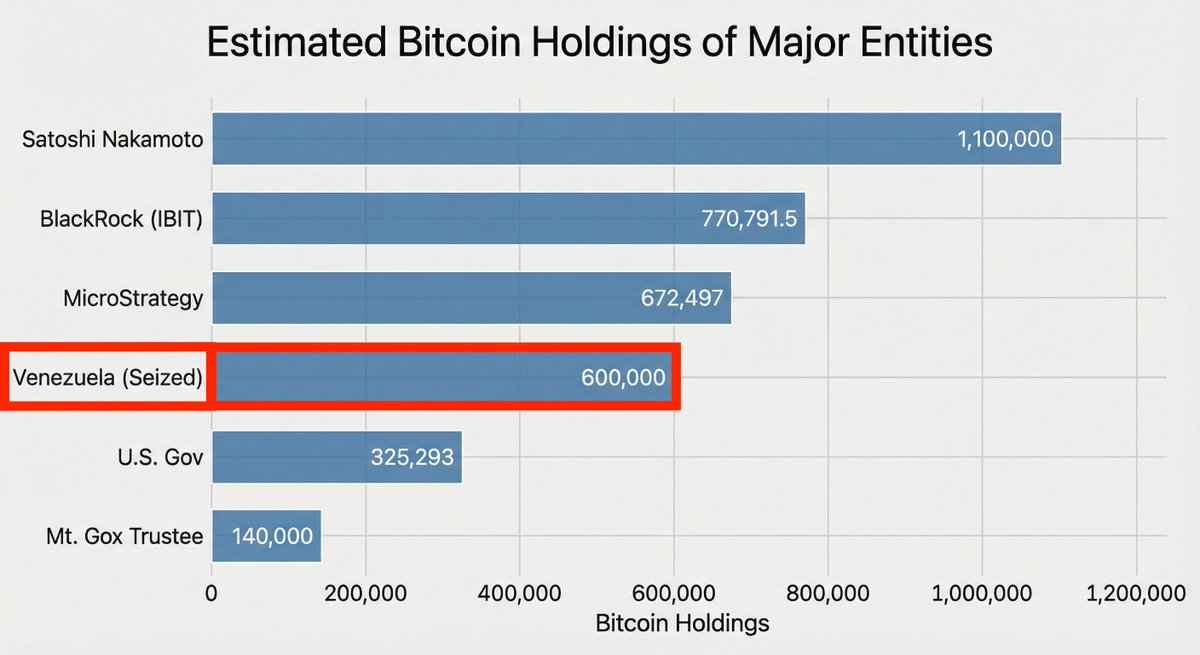
Here's the leading entity holders of Bitcoin:
1. Satoshi Nakamoto ~1,100,000
2. BlackRock (IBIT) ~770,791.5
3. MicroStrategy ~672,497
4. Venezuela (Seized) ~600,000
5. U.S. Gov ~325,293
6. Mt. Gox Trustee ~140,000
Now, here's what will likely happen from here:
The "Frozen Asset" (High Probability):
The assets are seized but immediately entangled in complex litigation Creditors file injunctions; the DOJ claims forfeiture. The keys are held in escrow by the U.S. Treasury, but the coins cannot move.
Short-term volatility due to uncertainty, followed by a bullish "supply shock" narrative.
Short-term volatility due to uncertainty, followed by a bullish "supply shock" narrative. The market realizes that 600,000 BTC (3% of circulating supply) have been effectively removed from the market for 5-10 years. This acts as a massive "lock-up," reducing liquid supply and supporting higher prices.
The "Strategic Reserve" Pivot (High Probability):
Influenced by the "Strategic Bitcoin Reserve" movement, President Trump orders the Treasury to hold the Bitcoin as a permanent U.S. asset.
This too acts as a massive lock up, reducing liquid supply and supporting higher prices.
The "Fire Sale" (Very Low Probability):
The U.S. DOJ declares the assets "perishable/volatile" and executes an immediate liquidation via Coinbase Prime or USMS auctions to fund the occupation costs.
However, this is unlikely due to Trump's positive stance toward Bitcoin "Reserves" from confiscating assets.
_
Results:
Markets have been looking at the massive oil reserve and beneficiaries, while ignoring the elephant in the room: Bitcoin.
The "second order effect" is likely a massive supply lock-up.
If the U.S. seizes these assets, they will likely move from "active liquid reserves" of a rogue state to "frozen sovereign assets" of the U.S. Treasury, reducing available supply and potentially acting as a catalyst for higher prices in Q1 2026.
There will likely be increased volatility. But for market participants shorting Bitcoin because of fears of "conflict", this event is generally seen as bullish for $MSTR and Bitcoin holders as this effectively locks up supply for many years to come.
🚨 BREAKING: This Venezuelan man is going viral for explaining to everyone why Maduro NEEDED to be toppled
The Democrats are clueless.
“Venezuela has already been invaded.” 🔥🇺🇸
He knows his country.
The people are ecstatic.