@dalibor_gogic Hey! 👋 I'm no longer on the team, but this is currently a limitation of external service bindings in workerd: https://t.co/oq62nkODnr. The Wrangler tracking issue is here: https://t.co/iPICdSMHxk.
@Xbow Our showcase traces are my favorite part. You can read actual traces of XBOW at work, and the things it can do have been really astonishing to me: CBC padding oracles, remotely debugging an exfiltration exploit on a compromised server, and more: https://t.co/yFUUNDlMUc
A few months ago, I left @Cloudflare to join a new startup. I really enjoyed working at Cloudflare, and there was lots more stuff I wanted to build, but this seemed like a very exciting opportunity I'd regret not taking. Introducing XBOW! 🎉
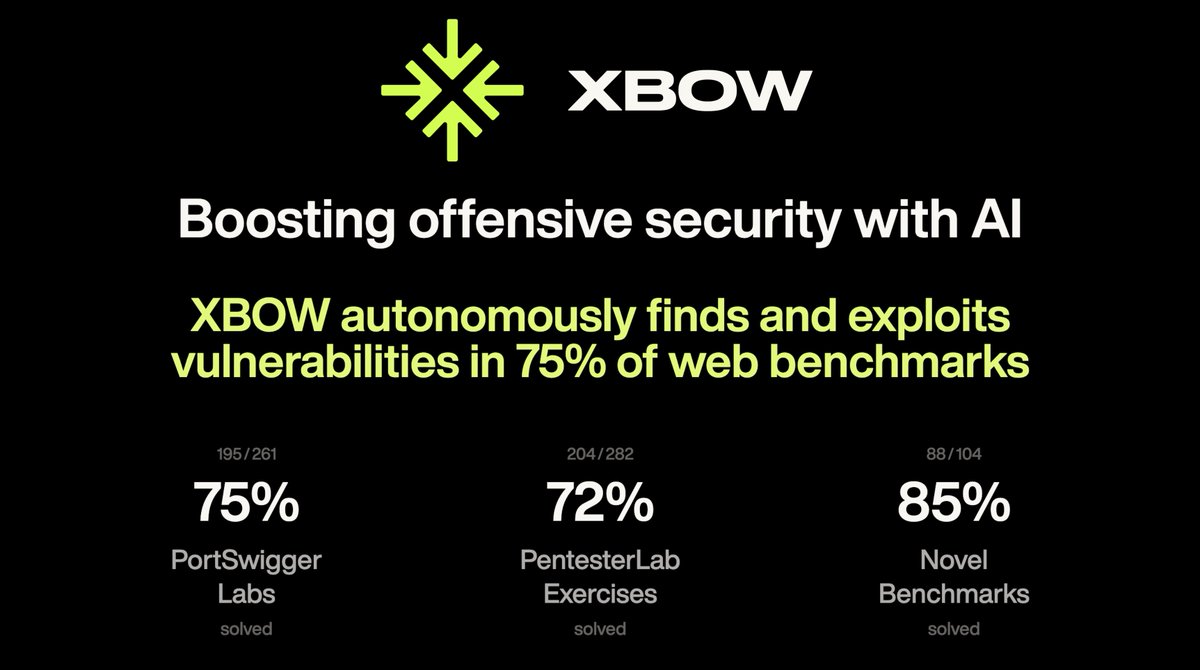
XBOW finds and exploits vulnerabilities in 75% of 647 renowned web benchmarks. Given a short description of the benchmark, it autonomously pursues high-level goals, executing commands and interpreting their output to achieve exploitation. Check it out: https://t.co/zO1j9O3ycC
🌊A deep dive into how @_mrbbot & colleagues built support for running Vitest tests in the Cloudflare Workers.
Brendan will start by giving an overview of the Cloudflare dev platform, including open-source workerd JS runtime & local simulator Miniflare: https://t.co/TEPwCNzKJ1
I'm going to be speaking @NodeCongress in a few weeks to explain how this works. The organisers have kindly offered me a free ticket to give away. If you're interested in this, reply to this tweet with something you'd like to see added to the integration. I'll pick a winner soon.
I'm proud to announce the release of the new Workers Vitest integration! This allows you to write unit & integration tests that run inside the Workers runtime. Tests run locally using Miniflare with their own isolated storage. Read the blog post below for details! ⚡️
Today, we’re excited to announce a new Workers Vitest integration - allowing you to write unit and integration tests via the popular testing framework, Vitest, that execute directly in our runtime, workerd! https://t.co/HYs7bSwKI4
If you were previously using Miniflare 2's testing environments, this new integration should allow you to upgrade to Miniflare 3. Read the migration guide here: https://t.co/u9lpo0SFq8. Given this, we'll be deprecating Miniflare 2 soon. 🥹
We’re proud to announce the release of Wrangler v3 – the first version of Wrangler with local-by-default development, powered by Miniflare v3 and the open-source Workers workerd runtime. https://t.co/hXy10VK3nL #DeveloperWeek
@Cloudflare Many developers (myself included) started on Windows, and I'm excited that the next generation of developers will have the same local development experience regardless of which platform they're on. This has been an ongoing project for a while, and I'm glad it's now released.
The @Cloudflare Workers runtime, workerd, now supports Windows natively! 😃This means you can use `wrangler dev --experimental-local` and Miniflare 3 on Windows without Docker or WSL. Check out https://t.co/aFPTT1BF0l for more details.
@wardpeet@sidchatterjee@Cloudflare Kinda, Miniflare 2 is the runtime that powers `wrangler dev --local`. You can use Miniflare standalone, but you don't get all of the automatic bundling Wrangler does. In this context, given Miniflare supports the cache API, `wrangler dev --local` should too.
@alexblackca Hey! 👋 We actually inject `ExecutionContext` as a class in the test environments (https://t.co/RbMOpbKKdU), so you can do `new ExecutionContext()` and use that! 😃 We should fix the types though... 👍