Introducing: booking flights right inside Claude.
Travel was supposed to set you free. It became a 16 hour job. Connect it in 30 seconds, take it back.
https://t.co/fL0h7KnmPb
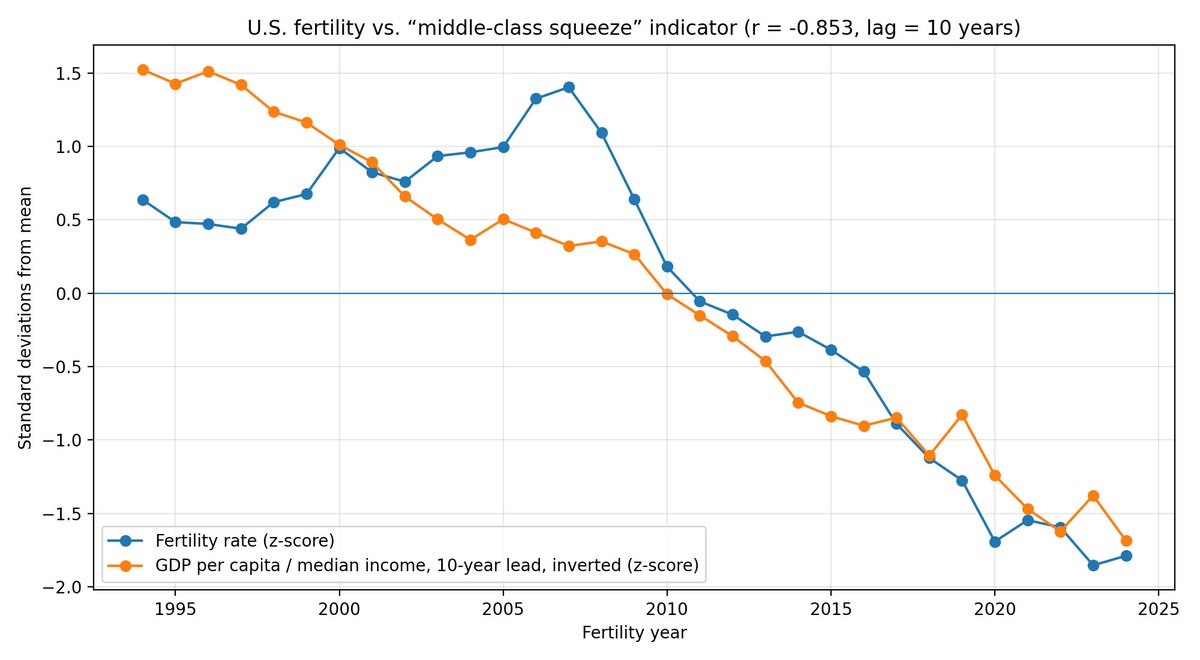
I took the first chart on fertility rate and then asked the following:
“Run a Monte Carlo simulation where you overlay various economic indicators on this chart of fertility. For example, GDP, GINI, cost of housing, middle class income growth etc. find the economic indicator that has the highest correlation to the chart provided. There may be a lag effect where the chart is the byproduct of some economic event so consider this lag in your correlation analysis.”
Result: the strongest match was not GDP, Gini, or housing alone. It was a derived “middle-class squeeze” indicator: real GDP per capita ÷ real median household income, with the indicator leading fertility by 10 years. The correlation was r = -0.853 over the 1994–2024 fertility window. Interpreted plainly: when output per person rose faster than median household income, fertility tended to be lower roughly a decade later.
What's your Myers-Briggs? (I'm an INTP)
Curious if there are any obvious trends with Bitcoiners.
Please complete this form (no PII) and retweet this. I will share results when complete. 🙏
https://t.co/KegzH8rx7A
@LynAldenContact What a prescient post from ‘21! Lyn, please make an update on how you see stablecoins now. I’ve noticed a lot of industry hype around them with the GENIUS act.