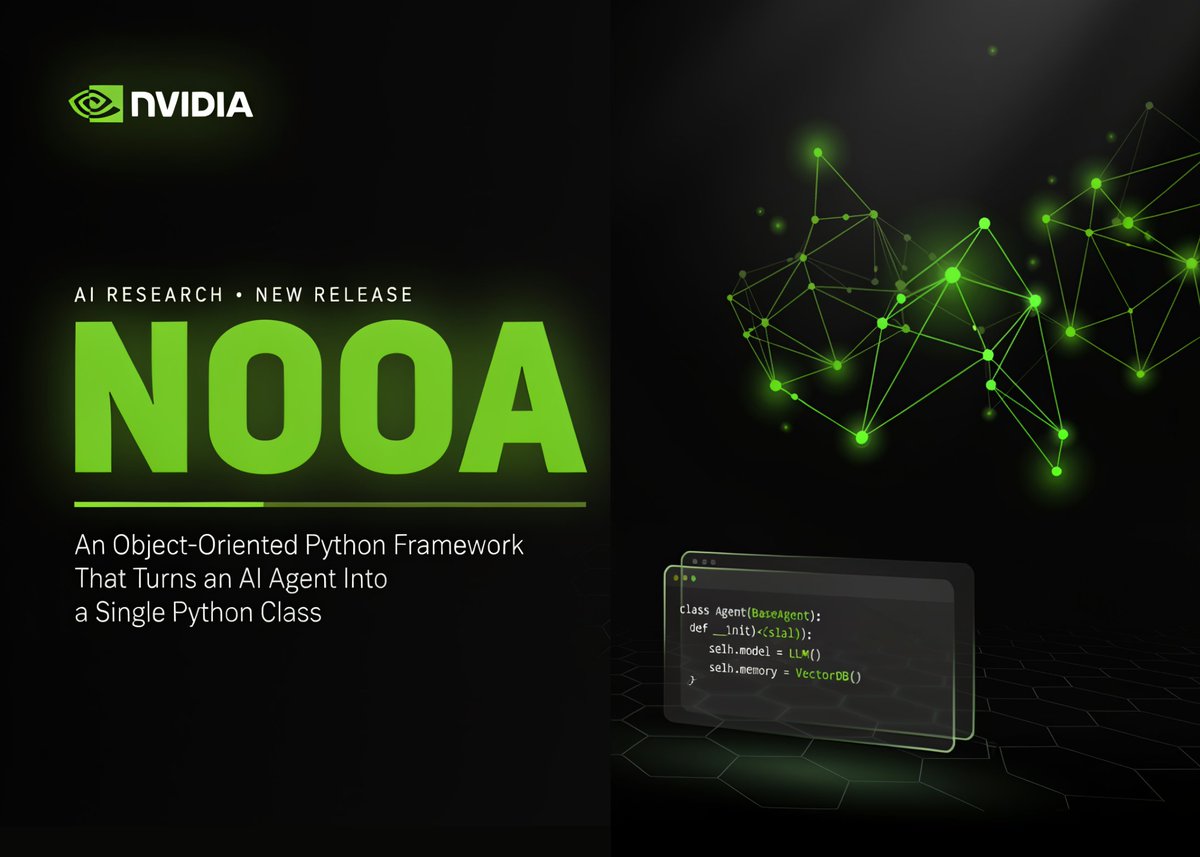
NVIDIA AI's NOOA: An Object-Oriented Python Framework That Turns an AI Agent Into a Single Python Class
Here's what's actually interesting:
1. The whole agent is one classMethods are the actions the model can take. Fields are state. Docstrings are prompts. Type annotations are contracts the runtime enforces. A method whose body is ... becomes an LLM-driven loop; a method with a real body stays deterministic Python the model can call as a tool.
2. Pass by reference is the load-bearing pieceArguments stay live in the execution environment. The model sees a bounded preview — concrete type, true length, head/tail sample — and writes code against the real object. → SWE-bench sessions peaked at 22–72k prompt tokens against 200–400k windows → No context compaction needed
3. The benchmark numbers
→ 82.2% SWE-bench Verified with GPT-5.5, from a benchmark-agnostic 253-line agent
→ 86.8% CyberGym L1 with network access blocked, top open-source result reported
→ 85.1% mean RHAE on ARC-AGI-3 with GPT-5.6-sol, under $20 per game
→ ~1.1M tokens and ~28 model calls per task, against 2.2M and 66 for the compared harness
Full analysis: https://t.co/lXQ6GbbfOB
Paper: https://t.co/RCI2T9Y4Ck
Technical details: https://t.co/OoqdKhhBZl
Repo: https://t.co/9EoLRzBJe0
@nvidia@NVIDIAAI
If you want to build an agent that actually remembers what happened, our guest author from MongoDB published a full tutorial for it along with Codes.
It's an event venue operator agent built on MongoDB Atlas, Voyage AI embeddings, and LangGraph, with optional Langfuse tracing. The scenario is a fictional tennis tournament on Day 6 — rain approaching, covered hospitality constrained, two visitor journeys to protect.
Here's what you'll build:
1. One backend for the whole agent stack Operational records, semantic memory, visual document embeddings, agent actions, and LangGraph checkpoints all live in Atlas. No syncing into a second vector database.
2. A namespaced memory store
→ ("guests", guest_id) for visitor-specific memory
→ ("fleet", event_id) for event-wide operator patterns
→ ("docs", event_id) for visual operational documents
Scoped retrieval, single data layer.
3. Vector and hybrid retrieval you can curl
The hybrid endpoint returns vector score, lexical score, and combined score. Event-ops queries mix semantic intent with exact terms like "covered seating," so both signals matter.
4. Vision RAG over operational images
Five seeded documents — capacity charts, weather-response sheets, evacuation diagrams — embedded with Voyage multimodal, retrieved from Atlas, passed to Claude Vision.
5. A LangGraph loop that closes perceive → plan → hitl_gate → act → reflect. Reflect writes new inferences back to semantic memory, so the next disruption starts with context.
6. A FastAPI app you can deploy Python 3.12, uv, local run, smoke test against Atlas, and a Vercel deployment path for a hosted demo.
Full tutorial: https://t.co/lZTseFLnj4
Github Repo: https://t.co/QwwYyYxHPg
Live demo: https://t.co/f8lo6QEwNn
@MongoDB
𝐀𝐈 𝐓𝐨𝐨𝐥𝐬 & 𝐀𝐠𝐞𝐧𝐭𝐬 𝐔𝐩𝐝𝐚𝐭𝐞𝐬: Kimi Work, a local AI agent + 5 Claude Design Tips + ChatGPT & Gemini 101... 🧵
Starting something cool. Hope y'all like it :)
→ Free Newsletter: https://t.co/fpTqdt8Riu
→ Website: https://t.co/VGrtViizrZ
#AI#Free
↗️ Top 5 Claude Design Tips to Get Better Outputs (Without Burning Your Tokens)
Claude Design is a dedicated tool to create designs, prototypes, presentations, and more. We spent some time digging into it to present the top 5 tips for good outputs.
→ https://t.co/7IgPWDyaG0
We at Marktechpost been building a GitHub repository of 300+ hands-on Jupyter notebooks covering the tools, models, and frameworks that actually matter for AI Agents and Agentic AI
Here's what's inside:
→ LLM fine-tuning, RAG pipelines, and agentic workflows — end to end
→ Notebooks for open-source models: LLaMA, Mistral, Qwen, Gemma, and more
→ Covers LangChain, LlamaIndex, HuggingFace, vLLM, and the full modern stack
→ Every notebook is runnable — Google Colab links included
→ Updated continuously as new models and frameworks drop
The goal was simple: if you read about something on Marktechpost, you should be able to run it the same day.
300+ notebooks. Zero paywalls.
https://t.co/B8Z6nRou83
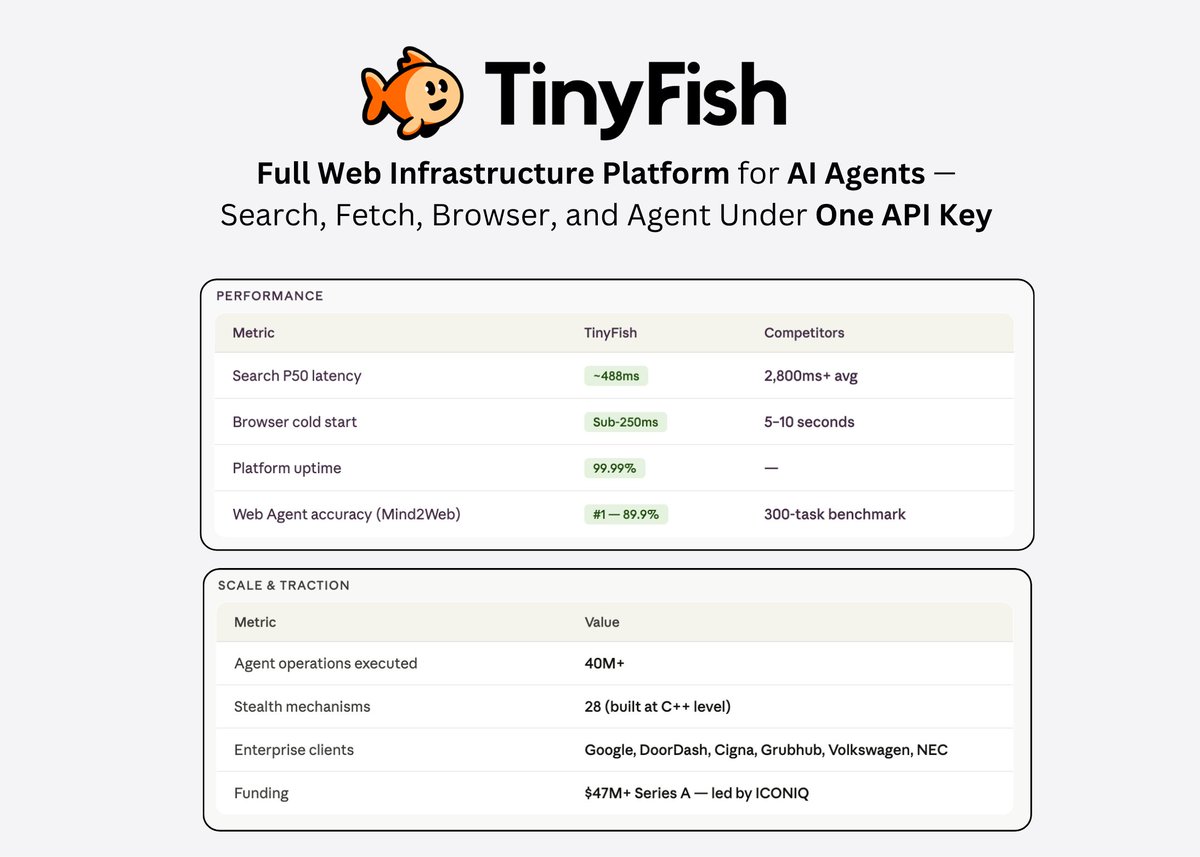
TinyFish just shipped four products under one API key: Web Search, Web Fetch, Web Browser, and Web Agent.
Each one addresses a specific failure point in AI web automation:
— Web Search returns structured JSON via a custom Chromium engine at ~488ms P50. Competitors average 2,800ms+.
— Web Fetch renders the full page in a real browser, strips everything irrelevant, and returns clean Markdown or JSON. Native fetch tools in most coding agents dump the entire page — CSS, ads, navigation — straight into the context window.
— Web Browser provides managed stealth Chrome sessions via CDP with sub-250ms cold start and 28 anti-bot mechanisms built at the C++ level.
— Web Agent executes autonomous multi-step workflows on real websites and currently sits at #1 on Mind2Web with 89.9% accuracy across 300 tasks.
All four are also accessible via CLI (npm install -g @tiny-fish/cli) with an Agent Skill — a markdown instruction file that teaches coding agents like Claude Code, Cursor, and Codex how to use every endpoint automatically.
CLI operations use ~100 tokens per task versus ~1,500 over MCP. Output writes to the filesystem, not the context window. 2× higher task completion on complex multi-step workflows.
One API key. One credit system. Search, fetch, browser, and agent — all built in-house.
Full analysis: https://t.co/Ip1ft7H1qF
500 free steps, no credit card: https://t.co/EAwiE3noaA
@Tiny_Fish
Top 10 Best AI Tools to Automate Your Entire Workflow in 2026 (No Coding Required)
1. @atoms_dev - https://t.co/UTZPEe00tG
2. @n8n_io - https://t.co/SYZsKWlLi5
3. @make_hq - https://t.co/jIsG8zF7cL
and more...
Save for later 🔖
🔗 Full read: https://t.co/9YxJ1ohJdg
#AITools
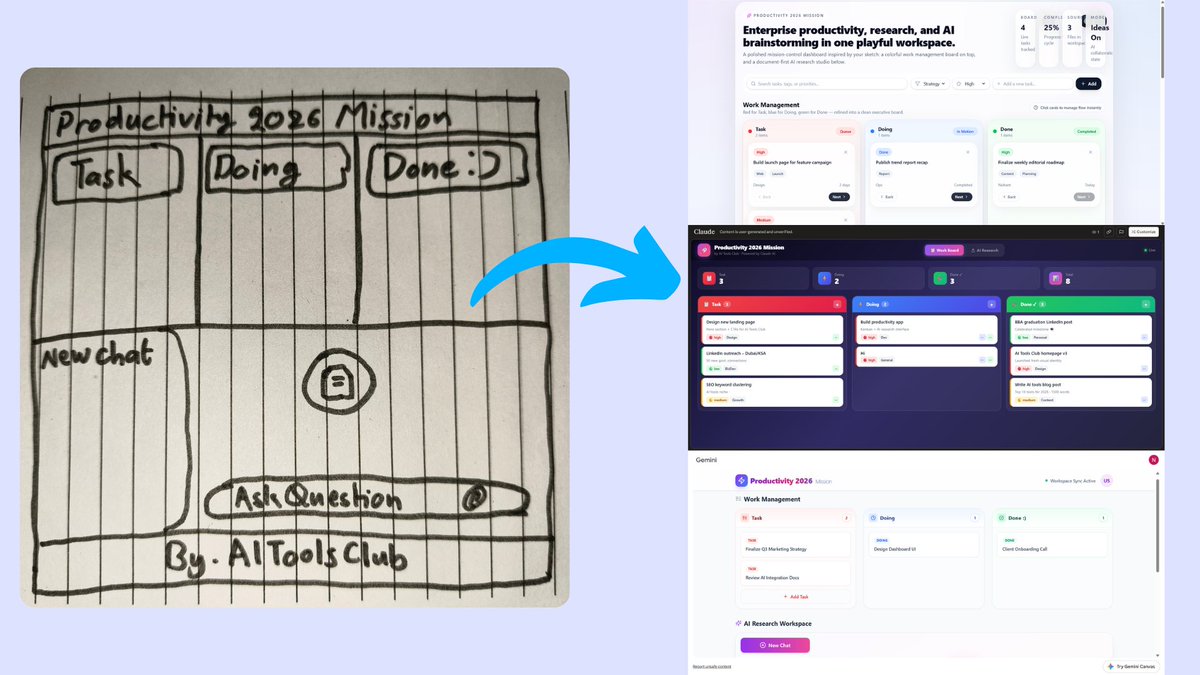
I gave the same hand-drawn sketch and prompt to ChatGPT, Claude & Gemini to test which AI can turn it into a working app.
3 Different AI models.
1 Sketch & same prompt.
3 Different outputs.
🔗 Full read: https://t.co/UfYshpWXjF
#ChatGPT#Claude#Gemini
Excel just got ChatGPT — ChatGPT for Excel powered by GPT-5.4 can build & edit spreadsheets and give you insights using plain language prompts.
▶️ Automate your entire workflow using this AI tool
🔗 Full read: https://t.co/4EmXzWrRnG
@OpenAI#GPT54#ChatGPTforExcel#ChatGPT
Two AI models launched in one day:
▶️ Google Gemini 3.1 Flash-Lite, a ultra-fast & ultra-cheap AI model for devs & enterprises
▶️ ChatGPT-5.3 Instant, a fast new model for smoother, more useful everyday conversations
🔗 Full read: https://t.co/Yrj5GRo8bh
@GoogleAI@OpenAI#AI
Stop paying $$$/monthly... 7 FREE Google AI tools—Stitch, AI Studio, Opal, NotebookLM, Pomelli, Gemini Canvas, Nano Banana 2—that can replace paid software.
If you’re paying for AI, this thread might cost you a subscription. 🧵
🔗 Full read: https://t.co/EmVrQncJUz
#GoogleAI
I Made ChatGPT Agent Mode Run Claude AI to Automate a Full Workflow (Step-by-Step)
In this article, we made ChatGPT Agent mode use Claude AI to vibe-code a macOS simulation—completing the entire task on your behalf.
↗️ Full read: https://t.co/QEaHMdqNg7
#ChatGPTAgent#ChatGPT
ChatGPT vs Gemini vs Claude vs Perplexity 🥊
I tested popular AI assistants (ChatGPT, Gemini, Claude, and Perplexity) to see which can help find the best deals on 3 random products.
Save for later 🔖
↗️ https://t.co/Q2twt12eWr
#ChatGPT#Gemini#Claude#PerplexityAI