The audience tonight: mostly Japanese. The performer: Japanese @yukichiba_info . The venue: Hawaii. Me: the lone Indian soaking it all in. Music has a way of making everyone feel local. 🎶
Just saw @yukichiba_info at Blue Note Hawaii. Pure stage presence. The rare artist who can command a room without trying too hard. Tokyo energy meets Waikiki. ��🎤 #YukiChiba #BlueNoteHawaii
For the past 12 months or so, SaaStr has been getting 100x more PR pitches than before.
All AI-generated. Always decent. Never great.
Good enough to get opened, completely useless once opened.
I used to reply to mediocre human pitches with feedback — here's what we actually want, here's what an A-tier speaker looks like. No point doing that with an AI. So now I block them.
Which means when you finally have something genuinely worth pitching, I'll never hear it.
You burned the relationship with the lazy AI pitch. The domain's blocked before your best idea gets written.
The “2026 SaaS crash” isn’t AI killing SaaS.
It’s AI reallocating the same enterprise budgets.
AI spend is exploding.
Total IT spend is relatively flat.
The delta comes from slower SaaS expansion, consolidation, and fewer seat-based buys.
This is a business model reset, not a tech one.
https://t.co/Zx4i1bggPD
"You can't just hand an AI Agent to the sales team or marketing team to deploy.
Not if they don't have the skills to implement the agent, train it, manage it." with @kylecnorton CRO @kylecnorton
"You have to find that GTM nerd that is chomping at the bit to deploy it."
Like many others, been saying it for years.
Anyone who discourages your child from playing multiple sports does not have your child’s best interests in mind.
Period.
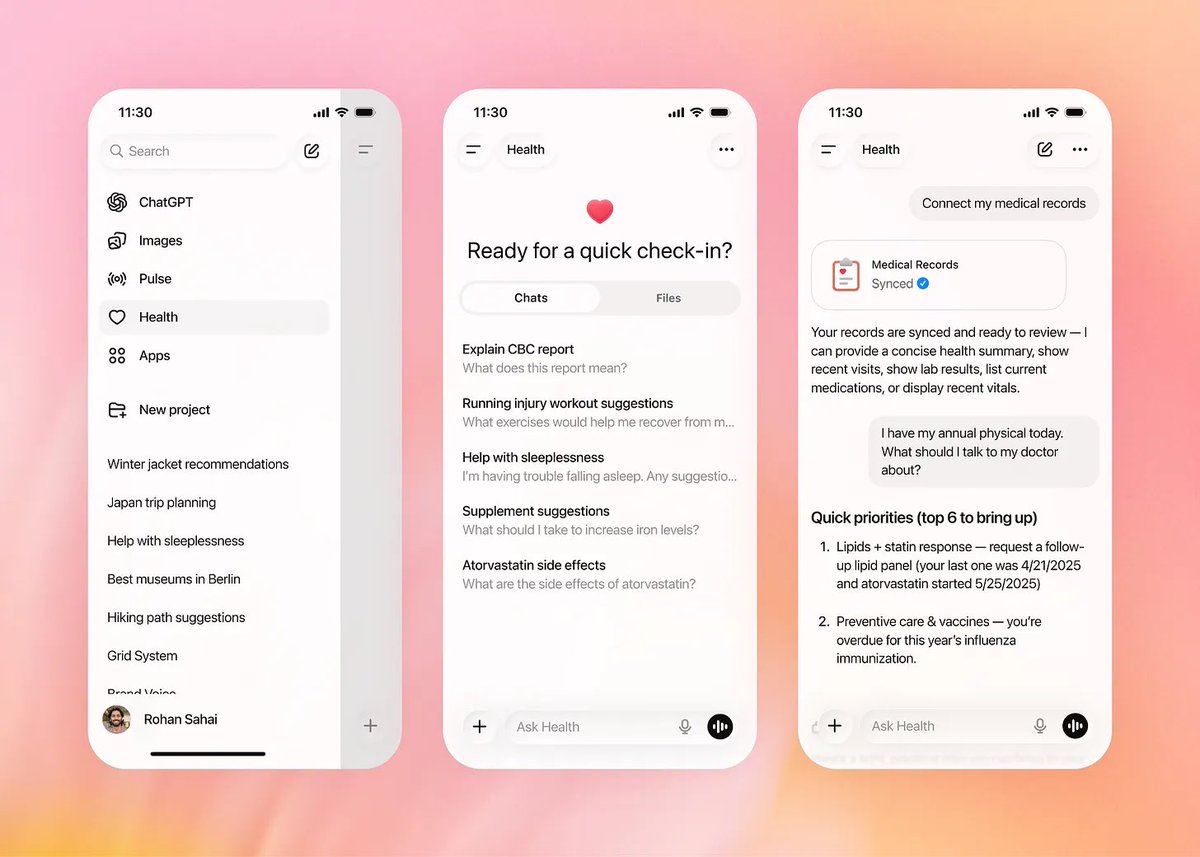
BREAKING 🚨: OpenAI is launching ChatGPT Health on mobile and web!
“We’re launching ChatGPT Health, a dedicated, private space for health conversations where you can easily and securely connect your medical records and wellness apps, Apple Health, Function Health and Peloton”
Dear vibecoders: you’re fucked.
So are real devs. Possibly more fucked, since we invested years learning to code. Here’s my the take:
Vibecoding will do to apps what Netflix did to TV: make the best apps ever.
Historically, TV had limited shelf space: ~100 channels and only so many hours in a day.
Then came unlimited shelf space.
Unlimited shelf space → more supply → more competition → better shows → more people watching TV → movie stars doing TV shows → the market grows → competition increases → quality keeps going up.
The same thing is happening to the App Store.
Anyone can make an app → more apps → more competition → better apps → users become more comfortable paying for software → growth marketers become solo founders → the market grows → competition increases → apps keep getting better.
But one thing doesn’t change: attention.
There are still only 24 hours in a day, and only so many apps a person can realistically use.
So while we may get 10–100× more apps to choose from, we will not choose or use 10–100× more apps.
As supply goes infinite, outcomes concentrate. Power laws get harsher. Platforms and tools win, but not all founders do.
We’ve seen this before.
Radio → CDs → Napster → GarageBand → YouTube.
Unlimited shelf space. Near-zero barriers. Instant distribution.
The result?
Jacob Collier wins a Grammy from songs launched on YouTube and there are more broke musicians than ever before.
Sound familiar? @zach_yadegari ;)
This is why @Superwall is a requirement.
Anyone can copy your product, your growth strategy, your ads, your paywalls.
But speed - how fast you iterate, reinvent, and discover new growth strategies, new paywall mechanics, new “genres” - and doing that consistently
That’s your only real fighting chance.
I've never felt this much behind as a programmer. The profession is being dramatically refactored as the bits contributed by the programmer are increasingly sparse and between. I have a sense that I could be 10X more powerful if I just properly string together what has become available over the last ~year and a failure to claim the boost feels decidedly like skill issue. There's a new programmable layer of abstraction to master (in addition to the usual layers below) involving agents, subagents, their prompts, contexts, memory, modes, permissions, tools, plugins, skills, hooks, MCP, LSP, slash commands, workflows, IDE integrations, and a need to build an all-encompassing mental model for strengths and pitfalls of fundamentally stochastic, fallible, unintelligible and changing entities suddenly intermingled with what used to be good old fashioned engineering. Clearly some powerful alien tool was handed around except it comes with no manual and everyone has to figure out how to hold it and operate it, while the resulting magnitude 9 earthquake is rocking the profession. Roll up your sleeves to not fall behind.
Much of the AI security conversation today is optimizing for comfort, not risk reduction.
If your strategy is automated red-teaming + guardrails, you’re likely buying reassurance not resilience.
AI systems fail in ways that tools alone can’t meaningfully prevent.
This essay by Sander Schulhoff captures that tension well and articulates why the current market framing is fundamentally flawed. https://t.co/boK8No0pU1
The harder work is architectural, organizational, and human.
The “AI divide” isn’t really about AI. It’s about which companies already rebuilt their data, identity, and decision flows before AI showed up. The market is now rewarding the quiet work most SaaS companies postponed. https://t.co/vLKJVDy5g7
this is big... 50 AI researchers from Bytedance, Alibaba, Tencent, and other labs/universities just published a 300-page paper with surprising lessons about coding models and agents (data, pre and post-training, etc). key highlights:
> small LLMs can beat proprietary giants
RL (RLVR specifically) gives small open-source models an edge over big models in reasoning. a 14B model trained with RLVR on high-quality verified problems can match the performance of OpenAI's o3.
> models have a hard time learning Python.
mixing language models during pre-training is good, but Python behaves different from statically typed languages. languages with similar syntax (Java and C#, or JavaScript and TypeScript) creates high positive synergy. mixing Python heavily into the training of statically typed languages can actually hurt because of Python's dynamic typing.
> not all languages are equal (coding scaling laws)
the amount of data required to specialize a model on a language drastically depends on the language. paper argues like C# and Java are easier to learn (less training data required). languages like Python and Javascript are actually more tricky to learn, ironically (you see AI most used for these languages :)
> MoE vs Dense (ability vs stability)
MoE models offer higher capacity, but are much more fragile during SFT than dense models. hyperparams in training have a more drastic effect in MoE models, while dense models are more stable. MoE models also require constant learning rate schedules to avoid routing instability.
> code models are "insecure" by default (duh)
training on public repos makes models learn years of accumulated insecure coding patterns. safety fine-tuning often fails to work much on code. a model might refuse to write a hate speech email but will happily generate a SQL-injection vulnerable function because it "works."
> structure matters more than content in reasoning training
when fine-tuning on CoT the template and the step-by-step reasoning pattern matter much more than the factuality of the reasoning! the model actually learns the "cognitive template" of breaking down a problem. when creating synthetic training data for reasoning, the step-by-step structure (the "how") matters more than making sure every single intermediate fact is perfect.
> "lost in the middle" problem still persists
newer models support massive contexts, but accuracy still degrades when important code is in the middle of the prompt (or context) rather than at the beginning or end.
> multi-agent debate reduces hallucination
it is significantly better for complex software engineering tasks. i believe setting up the debate is very critical, it can even cause agents to reinforce hallucinations if not tuned correctly.
> the"alignment tax" on code
safety alignment can degrade general coding ability. the paper actually proposes a solution to do the alignment in a way to mitigate this tax.
read the full paper: https://t.co/UMcKuRnJ5H
@ArthurMacwaters @AmericanTimdog True. FSD is the most freeing experience when it comes to driving. You will never want to deal with the stress of driving.
@jasonlk@jasonlk did you have to assign any engineers to manage the prod environment once deployed , or are you able to manage dev, prod , feature development etc. by yourself.
@bryan_johnson Cost of learning extremely low with AI. This will lead to new styles of interaction, new business models and a generation with very diff skills. But the chasm between the curious vs the non curious will deepen. Not enough attention is being paid to how it will impact the society.